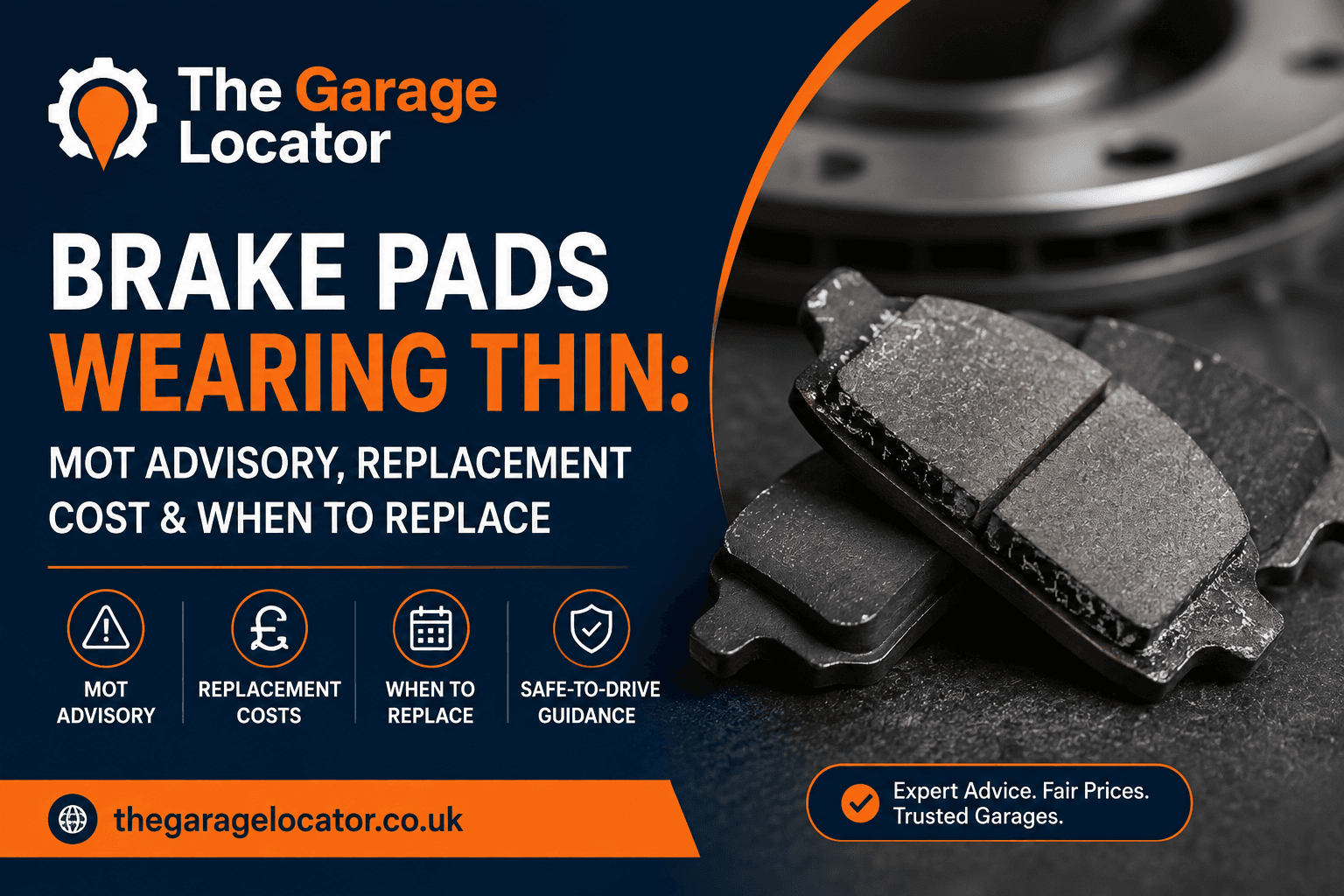
Receiving a brake pad advisory on your MOT certificate can be worrying, especially if you're unsure whether it's safe to continue driving or how much the repair might cost.
The good news is that a brake pad advisory means your vehicle passed its MOT. However, it also means the MOT tester found that your brake pads are becoming worn and will need replacing before they reach the legal minimum thickness or begin affecting your braking performance.
Brake pads are one of the most important safety components on your vehicle. Every time you press the brake pedal, the brake pads create friction against the brake discs to slow and stop your vehicle. As they wear down, braking performance gradually reduces, making it important to replace them before they become excessively worn.
In this guide, you'll learn:
- What a brake pad advisory means
- Whether it's safe to continue driving
- Typical UK brake pad replacement costs
- When an advisory could become an MOT failure
- What to look for when buying a used car with this advisory
Quick facts
- MOT result
- Passed with advisory
- Safe to drive
- Usually yes, if braking remains normal
- Repair urgency
- Within the next few weeks
- Typical repair cost
- £120–£350 (pair of pads fitted)
- Future MOT risk
- High if ignored
What Does a Brake Pad Advisory Mean?
A brake pad advisory means the MOT tester found that one or more of your vehicle's brake pads are becoming worn but are not yet worn enough to fail the MOT.
Brake pads naturally wear down every time you use your brakes. During an MOT, the tester checks the condition of the braking system and records an advisory when the pads are approaching the point where replacement will soon be needed.
Although your vehicle passed the MOT, the advisory should not be ignored. Worn brake pads continue to deteriorate with normal driving and, if left too long, can reduce braking performance, damage the brake discs and eventually result in an MOT failure.
Brake pad wear is affected by factors such as driving style, annual mileage, vehicle weight and the type of roads you regularly drive on. Vehicles used mainly in town traffic often wear brake pads more quickly than those driven mostly on motorways.
Read our complete guide to What Are MOT Advisories? to learn more about how advisory notices work.
Common MOT Wording for a Brake Pad Advisory
The exact wording on your MOT certificate can vary depending on the vehicle and the tester's observations. However, most brake pad advisories are very similar.
Common examples include:
- Brake pad(s) wearing thin
- Brake friction material wearing thin
- Brake pads close to wear limit
- Front brake pads wearing thin
- Rear brake pads wearing thin
Brake pad(s) wearing thin
This is the most common advisory wording. It means the tester found that the brake pads still met the MOT standard but are becoming worn and are likely to need replacing before the next MOT.
Brake friction material wearing thin
The friction material is the part of the brake pad that presses against the brake disc. This advisory means there is still sufficient material remaining, but replacement should be planned in the near future.
Brake pads close to wear limit
This wording indicates the brake pads are approaching the minimum acceptable thickness. Although the vehicle passed the MOT, leaving the pads unchanged for too long could result in reduced braking performance and an MOT failure at a future test.
The exact wording should always be considered alongside which axle is affected (front or rear) and whether the same advisory has appeared on previous MOT tests.
Why Did My Vehicle Receive This Advisory?
Brake pads are designed to wear down over time, so receiving a brake pad advisory is a normal part of vehicle ownership. The rate at which they wear depends on how and where you drive.
Common causes include:
- Normal wear from everyday braking
- Frequent stop-start town driving
- High annual mileage
- Carrying heavy loads or towing
- Aggressive braking habits
Vehicles that spend most of their time in city traffic generally wear brake pads much faster than those driven mainly on motorways because the brakes are used far more frequently.
Other factors, such as poor-quality replacement brake pads, seized brake calipers or sticking guide pins, can also cause brake pads to wear unevenly or more quickly than expected.
Diagnosis guide
Common causes
Normal wear over time
Frequent stop-start driving
High annual mileage
Heavy loads or towing
Aggressive braking
What Symptoms Might You Notice?
You may not notice any obvious symptoms when a brake pad advisory is first recorded. In many cases, the MOT tester identifies the wear during their inspection before it affects everyday driving.
As the brake pads continue to wear, you may begin to notice:
- Squealing or squeaking when braking
- Grinding noises (if the pads become severely worn)
- Reduced braking performance
- Longer stopping distances
- A brake pad warning light on some vehicles
If you notice grinding noises or a significant reduction in braking performance, have the vehicle inspected immediately. These symptoms may indicate the brake pads are worn beyond a safe level or that the brake discs have also been damaged.
Can You Drive With a Brake Pad Advisory?
Yes, in many cases you can continue driving after receiving a brake pad advisory, provided your brakes are still working normally and the vehicle remains safe to drive. An advisory means the brake pads were worn but had not yet reached the point where they failed the MOT.
However, you should arrange to have the brake pads inspected and replaced sooner rather than later. Brake pads continue to wear with every journey, and delaying replacement can increase repair costs if the brake discs also become damaged.
Remember that an MOT is only a snapshot of the vehicle's condition on the day of the test. You are legally responsible for ensuring your vehicle remains roadworthy after leaving the test centre.
Can you drive with this advisory?
Most vehicles can continue to be driven for a short period after receiving a brake pad advisory, but the repair should not be unnecessarily delayed.
Driving guidance
- Book a brake inspection within the next few weeks.
- Replace the brake pads before they become excessively worn.
- Stop driving immediately if braking performance changes or grinding noises develop.
Stop driving and seek immediate professional advice if you notice:
- Grinding or metal-on-metal noises
- Significantly reduced braking performance
- A brake warning light that remains illuminated
- The vehicle pulling to one side when braking
- Unusual vibrations through the brake pedal
Is a Brake Pad Advisory Serious?
A brake pad advisory should always be taken seriously because it relates to one of your vehicle's most important safety systems. However, an advisory does not mean the brakes are unsafe or that the vehicle should immediately be taken off the road.
The seriousness depends on how much friction material remains on the brake pads, how quickly they are wearing and how the vehicle is being used. A car driven occasionally may be able to safely cover many more miles before replacement, whereas a high-mileage vehicle used daily could require new brake pads much sooner.
Ignoring the advisory increases the risk of damaging the brake discs. Once the brake pads wear completely, the metal backing plate can come into contact with the disc, significantly increasing repair costs and reducing braking performance.
Could It Fail the Next MOT?
Yes. If the brake pads continue to wear and are not replaced, they are likely to fail a future MOT.
During an MOT, the tester assesses whether the brake pads still provide enough friction material to operate safely. Once they become excessively worn or their condition affects braking performance, the advisory can become an MOT failure.
Whether this happens before your next MOT depends on several factors, including:
- How many miles you drive each year
- Whether you mainly drive in town or on motorways
- Your braking style
- The current thickness of the brake pads
- The condition of the rest of the braking system
A vehicle that only covers a few thousand miles each year may still have serviceable brake pads at its next MOT, while a vehicle driven daily for long distances may require replacement within a few months.
If the brake pads wear completely, they can damage the brake discs and significantly reduce braking performance, increasing both repair costs and safety risks.
Read our guide to MOT Minor Defects Explained to understand how advisories, minor defects, major defects and dangerous defects differ.
Typical Brake Pad Replacement Costs in the UK
The cost of replacing brake pads depends on your vehicle, the quality of the replacement parts and local labour rates. Premium vehicles and performance cars generally cost more than smaller family cars.
Brake pad replacement cost
£120–£350
Most brake pad replacements cost between **£120 and £350** for a pair of pads, including fitting. If the brake discs also require replacement, the total cost will usually be higher.
Typical prices include:
| Repair | Typical UK cost |
|---|---|
| Front brake pads | £120–£250 |
| Rear brake pads | £100–£220 |
| Front pads and discs | £250–£500 |
| Rear pads and discs | £220–£450 |
These are general UK estimates and may vary depending on your vehicle and where you have the work carried out.
Costs may increase if:
- Brake discs also need replacing
- The vehicle uses premium or performance brake components
- Brake calipers have seized
- Additional brake system repairs are required
💷 Save money on brake repairs
How Soon Should You Repair It?
You shouldn't panic after receiving a brake pad advisory, but you also shouldn't ignore it. Arranging an inspection within the next few weeks is usually sensible, especially if you drive regularly.
The correct timing depends on how worn the pads are, how much you drive and whether any symptoms are already developing.
At a glance
- Pads have useful material remaining
- Monitor condition and plan replacement
- Pads are approaching replacement
- Arrange replacement soon
- Pads are significantly worn
- Book replacement promptly
- Grinding or very poor braking
- Stop driving and have the brakes inspected
Replacing the pads before they become excessively worn is usually the most cost-effective option.
What Happens If You Ignore It?
Ignoring a brake pad advisory allows the pads to continue wearing every time you drive. Eventually, they can become so thin that braking performance is affected and the vehicle may fail its next MOT.
If left for too long, worn brake pads can also damage other parts of the braking system.
Ignoring the advisory may lead to:
- An MOT failure
- Longer stopping distances
- Brake disc damage
- Increased repair costs
- Reduced braking performance
⚠️ Ignoring this advisory can become expensive
Acting early is usually the safest and most economical approach.
Does a Brake Pad Advisory Stay on the MOT History?
Yes. Once a brake pad advisory has been recorded during an MOT, it remains part of the vehicle's MOT history, even if the brake pads are replaced shortly afterwards.
Future MOT certificates may no longer mention the advisory if the repair has been completed, but the original advisory will still be visible when you check the vehicle's MOT history.
Looking at previous MOT records can help you identify whether:
- The brake pads were replaced promptly
- The same advisory appeared over multiple MOTs
- The advisory later became an MOT failure
- Other braking components have also received advisories
- The vehicle has been maintained regularly
Repeated brake pad advisories across several MOTs may suggest maintenance has been delayed, although they can also simply reflect normal wear on a high-mileage vehicle.
Use our free MOT History Checker to see previous advisories, MOT failures and recorded mileages before buying a used car.
Buying a Used Car With a Brake Pad Advisory
A brake pad advisory should not automatically put you off buying a used car. Brake pads are consumable items that naturally wear over time and are expected to be replaced periodically.
Instead of focusing solely on the advisory, consider the overall condition of the vehicle and its maintenance history.
Ask yourself:
- Has the advisory appeared on more than one MOT?
- Has the seller replaced the brake pads since the MOT?
- Are there invoices for the repair?
- Are there any other brake-related advisories or MOT failures?
- Does the asking price reflect the likely repair cost?
If the advisory is the vehicle's only significant issue and the rest of the MOT history is good, it should rarely be a reason to walk away from an otherwise well-maintained car.
Read our guide to Buying a Used Car With MOT Advisories for more advice.
What Should You Check Before Buying?
Before buying any used car, always review the complete MOT history rather than relying only on the latest MOT certificate.
Frequently Asked Questions
What does a brake pad advisory mean?
It means the brake pads are worn but were still above the MOT failure threshold when the vehicle was tested.
Can I drive with a brake pad advisory?
Usually yes, provided the brakes continue to work normally and there are no signs of reduced braking performance or unusual noises.
Will worn brake pads fail the next MOT?
They can. If the brake pads continue to wear and fall below the required standard before the next MOT, the vehicle is likely to fail.
How much does it cost to replace brake pads?
Most UK brake pad replacements cost between £120 and £350, although premium vehicles may cost more.
How long can I leave a brake pad advisory?
It depends on your mileage and driving style, but it is generally best to arrange replacement within the next few weeks rather than waiting until braking performance is affected.
Should I buy a car with a brake pad advisory?
Yes, provided the rest of the vehicle is in good condition. Brake pads are normal service items and are relatively inexpensive to replace compared with many other repairs.
Can a brake pad advisory disappear from the next MOT?
Yes. If the brake pads are replaced before the next MOT, the advisory should no longer appear, although it will remain visible in the vehicle's previous MOT history.
Is a repeated brake pad advisory a bad sign?
Not necessarily. It often reflects normal wear over time. However, repeated advisories without evidence of repair may suggest maintenance has been delayed.
Final Thoughts
A brake pad advisory means your vehicle passed its MOT, but the brake pads are becoming worn and should be replaced before they deteriorate further.
Although it isn't usually an emergency, ignoring the advisory can lead to reduced braking performance, damaged brake discs, higher repair costs and a future MOT failure.
Replacing brake pads promptly is one of the simplest and most cost-effective ways to keep your vehicle safe and avoid more expensive repairs later.
Before buying any used vehicle, use our free MOT History Checker to review its complete MOT history, previous advisories, MOT failures and recorded mileages.
You may also find these guides useful: