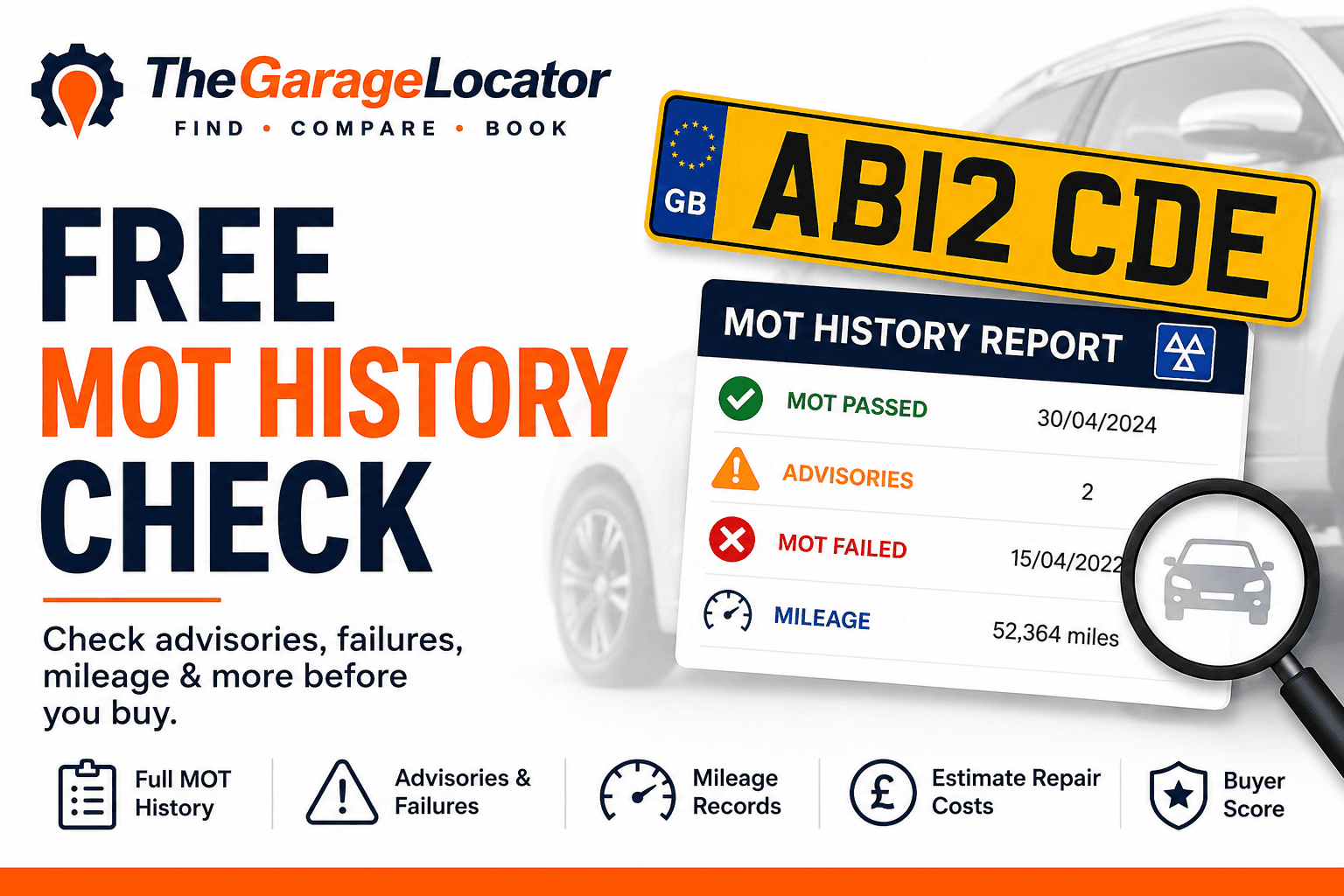
Checking a car’s MOT history is one of the quickest and most useful steps you can take before buying a used vehicle.
A free MOT history check can reveal previous failures, recurring advisories, recorded mileage, serious defects and signs that expensive repairs may be needed in the future.
You only need the vehicle’s registration number to begin.
Use our Free MOT History Check to review official DVSA MOT records before you buy.
Quick facts
- Cost
- Free
- Information needed
- Vehicle registration number
- Data shown
- MOT tests, advisories, failures and mileage
- Data source
- Official DVSA MOT records
- Best time to check
- Before viewing or buying a used car
How Do You Check a Car’s MOT History?
To check a vehicle’s MOT history:
- Find the vehicle registration number.
- Open our Free MOT History Check.
- Enter the registration exactly as it appears on the number plate.
- Review the vehicle details to make sure they match the car being advertised.
- Check previous MOT passes, failures, advisories and mileage readings.
- Investigate any repeated or serious issues before making an offer.
The process is free and usually takes less than a minute.
Check the registration carefully
What Information Does a Free MOT History Check Show?
An MOT history check provides a chronological record of previous MOT tests.
Depending on the vehicle and the records available, you may be able to see:
- The date of each MOT test
- Whether the vehicle passed or failed
- MOT expiry information
- Advisory notices
- Minor defects
- Major defects
- Dangerous defects
- Mileage recorded at each test
- Vehicle details such as make, colour and fuel type
This information can help you understand how the vehicle has been maintained and whether certain faults keep returning.
An MOT history does not tell you everything about a vehicle, but it gives you valuable independent evidence before you speak to the seller or arrange an inspection.
Why Should You Check MOT History Before Buying?
A used car may look clean, drive well during a short test drive and still have a history of unresolved problems.
Checking its MOT history can help you:
- Spot recurring faults
- Identify neglected maintenance
- Check mileage consistency
- Find previous major or dangerous defects
- Estimate likely repair costs
- Prepare questions for the seller
- Negotiate a more realistic purchase price
- Decide whether an independent inspection is needed
A current MOT certificate only confirms that the vehicle met the required standard when it was tested.
It does not guarantee that the vehicle has been properly serviced, that every advisory has been repaired or that it remains free from faults.
⚠️ A valid MOT is not a condition report
What Should You Look for in an MOT History?
Do not look only at the latest result.
The most useful information often comes from patterns across several years.
Repeated Advisories
If the same advisory appears year after year, it may suggest that the issue has not been properly repaired.
Common repeated advisories include:
- Tyres worn close to the legal tread limit
- Brake pads or discs showing wear
- Suspension bushes deteriorating
- Shock absorbers beginning to leak
- Corrosion on brake pipes
- Structural corrosion
- Oil or fluid leaks
Repeated advisories are not always proof of neglect. Similar wording may refer to different components or recurring wear.
However, repeated warnings involving brakes, tyres, steering, suspension or corrosion should be investigated carefully.
For more detail, read What Are MOT Advisories? A Complete Guide.
Previous MOT Failures
A previous MOT failure does not automatically make a vehicle a bad purchase.
Cars can fail for relatively straightforward problems such as:
- Failed bulbs
- Worn wiper blades
- Damaged tyres
- Brake imbalance
- Exhaust faults
- Emissions problems
The important questions are:
- Why did the vehicle fail?
- Was the fault repaired promptly?
- Did the same issue return?
- Was the failure caused by routine wear or poor maintenance?
- Were any dangerous defects recorded?
One repaired failure may be less concerning than a long pattern of repeated advisories and similar failures.
Major and Dangerous Defects
Major and dangerous defects deserve closer attention.
A major defect causes an MOT failure because it may affect safety, the environment or other road users.
A dangerous defect presents an immediate and direct risk to road safety or has a serious environmental impact.
Historical defects may have been repaired correctly. However, repeated major or dangerous defects can indicate poor maintenance, heavy use or unresolved underlying problems.
Mileage Trends
Mileage records from previous MOT tests can help you assess whether the vehicle’s recorded mileage appears consistent.
Normal mileage should generally increase from one test to the next.
Warning signs include:
- Mileage decreasing between tests
- Large unexplained increases
- Long periods with almost no recorded use
- Mileage that conflicts with service documents
- Mileage that does not appear consistent with the vehicle’s age or condition
A mileage inconsistency does not automatically prove that a vehicle has been clocked.
Possible explanations include:
- A typing error during an MOT test
- A replacement instrument cluster
- Mileage recorded in kilometres rather than miles
- A vehicle being stored or kept off the road
- An incorrect registration being entered
Any discrepancy should still be explained before you buy.
Read How to Spot Clocked Mileage Using an MOT History Check for further guidance.
Corrosion
Corrosion advisories should be assessed carefully, especially on older vehicles.
Minor surface corrosion may not be unusual, but repeated or worsening corrosion can become expensive.
Pay particular attention to references involving:
- Brake pipes
- Suspension mounting points
- Subframes
- Chassis areas
- Structural components
- Load-bearing sections of the vehicle
Corrosion may require treatment, component replacement or welding depending on its location and severity.
Tyres and Brakes
Tyres and brakes are wear items, so occasional advisories are common.
However, repeated advisories may suggest:
- Maintenance has been delayed
- The vehicle covers high mileage
- Wheel alignment is incorrect
- Suspension wear is causing uneven tyre wear
- Brake components are being replaced only when they fail
These issues may give you a legitimate reason to budget for repairs or negotiate the asking price.
How Can You Tell Whether an MOT History Is Good?
A good MOT history does not need to be completely free from advisories or failures.
Older vehicles naturally develop wear, and even well-maintained cars can fail an MOT occasionally.
A reassuring MOT history may show:
- Consistent annual testing
- Logical mileage increases
- Few repeated advisories
- No recurring dangerous defects
- Evidence that faults were repaired
- Limited corrosion
- No unexplained gaps
- A general pattern of responsible maintenance
A weaker history may show:
- Repeated safety-related advisories
- Frequent MOT failures
- Worsening corrosion
- Unexplained mileage inconsistencies
- Similar defects returning every year
- Major faults shortly after earlier warnings
- Long gaps with no clear explanation
At a glance
- Repeated age-related wear
- Ask for repair evidence and budget for maintenance
- Recurring brakes, tyres or suspension issues
- Arrange an independent inspection
- Mileage inconsistencies
- Ask for documents and investigate before proceeding
- Repeated dangerous defects or severe corrosion
- Consider walking away unless professionally assessed
For a more detailed assessment, read What Makes a Good MOT History When Buying a Used Car?.
How Far Back Can You Check MOT History?
The amount of MOT history available depends on the vehicle and the official records held.
Many vehicles have several years of digital MOT records, allowing you to review long-term patterns.
Some vehicles may have limited or no visible history because:
- They are too new to require an MOT
- They were recently imported
- They were previously used outside the UK
- They have been kept off the road
- Their registration number has changed
- Older records are not available digitally
A missing history does not automatically mean there is a problem, but it should be discussed with the seller.
Can You Check MOT History Without the VIN?
Yes.
For a standard MOT history check, you normally only need the vehicle registration number.
You do not usually need:
- The vehicle identification number
- The V5C document reference number
- The seller’s permission
- The current MOT certificate
- The owner’s personal details
This makes it possible to check the history before contacting the seller or arranging a viewing.
Does a Free MOT Check Show Service History?
No.
MOT history and service history are different.
An MOT test checks whether a vehicle meets minimum legal safety and environmental standards at the time of the test.
A service involves routine maintenance, which may include:
- Changing the engine oil and filter
- Checking fluids
- Inspecting brakes and tyres
- Replacing scheduled service items
- Checking the battery
- Inspecting belts, hoses and filters
A vehicle can have a clean MOT history but still have poor servicing.
It can also have a good service history while occasionally receiving MOT advisories or failures.
You should review both records before buying.
Read How to Check a Car’s Service History for more information.
Can an MOT Check Tell You Whether a Car Has Been Written Off?
No.
An MOT history check does not usually confirm whether a vehicle:
- Has been written off by an insurer
- Has outstanding finance
- Has been stolen
- Has been imported
- Has had a registration plate change
- Has suffered previous accident damage
These checks normally require a separate vehicle provenance or history report.
The MOT record should therefore be used as one part of your wider used-car checks.
Can an MOT History Help You Negotiate?
Yes.
MOT advisories and unresolved defects can help you estimate upcoming repair costs and support a reasonable negotiation.
For example, you may be able to negotiate if the history shows:
- Tyres close to replacement
- Worn brake pads or discs
- Suspension wear
- Corroded brake pipes
- Exhaust deterioration
- Repeated minor oil leaks
- An upcoming MOT expiry
- Previous advisories with no repair evidence
The aim is not simply to reduce the price.
You should first understand the likely repair cost and decide whether you are comfortable taking on the risk.
What Questions Should You Ask the Seller?
After reviewing the MOT history, ask specific questions rather than simply asking whether the car has any problems.
Useful questions include:
- Have the latest advisories been repaired?
- Do you have invoices for the work?
- Why did the vehicle fail its previous MOT?
- Has any corrosion been inspected or treated?
- Why is there a mileage inconsistency?
- Why was the vehicle off the road between these dates?
- Have the tyres, brakes or suspension been replaced recently?
- Is there any current warning light or mechanical fault?
- When is the next MOT due?
A genuine seller should be able to provide clear explanations or supporting documents.
Vague answers, conflicting information or pressure to buy quickly should make you more cautious.
What Else Should You Check Before Buying?
An MOT history check is important, but it should not be your only check.
Before buying a used car, you should also:
- Inspect the vehicle in daylight
- Check the service history
- Confirm the VIN matches the documents
- Check tyre condition and tread depth
- Test all warning lights
- Look for fluid leaks
- Listen for unusual engine or suspension noises
- Check for uneven panel gaps or paintwork
- Test-drive the vehicle
- Arrange an independent inspection when necessary
- Consider a separate finance, theft and write-off check
How to Use The Garage Locator MOT History Checker
To check a vehicle:
- Visit the Free MOT History Check.
- Enter the registration number.
- Confirm the vehicle details.
- Review the MOT timeline.
- Check advisories, defects and failures.
- Compare recorded mileage.
- Review the Buyer Score and repair-risk information.
- Use the findings before viewing, negotiating or buying.
Our checker can help you review:
- MOT pass and failure history
- Advisory notices
- Mileage records
- Repeated issues
- Estimated repair costs
- Used-car Buyer Score
- Potential negotiation opportunities
- Questions to ask the seller
All using official DVSA MOT data.
Frequently Asked Questions
Is checking a car’s MOT history free?
Yes. MOT history records can be checked free of charge using the vehicle registration number.
Can I see previous MOT failures?
Yes. Previous failures, advisories and recorded defects are normally included in the MOT history.
Does an MOT advisory mean the car is unsafe?
Not necessarily.
An advisory identifies wear or deterioration that was not serious enough to cause an MOT failure at the time of the test.
Safety-related advisories should still be investigated promptly.
Should I avoid a car with MOT advisories?
Not automatically.
Many older vehicles have some advisories. The type, severity and repetition of the advisories matter more than the total number.
Can I check the MOT history before viewing the car?
Yes. You only need the registration number, so you can check the history before contacting the seller or travelling to a viewing.
Does an MOT history show mileage?
Yes. The mileage recorded during previous MOT tests is normally shown.
Can a car have a valid MOT and still have problems?
Yes.
A valid MOT confirms that the vehicle met the required standard when it was tested. It does not guarantee that it has no current faults or that it has been serviced correctly.
What should I do if the mileage goes down?
Ask the seller for an explanation and compare the MOT history with service invoices, maintenance records and previous documents.
Do not proceed until the discrepancy has been understood.
Is one MOT failure a bad sign?
Not necessarily.
Look at the reason for the failure, whether it was repaired and whether the same issue appeared again.
Does an MOT history check show outstanding finance?
No. Outstanding finance normally requires a separate vehicle provenance check.
Final Thoughts
Checking a vehicle’s MOT history is one of the simplest ways to reduce the risk of buying a problematic used car.
By reviewing previous advisories, failures, defects and mileage records, you can identify warning signs before committing to a purchase.
A good MOT history does not need to be perfect, and one previous failure does not automatically make a vehicle unsuitable.
The most important factors are the type of defects recorded, whether they were repaired and whether the same problems continued to return.
Before buying a used vehicle, use our Free MOT History Check to review its official DVSA MOT records.
Related Guides
You may also find these guides useful:
- What Is an MOT History Check?
- What Are MOT Advisories? A Complete Guide
- What Makes a Good MOT History When Buying a Used Car?
- 10 MOT History Red Flags That Should Make You Walk Away From a Used Car
- Can You Drive With an MOT Advisory?
- Top 10 Reasons Cars Fail Their MOT
Use our Free MOT History Check to review MOT records, advisories, failures and mileage history before buying.