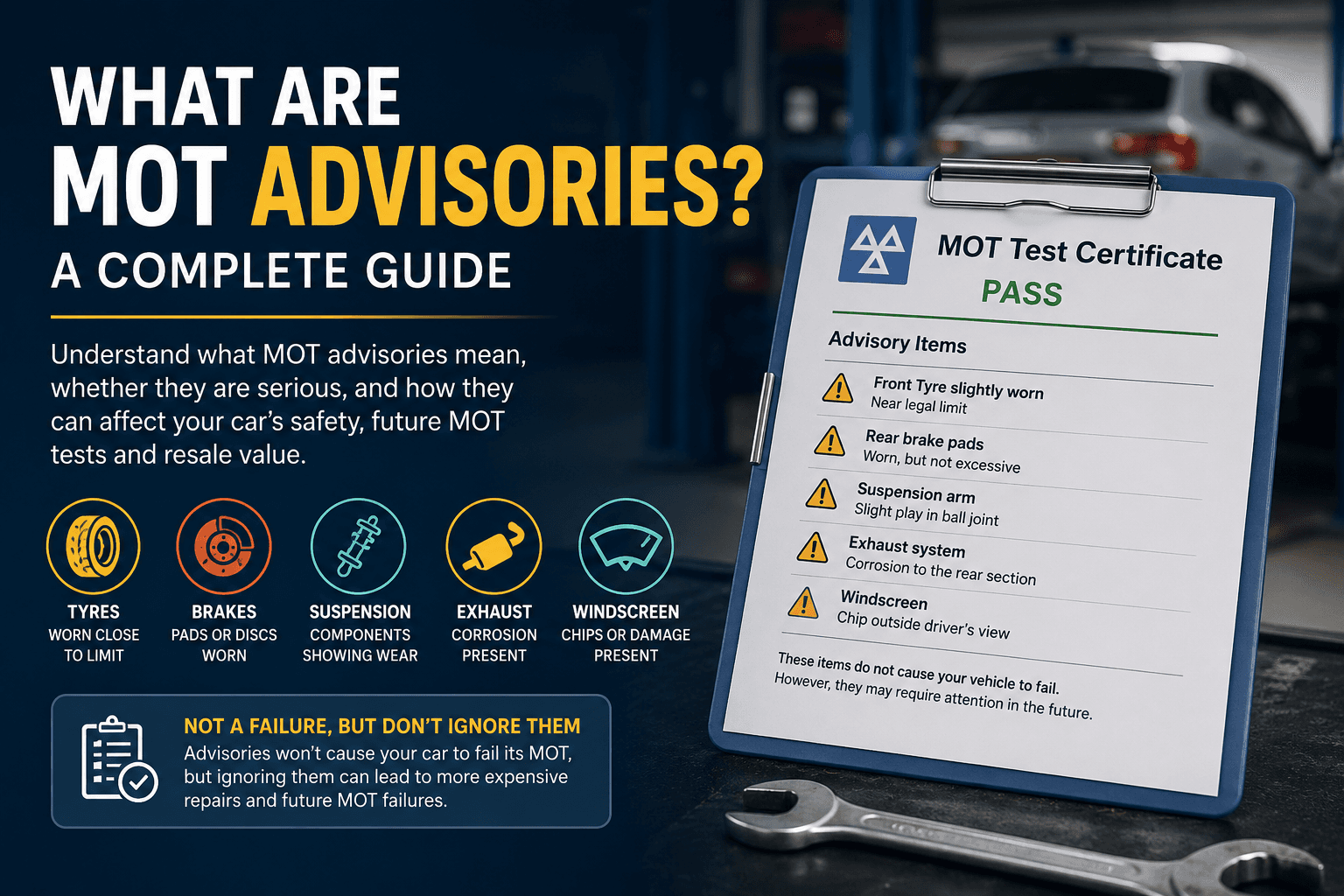
When your vehicle passes its MOT, you may receive one or more MOT advisories on the test certificate. Many drivers aren't sure what these advisories mean or whether they need to take action.
MOT advisories are warnings recorded by an MOT tester about wear or deterioration that is not serious enough to fail the vehicle at the time of the test. Your car can still pass with advisories, but some issues — particularly brakes, tyres, steering, suspension and corrosion — should be checked promptly.
If you're buying a used car, advisory notices can also reveal how well the vehicle has been maintained over time.
Quick facts
- MOT result
- The vehicle still passes
- Immediate repair
- Depends on the advisory
- Safe to drive
- Usually, but safety-related issues should be checked promptly
- Visible on MOT history
- Yes
What Is an MOT Advisory?
An MOT advisory is a note added by the MOT tester to highlight an issue that does not meet the criteria for an MOT failure but may require attention in the future.
Examples include:
- Tyres wearing close to the legal tread limit
- Brake pads becoming worn
- Minor suspension wear
- Surface corrosion
- Windscreen chips outside the driver's line of sight
Although the vehicle passes its MOT, these issues should be monitored and repaired before they become more serious.
MOT testers may record advisories for wear or deterioration that does not currently justify a formal defect classification. Advisories are separate from minor, major and dangerous MOT defects.
If you're unfamiliar with the MOT process, read our guide on What Is an MOT History Check?.
Why Are MOT Advisories Important?
An advisory is an early warning
Fixing advisory items early can:
- Prevent future MOT failures
- Improve vehicle safety
- Reduce repair costs
- Protect the value of your vehicle
- Lower the risk of unexpected breakdowns
Ignoring an advisory does not automatically mean the vehicle will become unsafe. However, many advisory items worsen through normal use, mileage, weather exposure and continued wear.
Common MOT Advisories
Some of the most common advisory notices relate to tyres, brakes, suspension, corrosion and visibility.
Tyre advisories
A tester may record an advisory when a tyre is worn but still above the legal tread-depth limit, has minor cracking or is beginning to deteriorate.
Tyres should be checked regularly because their condition can worsen quickly, particularly if the vehicle covers a high annual mileage or has incorrect wheel alignment.
Brake advisories
Brake pads, discs and pipes may receive advisories when wear or corrosion is present but not yet severe enough to fail the test.
Brake-related advisories should be taken seriously because braking performance can deteriorate as parts continue to wear. If your MOT specifically mentions rusty, pitted or corroded discs, read our brake disc corrosion guide to understand the MOT failure risk, replacement costs and when the discs may need changing.
Suspension advisories
Worn suspension bushes, minor play in joints or slight leakage from a shock absorber may be recorded as advisories.
Suspension wear can affect handling, braking stability and tyre wear if it becomes more severe.
Corrosion advisories
Surface corrosion may be recorded on brake pipes, structural areas, exhaust components or other metal parts.
Minor corrosion does not necessarily make a vehicle unsafe, but untreated corrosion can spread and eventually result in an MOT failure.
Visibility advisories
Worn wiper blades, minor windscreen damage and deteriorating registration plates may also appear as advisories.
These problems are often inexpensive to correct and should usually be dealt with before they worsen.
Can You Drive With MOT Advisories?
Yes, in most cases.
Receiving an advisory does not make your vehicle illegal to drive. It means the issue was not serious enough to cause an MOT failure at the time of the test.
However, an MOT only confirms that the vehicle met the required standard when it was inspected. If the condition worsens afterwards and the vehicle becomes unroadworthy, you could still be prosecuted for driving an unsafe vehicle.
Find out more in our guide: Can You Drive With an MOT Advisory?.
Are MOT Advisories Serious?
It depends on the component, the wording of the advisory and how quickly the condition is likely to worsen.
Some advisories are relatively minor and can be monitored for a period. Others indicate that a repair may soon become necessary.
For example:
- Tyres wearing close to the legal limit — Plan to replace them soon.
- Brake pads wearing thin — Arrange an inspection and replace them when required.
- Slight suspension wear — Monitor the condition and investigate unusual noises or handling.
- Surface corrosion — Treat or inspect it before the corrosion spreads.
- Minor windscreen damage — Repair it before the damage grows or affects the driver's view.
Safety-related advisories involving brakes, tyres, steering and suspension should generally be prioritised.
What Is the Difference Between an Advisory and an MOT Defect?
An advisory is different from an official MOT defect classification.
An advisory highlights an issue that does not currently meet the threshold for failure.
A minor defect identifies an issue that has no significant effect on vehicle safety or the environment. The vehicle can still pass, but the defect is formally recorded.
A major defect means the vehicle fails its MOT because the issue may affect safety, the environment or other road users.
A dangerous defect means the vehicle fails and presents an immediate or direct risk to road safety or a serious environmental impact.
Read our complete guide to MOT minor defects for a more detailed explanation.
Do MOT Advisories Stay on the MOT History?
Yes.
Advisory notices remain on the vehicle's recorded MOT history and can be viewed when checking previous test results.
A new MOT does not remove older advisory records. The full history can therefore show whether an issue appeared once, was repaired or continued across several tests.
Repeated advisories can be particularly useful when assessing a used car because they may reveal:
- Maintenance that has been repeatedly delayed
- Recurring corrosion
- Ongoing tyre or alignment problems
- Suspension wear that has not been repaired
- Previous faults that later became MOT failures
Read How Long Do MOT Advisories Stay on Record? for more information.
Why Do the Same Advisories Appear Every Year?
When the same advisory appears on several consecutive MOT tests, it may mean the problem has not been repaired.
However, similar wording does not always confirm that the exact same component is still defective. A vehicle could have recurring wear in the same area, or a tester may describe a different issue using similar language.
Repeated safety-related advisories should still be investigated. They may suggest that the owner has postponed maintenance or carried out only temporary repairs.
For example, repeated tyre advisories could indicate:
- High annual mileage
- Poor wheel alignment
- Incorrect tyre pressures
- Worn suspension components
- A pattern of delaying tyre replacement
The wider MOT history should always be considered rather than relying on one line in isolation.
Do Different MOT Testers Record Different Advisories?
They can.
MOT testers follow official testing standards, but advisory notices can involve professional judgement. Different testers may describe the same wear or deterioration using slightly different wording.
One tester may record a component as deteriorated, while another may describe it as worn or corroded.
The most important factors are:
- Which part of the vehicle is affected
- Whether the issue is safety-related
- Whether it has appeared before
- Whether the condition is becoming worse
- Whether it later resulted in an MOT failure
Differences in wording do not necessarily mean that one tester was wrong.
Do MOT Advisories Affect the Value of a Used Car?
They can.
A small number of minor advisories is normal on many older vehicles. Advisories do not automatically make a car unreliable or a poor purchase.
However, numerous advisories, repeated issues or warnings affecting safety-critical parts may reduce the vehicle's value.
They can also give a buyer legitimate reasons to:
- Request evidence that repairs have been completed
- Arrange an independent inspection
- Budget for upcoming maintenance
- Renegotiate the asking price
- Walk away if the repair risk is too high
Our guide on What Makes a Good MOT History When Buying a Used Car? explains what to look for.
You can also read Buying a Used Car With MOT Advisories: Is It Worth the Risk?.
Should You Repair Advisory Items Immediately?
Not every advisory requires an immediate repair, but every advisory should be understood.
Some issues may remain within a safe and legal condition for months. Others can deteriorate quickly or affect a safety-critical system.
Arrange a prompt inspection when an advisory involves:
- Brakes
- Tyres
- Steering
- Suspension
- Structural corrosion
- Significant fluid leaks
- Visibility problems
Less urgent cosmetic or age-related deterioration may be monitored, but it should still be checked during routine servicing.
At a glance
- Brakes, tyres, steering or suspension
- Arrange an inspection promptly
- Structural or brake-pipe corrosion
- Ask a garage to assess the severity
- Wiper blades, bulbs or number plates
- Repair before the condition worsens
- Minor age-related deterioration
- Monitor it during routine servicing
- A worsening or dangerous symptom
- Stop driving and seek professional advice
What Happens If You Ignore MOT Advisories?
Ignoring advisory notices can lead to:
- Higher repair costs
- A future MOT failure
- Reduced vehicle safety
- Lower resale value
- Additional damage to connected components
- Unexpected breakdowns
For example, worn brake pads can eventually damage the brake discs, increasing the total repair cost. Poorly worn tyres can become illegal, while untreated corrosion can spread into structural areas or brake pipes.
⚠️ An MOT pass is not a guarantee for the next 12 months
Dealing with an advisory shortly after the MOT is often cheaper than waiting until the component fails completely.
How Many MOT Advisories Are Too Many?
There is no official number of advisories that automatically makes a vehicle unsafe or unsuitable to buy.
The type and pattern of advisories matter more than the total.
For example, six inexpensive age-related items may be less concerning than two repeated advisories involving structural corrosion and worn brakes.
When assessing the number of advisories, consider:
- The age and mileage of the vehicle
- Whether the issues affect safety
- Whether the same faults appear repeatedly
- Whether previous advisories were repaired
- The likely cost of the work
- Whether the vehicle has a history of MOT failures
Read How Many MOT Advisories Are Too Many? for a detailed assessment.
Check a Vehicle's MOT Advisory History
If you're buying a used car, don't just check whether its latest MOT was a pass or fail.
Reviewing the complete MOT history allows you to identify:
- Current and previous advisories
- Repeated faults
- Previous MOT failures
- Mileage records
- Changes in recorded defects
- Potential future repair costs
Use our free MOT History Checker to check any UK vehicle before you buy.
You may also find these guides helpful:
- How to Check a Car's MOT History for Free
- 10 MOT History Red Flags That Should Make You Walk Away From a Used Car
- Top 10 Reasons Cars Fail Their MOT
Frequently Asked Questions
Do MOT advisories mean my car is unsafe?
Not necessarily. An advisory identifies an issue that was not serious enough to cause an MOT failure at the time of the test. However, advisories involving brakes, tyres, steering, suspension or structural corrosion should be investigated promptly.
Can I pass an MOT with advisories?
Yes. A vehicle can pass its MOT while receiving one or more advisory notices.
Do advisories stay on the MOT history?
Yes. Previous advisories remain visible in the vehicle's recorded MOT history.
Should I buy a car with MOT advisories?
Possibly. Minor advisories are common, particularly on older vehicles. The decision should depend on the type of advisory, whether it is repeated, the likely repair cost and the overall condition of the vehicle.
Can an MOT advisory become a failure?
Yes. If the affected component continues to wear or deteriorate, it may become a minor, major or dangerous defect at a future test.
Do I have to repair an MOT advisory?
There is no automatic requirement to repair every advisory immediately. However, you are legally responsible for keeping your vehicle safe and roadworthy, regardless of its MOT status.
Can an advisory disappear from the next MOT?
Yes. An advisory may not appear on the next test if the issue has been repaired, the condition has not progressed or the next tester assesses or describes it differently.
Are repeated advisories a bad sign?
They can be. Repeated advisories may indicate delayed maintenance, recurring wear or an unresolved fault. They should be considered alongside the vehicle's age, mileage, service history and overall condition.
Final Thoughts
MOT advisories are not something to panic about, but they should never be ignored.
They provide an early indication of wear, deterioration or maintenance that may soon be required. Acting early can improve safety, reduce repair costs and lower the risk of failing a future MOT.
If you're buying a used vehicle, advisories can also help you understand how the car has been maintained and whether you should budget for upcoming repairs.
Before buying any used car, use our free MOT History Checker to review its complete MOT history, advisory notices, previous failures and recorded mileage.
You can also learn how to interpret the results in our guide on How to Check a Car's MOT History for Free.