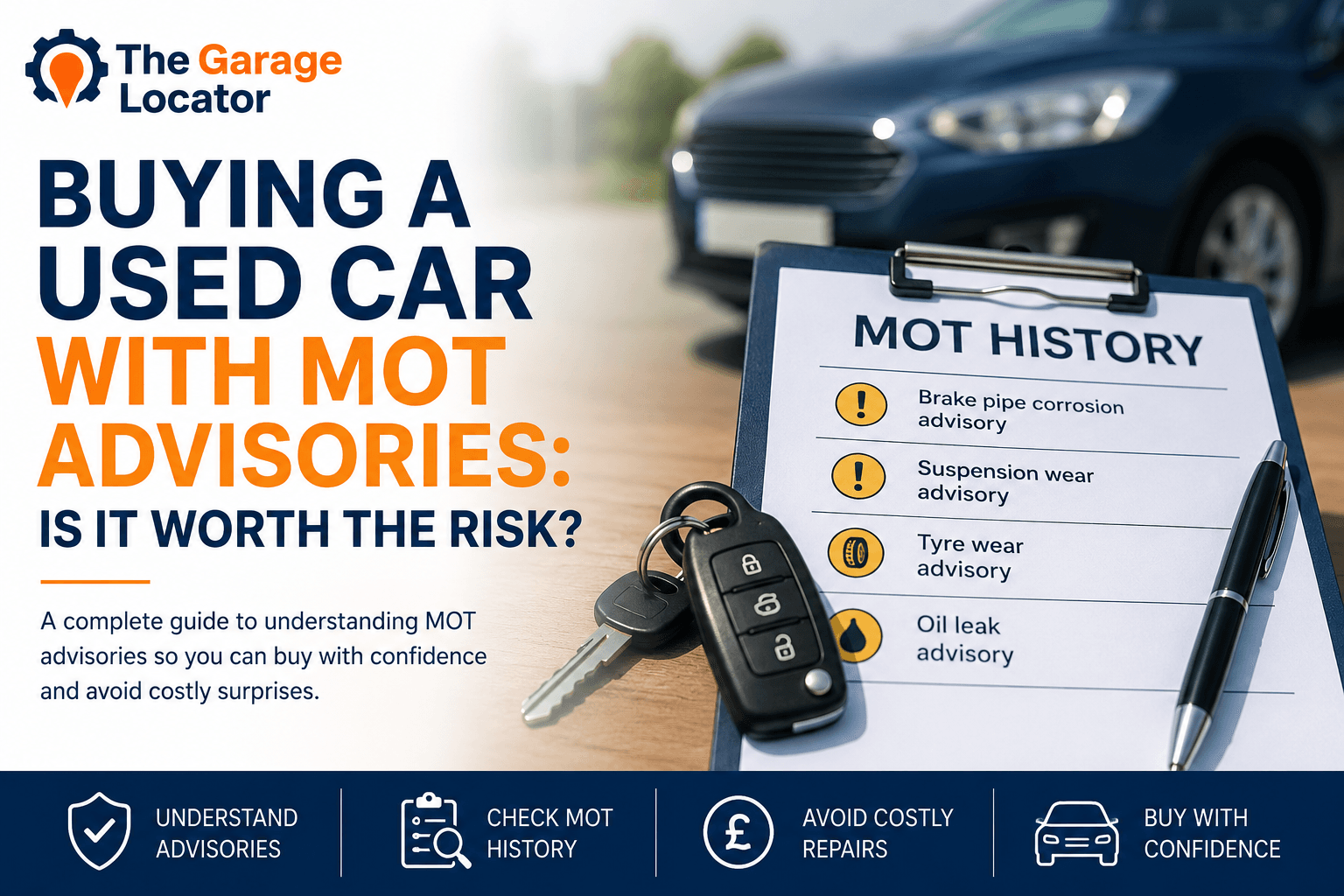
Buying a used car can save you thousands of pounds, but it's important to look beyond the asking price. One of the easiest ways to understand how well a vehicle has been maintained is by reviewing its MOT history, including any recorded advisories.
Seeing one or two advisories on an MOT certificate isn't necessarily a reason to avoid a vehicle. Many advisories relate to normal wear and tear. The important thing is understanding what they mean, whether they've been repaired and whether they form part of a larger pattern.
In this guide, we'll explain what MOT advisories are, which ones should concern you and how to decide whether a used car is still worth buying.
What Are MOT Advisories?
An MOT advisory is a note added by the MOT tester to highlight an issue that doesn't currently make the vehicle unsafe, but may require attention in the future.
Unlike an MOT failure, an advisory allows the vehicle to pass its MOT test.
Common advisories include:
- Worn tyres
- Brake pad wear
- Light corrosion
- Suspension wear
- Minor oil leaks
- Exhaust corrosion
If you're unfamiliar with how advisories work, read our guide on What Are MOT Advisories?.
Should MOT Advisories Put You Off Buying?
Not necessarily.
Almost every older vehicle will accumulate a few advisories over its lifetime. In many cases they're simply reminders that routine maintenance will soon be required.
A single advisory for worn tyres or brake pads is rarely a cause for concern.
However, numerous advisories or the same advisory appearing year after year could indicate that maintenance has been neglected.
Which Advisories Should Concern You?
Some advisories deserve a closer look because they can lead to expensive repairs if ignored.
These include:
- Brake pipe corrosion
- Structural corrosion
- Suspension wear
- Steering components
- Oil leaks
- Brake disc deterioration
These issues don't always mean you should avoid the vehicle, but they do justify asking more questions.
Brake-related corrosion deserves particular attention because the repair cost and MOT failure risk depend on the component and severity. Read our Brake Pipe Corrosion Advisory guide if the MOT mentions corroded brake pipes, or our Brake Disc Corrosion guide if it mentions rusty, pitted or corroded brake discs.
Look for Repeated Advisories
One advisory isn't usually a problem.
The real warning sign is when the same advisory appears on multiple MOT tests.
For example:
2023
Brake pipe corrosion advisory.
2024
Brake pipe corrosion advisory.
2025
Brake pipe heavily corroded.
This suggests the problem has been left untreated and may soon result in an MOT failure.
Checking several years of MOT history helps you spot these developing issues.
Consider the Vehicle's Age
Older vehicles naturally develop more wear-related advisories.
A fifteen-year-old family car with a few minor advisories isn't unusual.
In contrast, several significant advisories on a relatively new vehicle could indicate poor maintenance or unusually hard use.
Always judge advisories in the context of the vehicle's age and mileage.
Check the Mileage History
Advisories tell part of the story.
Mileage records tell another.
For example, a vehicle showing unusually low mileage but repeated suspension or braking advisories may have spent long periods standing unused.
Likewise, inconsistencies in recorded mileage should always be investigated.
Our guides How to Spot Clocked Mileage Using an MOT History Check and What Does Mileage Inconsistency Mean on an MOT History? explain what to look for.
Don't Forget the Service History
An MOT checks whether a vehicle meets minimum road safety standards on the day of the test.
It doesn't confirm whether the car has been serviced correctly throughout its life.
Before buying, ask to see:
- Service records
- Maintenance invoices
- Timing belt replacement records (where applicable)
- Brake and clutch repairs
- Major servicing receipts
You can learn more in How to Check a Car's Service History.
Questions to Ask the Seller
If you notice advisories, ask the seller:
- Have these issues been repaired?
- Do you have receipts for the work?
- Has the same advisory appeared before?
- Has the vehicle ever failed an MOT for related problems?
- Has the car been regularly serviced?
Honest sellers will usually be happy to provide supporting paperwork.
Why Checking the Full MOT History Matters
The latest MOT certificate only shows the vehicle's condition on one particular day.
Reviewing previous MOT records helps you identify:
- Repeated advisories
- Previous MOT failures
- Corrosion developing over time
- Brake or suspension problems
- Mileage progression
- Signs of consistent maintenance
Looking at the complete history gives you a much clearer picture than relying on the latest MOT alone.
You should also read 10 MOT History Red Flags That Should Make You Walk Away From a Used Car before making a purchase.
Frequently Asked Questions
Is it normal for used cars to have MOT advisories?
Yes. Minor advisories are very common, particularly on older vehicles, and often relate to routine maintenance.
Can a car pass its MOT with advisories?
Yes. Advisories indicate issues that don't currently meet the threshold for an MOT failure.
Should repeated advisories concern me?
Yes. The same advisory appearing over several MOT tests may suggest the issue has been ignored rather than repaired.
Should I avoid buying a car with advisories?
Not necessarily. Many advisories are inexpensive to fix. The important thing is understanding the severity of the issue and whether it forms part of a wider maintenance problem.
Final Thoughts
Buying a used car with MOT advisories isn't automatically a bad decision.
Many advisories simply reflect normal wear and tear and are relatively inexpensive to repair. What matters most is whether those issues have been dealt with or repeatedly ignored over several years.
Taking a few minutes to review the vehicle's complete MOT history, service records and mileage can help you avoid expensive surprises and buy with confidence.
Check the MOT History for Free
Before buying any used vehicle, use our free MOT History Checker to view previous MOT results, recorded mileages, advisories and failures. It only takes a few seconds and could help you spot developing problems before you buy.