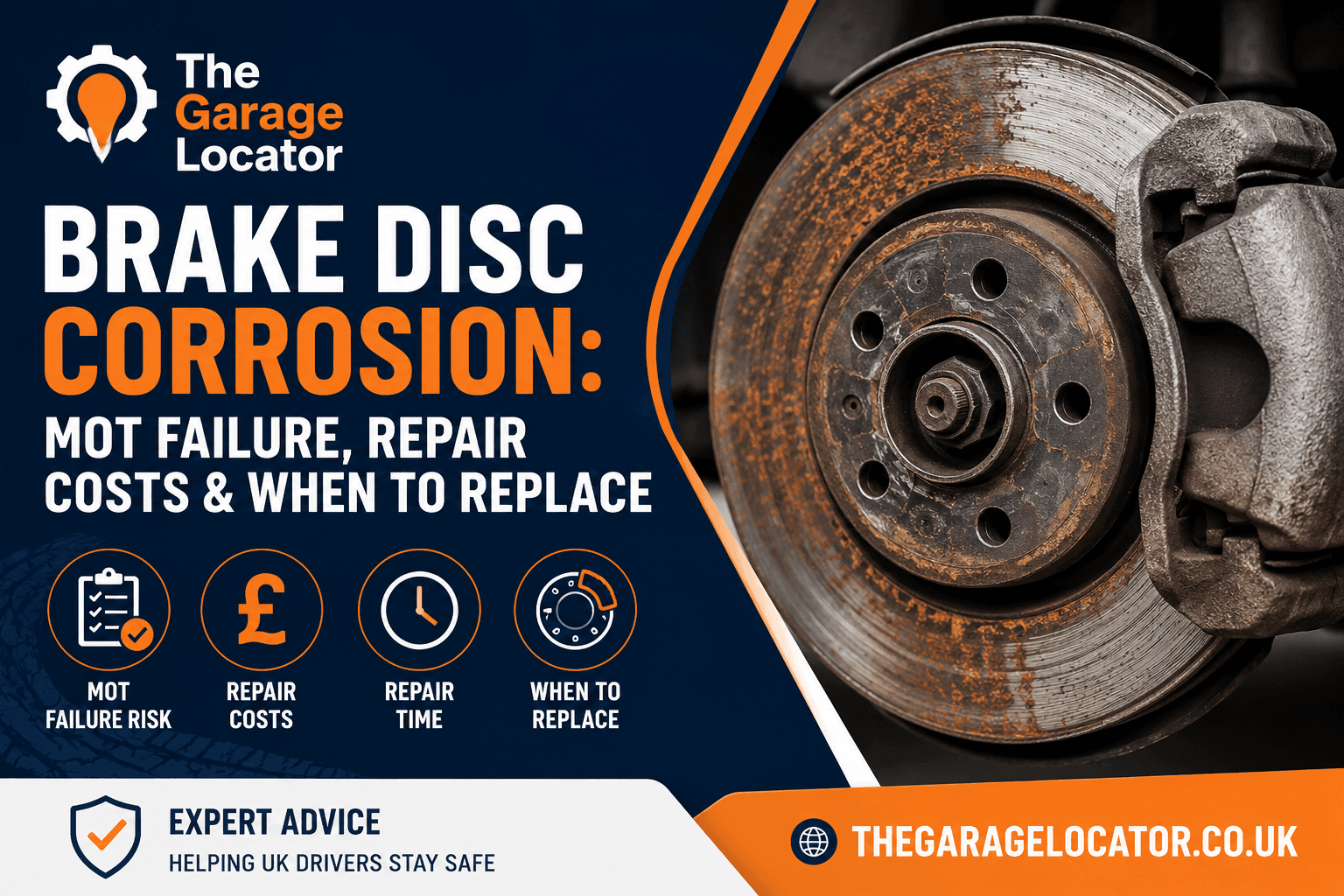
Brake disc corrosion is extremely common, particularly on cars that are parked outside, driven infrequently or used mainly for short journeys.
A thin orange coating can appear on brake discs after rain or even after leaving the car overnight. This light surface rust will often disappear once the brakes are used.
However, deeper corrosion, heavy pitting or an uneven braking surface can reduce braking performance and may eventually result in an MOT advisory or failure.
At a glance
- Surface rust
- Usually does not require replacement
- Persistent pitting or uneven contact
- Arrange a brake inspection
- Severely worn, fractured or weakened disc
- Replace the discs
Quick facts
- Surface rust
- Common after rain, washing or periods of inactivity
- MOT result
- Corrosion alone does not automatically cause an MOT failure
- Major defect
- A significantly and obviously worn brake disc
- Dangerous defect
- A fractured, insecure or failure-prone brake disc
- Replacement method
- Brake discs are normally replaced in axle pairs
- Brake pads
- New pads are commonly installed with replacement discs
- Typical cost
- Approximately £125–£375 per axle
What is brake disc corrosion?
Most conventional brake discs are made from cast iron. The metal braking surface is exposed because the brake pads must clamp directly against it.
When moisture, oxygen and road salt reach this surface, oxidation creates rust.
Some rust is therefore an expected consequence of normal use. The important question is not simply whether rust exists, but:
- how deep it is;
- how much of the braking surface it affects;
- whether the brake pad is contacting the disc evenly;
- whether the disc has been structurally weakened;
- whether braking performance has deteriorated.
This distinction matters because harmless surface rust and serious brake disc corrosion are not the same fault.
Is surface rust on brake discs normal?
A light orange film after rain, washing the car or leaving it parked for several days is normally surface rust.
When the vehicle is driven, the brake pads press against the rotating discs. This friction will often clean the contact surface after several normal brake applications.
Light rust-related noise may also disappear after a short period of normal driving. Persistent noise, vibration or poor braking should not be dismissed as ordinary surface corrosion.
Good to know
Will corroded brake discs fail an MOT?
Corroded brake discs do not automatically fail an MOT.
The DVSA MOT inspection manual states that a brake disc or drum must be significantly worn before it should be rejected. Being below a manufacturer's recommended wear limit is not, by itself, an MOT failure reason.
Relevant MOT defect classifications include:
| Brake disc condition | MOT category |
|---|---|
| Significantly and obviously worn | Major |
| Insecure, fractured or otherwise likely to fail | Dangerous |
| Contaminated with oil or grease | Major |
| Missing | Dangerous |
A major or dangerous defect means the vehicle fails its MOT.
Moderate corrosion may instead be recorded as an advisory, particularly where deterioration is visible but has not yet reached the rejection threshold.
⚠️ Important warning
Common MOT wording for corroded brake discs
Brake-related wording on an MOT history may vary according to what the tester observes and whether the defect reaches the failure threshold.
Examples may include:
- brake disc worn, pitted or scored, but not seriously weakened;
- brake disc slightly pitted;
- brake disc corroded;
- brake disc worn but not excessively;
- brake disc significantly and obviously worn;
- brake disc fractured or likely to fail.
An advisory does not mean the defect is irrelevant. It means the condition was identified but did not meet the failure threshold at the time of that test.
A recurring advisory across several MOT tests is more concerning than an isolated entry because it can indicate that the deterioration has been left unresolved.
⚠️ Important warning
What causes brake discs to corrode?
The car is driven infrequently
Cars that remain parked for long periods allow moisture to sit on the discs. Light rust may become deeper because the pads are not regularly cleaning the braking surfaces.
Low-mileage cars can therefore suffer significant brake corrosion despite having relatively little mechanical wear.
Frequent short journeys
Short journeys may not involve enough sustained braking to clean and heat the discs properly.
This can be particularly noticeable on rear discs because the front brakes normally perform a larger share of the braking work.
Wet weather and road salt
Rainwater, damp air and winter road salt accelerate oxidation.
Cars parked outside or driven on salted roads can develop corrosion more quickly than vehicles stored in a dry garage.
A sticking brake caliper
A seized slider, piston or pad can prevent even pressure across the disc.
This may leave part of the disc unused and rusty while another area becomes hot or excessively worn.
Poor pad contact
Incorrectly fitted, seized or unevenly worn pads may contact only part of the disc surface.
The resulting rust band is not necessarily just cosmetic. It can indicate that the braking system is not working evenly.
Hybrid and electric vehicle regenerative braking
Hybrid and electric vehicles may use regenerative braking for part of their deceleration.
This can reduce the frequency with which the conventional friction brakes are used, particularly during gentle driving.
The discs must still be inspected because low friction-brake use can allow corrosion to develop.
Diagnosis guide
Common Causes
Common causes of brake disc corrosion
The vehicle is parked for long periods
Repeated short journeys
Wet weather and winter road salt
A sticking caliper or seized slider
Uneven or restricted brake-pad movement
Limited use of rear brakes
Reduced friction-brake use on some hybrid and electric vehicles
How can you tell whether brake disc corrosion is serious?
You cannot accurately judge every brake disc through the wheel. A garage may need to remove the wheel and inspect both the inner and outer faces.
The inner face can sometimes be in substantially worse condition than the visible outer face.
Warning signs include:
- deep pits in the braking surface;
- heavy scaling or flaking;
- a large rusty band not contacted by the pad;
- pronounced scoring or grooves;
- a substantial lip around the outer edge;
- cracking;
- vibration or judder when braking;
- grinding or persistent scraping;
- the vehicle pulling to one side;
- increased stopping distance;
- one wheel becoming unusually hot;
- repeated brake-related MOT advisories.
Surface rust, pitting and scoring: what is the difference?
Surface rust
Surface rust is a thin layer of oxidation. It commonly appears after exposure to rain and may disappear after normal braking.
Pitting
Pitting creates small cavities in the disc surface. Unlike a light film of rust, the material has been physically eaten away.
Minor pitting may result in an advisory. Extensive pitting can reduce the effective contact area between the pad and disc and may require replacement.
Scoring
Scoring appears as circular grooves around the disc.
It may be caused by worn pads, trapped debris, contaminated components or metal-to-metal contact.
Deep scoring can reduce effective braking contact and damage new pads.
Lipping
A lip forms around the edge of a disc as the swept surface wears thinner while the outermost edge remains relatively untouched.
A small lip is common on used discs. A large lip can indicate advanced wear, but the disc's complete condition must be assessed rather than judging it from the lip alone.
Is it safe to drive with corroded brake discs?
That depends on the severity of the corrosion and whether braking performance is affected.
Light surface corrosion that disappears after ordinary brake use is generally different from deep pitting, cracking or structural deterioration.
Light surface rust
If the rust clears quickly and there is no noise, vibration, pulling or reduction in braking performance, the vehicle will usually not require immediate brake disc replacement.
Persistent corrosion or pitting
Book a brake inspection promptly if rust remains on the braking surface, the discs are visibly pitted or scored, there is an unused corrosion band, or the MOT history contains recurring brake disc advisories.
Serious braking symptoms
Stop driving and seek professional assistance if you experience:
- severe grinding;
- markedly reduced braking;
- strong pulling under braking;
- an unusually soft brake pedal;
- suspected brake disc cracking;
- smoke from a wheel;
- a wheel becoming excessively hot.
Never attempt to "clean" questionable discs by repeatedly braking hard on a public road. That can overheat the braking system and creates an unnecessary safety risk.
Can corroded brake discs be cleaned?
Light surface rust may clear naturally through normal braking.
A technician may sometimes clean accessible corrosion during brake servicing, but this does not restore metal that has been lost through deep pitting or severe wear.
Wire brushing or sanding may improve the appearance of limited non-critical corrosion, but it is not a valid repair for a disc that is structurally deteriorated, outside a safe service specification or no longer providing an even braking surface.
Can brake discs be resurfaced?
Brake disc resurfacing is possible in limited circumstances, but it is less common in the UK than replacement.
Before machining a disc, the technician must consider:
- the disc's current thickness;
- its minimum safe machining thickness;
- the depth of scoring or pitting;
- heat damage;
- cracking;
- run-out and distortion;
- the remaining usable life after machining;
- the cost compared with replacement.
A deeply corroded, cracked or excessively thin disc should be replaced rather than resurfaced.
When should corroded brake discs be replaced?
Replacement is normally appropriate when:
- corrosion is deep or widespread;
- the braking surface remains heavily pitted;
- a substantial part of the disc is not contacting the pad;
- the disc is cracked or structurally weakened;
- wear is significant and obvious;
- braking vibration is traced to the discs;
- the disc is outside the vehicle manufacturer's safe service specification;
- new pads would not bed correctly onto the old surface;
- brake efficiency or balance is affected;
- corrosion is linked to a sticking caliper that has also damaged the disc.
Brake discs are ordinarily replaced as a pair across the same axle.
Replacing only the left or right disc could produce different braking characteristics on either side.
Do brake pads need replacing with the discs?
New pads are normally fitted when brake discs are replaced.
Old pads will have worn to match the surface of the old discs. Installing them against new discs can produce poor contact and uneven bedding.
It may be possible to retain relatively new pads in limited circumstances, but the decision should be based on their condition, thickness, contamination and wear pattern.
How much does brake disc replacement cost in the UK?
For 2026, a reasonable indicative range is:
| Repair | Typical estimated cost |
|---|---|
| Front discs and pads | £130–£375 |
| Rear discs and pads | £125–£350 |
| Front and rear discs and pads | £250–£700+ |
| Performance or luxury vehicle | Potentially £350–£800+ |
Prices depend on the vehicle, disc size, parts quality, labour rate, electronic parking-brake requirements and whether seized or damaged components require additional work.
Published UK repair estimates vary substantially by vehicle and location, so these figures should be treated as guides rather than fixed quotations.
Additional work may be required if the garage finds:
- a seized caliper;
- damaged sliders or carriers;
- deteriorated brake hoses;
- a faulty electronic parking brake;
- contaminated pads;
- damaged wheel bearings;
- corroded fasteners;
- brake-fluid leakage;
- abnormal disc run-out.
How long does brake disc replacement take?
Replacing brake discs and pads commonly takes around one to two hours per axle.
The job may take longer where fasteners, calipers or carriers are heavily corroded, the vehicle has an electronic parking brake, or additional faults are discovered.
A complete front-and-rear replacement will normally require more labour than replacing the brakes on a single axle.
How can you prevent brake disc corrosion?
You cannot completely prevent exposed iron brake discs from developing surface oxidation, but you can reduce harmful corrosion.
Drive the vehicle regularly
Regular use allows the brake pads to clean light oxidation from the disc surfaces.
Avoid leaving the car wet for extended periods
After washing the car, a short normal drive can help dry the brakes.
Do not perform aggressive stops merely to heat them.
Have sticking brakes repaired
Persistent corrosion on only part of one disc may indicate restricted pad or caliper movement.
Include brake inspections in routine servicing
An inspection can identify uneven wear, seized components and inner-face corrosion before the fault becomes severe.
Investigate repeat MOT advisories
Do not allow the same brake disc advisory to appear year after year without checking whether the condition is worsening.
💷 Money-saving tip
What does brake disc corrosion mean when buying a used car?
Brake disc advisories are common on used vehicles, but they should still influence your inspection and repair budget.
One historic advisory that disappears at the next MOT may have been repaired or may have been relatively minor.
Repeated wording across several years suggests that the problem may have been monitored rather than fixed.
A fresh MOT does not prove that an advisory has been repaired.
Check the wording on the latest certificate and compare it with earlier tests.
Use The Garage Locator's free MOT history checker to identify recurring brake disc advisories before buying a used vehicle.
How much should you negotiate off a used car?
The negotiation amount should reflect the likely repair cost rather than an arbitrary discount.
For example, if a garage quotes £250 for rear discs and pads, a buyer could reasonably request that the seller:
- completes the repair before collection;
- reduces the purchase price by the quoted amount;
- contributes towards the repair cost;
- permits an independent inspection before the sale.
Increase the contingency where the fault might involve seized calipers, uneven braking or other components.
Do not accept "it passed the MOT" as proof that no maintenance is required.
An advisory specifically records a defect that the buyer should consider.
Brake disc inspection checklist
Related brake problems
Brake disc corrosion may be connected to faults elsewhere in the braking system.
A sticking caliper can create uneven pad contact. Worn pads can score the disc. Corroded brake pipes affect the hydraulic system rather than the friction surface, but they may appear alongside disc advisories on an older or poorly maintained vehicle.
Read our related guides:
- Brake Pipe Corrosion Advisory: MOT Failure Risk and Repair Cost
- What Are MOT Advisories?
- Buying a Used Car With MOT Advisories
- What Happens If Your Car Fails Its MOT?
- How Many MOT Advisories Are Too Many?
- Brake Repair Cost Guide
Frequently asked questions
Are rusty brake discs dangerous?
Light surface rust is not necessarily dangerous and may clear during normal use.
Deep corrosion, pitting, cracking, uneven pad contact or reduced braking performance can be unsafe and requires inspection.
Will rusty brake discs fail an MOT?
Not automatically.
The MOT rejection criteria cover discs that are significantly and obviously worn, insecure, fractured or otherwise likely to fail. Brake performance defects can also cause failure.
Can I remove brake disc rust by driving?
Light surface oxidation may clear after several normal brake applications.
Do not attempt aggressive braking to clean heavily corroded discs. Persistent corrosion needs inspection.
Why are my rear brake discs more corroded than the front?
Rear brakes often perform less braking work, so they may receive less friction to clean the surfaces.
Restricted pad movement, a sticking caliper and low vehicle use can make the problem worse.
Can a car pass its MOT with pitted brake discs?
It can pass where the deterioration does not reach the MOT rejection threshold and braking performance remains acceptable.
The tester may record an advisory. Significantly worn or unsafe discs will fail.
Should brake discs be replaced in pairs?
Yes. Brake discs should normally be replaced as a pair on the same axle to maintain balanced braking.
How much does it cost to replace corroded brake discs?
Typical UK estimates are approximately £125–£375 per axle, usually including pads.
Vehicle type, parts, labour rates and associated caliper faults can increase the price.
How quickly should I repair an MOT advisory?
Arrange an inspection promptly enough to understand the severity.
Brake advisories should not automatically be left until the next annual test, especially if the defect is recurring or symptoms are present.
Final verdict
Brake disc corrosion ranges from harmless temporary surface rust to serious deterioration that affects the strength and performance of the braking system.
Do not judge the fault from colour alone.
Light rust that disappears during normal use is usually different from persistent pitting, scoring, uneven pad contact or cracking.
When corrosion remains, appears repeatedly in the MOT history or is accompanied by noise, vibration or poor braking, have the braking system professionally inspected.
Checking the vehicle's MOT history can reveal whether the problem is new, worsening or repeatedly ignored.
Use The Garage Locator's free MOT history checker to review previous brake advisories, then find a local garage if the vehicle needs a professional brake inspection.