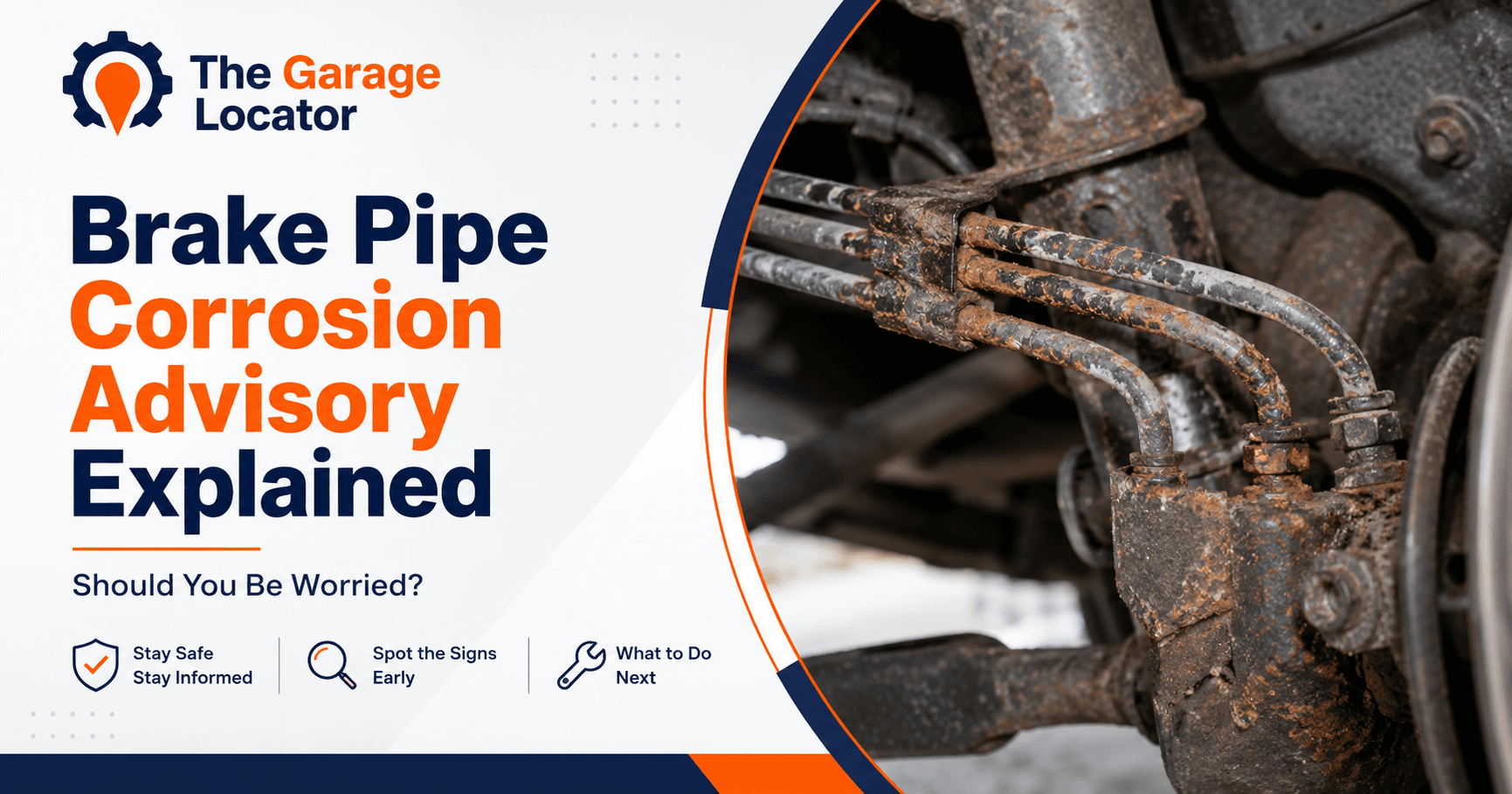
A brake pipe corrosion advisory means an MOT tester found corrosion on one or more brake pipes, but did not consider the condition serious enough to classify as an MOT failure on the day of the test.
The vehicle passed its MOT, but the advisory should not be ignored. Brake pipes are safety-critical components, corrosion normally progresses rather than repairs itself, and a pipe that receives an advisory this year could become a major or dangerous defect later.
At a glance
- Safe to drive?
- Usually, but arrange an inspection soon
- Will it fail the next MOT?
- It may if the corrosion worsens
- Typical repair cost
- £80–£700
- Urgency
- Inspect within the next few weeks
- Used-car risk
- Moderate – check for repeated advisories
In this guide, you will learn:
- What brake pipe corrosion means
- Whether the vehicle is safe to drive
- How an MOT tester assesses corroded brake pipes
- When an advisory becomes an MOT failure
- Typical UK brake pipe replacement costs
- Whether you should buy a used car with this advisory
- What to ask the seller before agreeing to buy
If you are checking a vehicle before buying, use our free MOT History Checker to identify repeated advisories, previous failures, recorded mileages and potential maintenance patterns.
What Is a Brake Pipe?
Brake pipes are rigid metal pipes that carry pressurised brake fluid through the vehicle's hydraulic braking system.
When you press the brake pedal, the master cylinder forces brake fluid through these pipes towards the brakes at each wheel. This hydraulic pressure allows the vehicle to slow down and stop.
Brake pipes are different from flexible brake hoses. Rigid pipes normally run underneath the vehicle, while flexible hoses allow movement between the vehicle body and components such as the wheels, suspension and brake callipers.
Because much of the pipework is located underneath the vehicle, it can be exposed to:
- Rain and standing water
- Road salt
- Mud and dirt
- Moisture trapped around clips
- Stone chips
- Damaged protective coatings
- General age-related deterioration
Over time, this exposure can cause the outer surface of a metal brake pipe to corrode.
Brake pipes and brake hoses are different
What Does a Brake Pipe Corrosion Advisory Mean?
A brake pipe corrosion advisory means the tester found deterioration that was worth bringing to the vehicle owner's attention, but did not judge it to meet the threshold for a major or dangerous MOT defect during that inspection.
In practical terms:
- Corrosion was visible or suspected
- The vehicle still passed its MOT
- The affected area may require monitoring or repair
- The advisory could become more serious in the future
It does not mean the pipe has been repaired, protected or guaranteed to remain safe until the next MOT.
MOT advisories involve an element of tester judgement. Two testers may describe similar corrosion differently, particularly when corrosion is close to the boundary between an advisory and a failure.
If you are unfamiliar with advisory items, read What Are MOT Advisories?.
Is It Safe to Drive With a Brake Pipe Corrosion Advisory?
Is it safe to drive?
A brake pipe corrosion advisory usually means the vehicle is still roadworthy, but the corrosion should be repaired before it becomes severe enough to weaken the brake pipe.
Driving guidance
- Drive only if the brakes feel completely normal.
- Book an inspection as soon as possible.
- Stop driving immediately if braking performance changes.
A vehicle with an advisory has passed the MOT test, so the corrosion was not classified as a major or dangerous defect at the time of inspection.
However, that does not mean it should automatically be driven for another year without being checked.
The MOT confirms that the vehicle met the relevant minimum test requirements on a particular day. It is not a full mechanical inspection and does not predict how quickly corrosion will deteriorate afterwards.
A sensible response is to:
- Ask where the corrosion is located.
- Arrange for a garage to inspect the affected pipe.
- Ask whether the corrosion is superficial or whether replacement is recommended.
- Record the advice and any quotation you receive.
- Check the area again during servicing rather than waiting for the next MOT.
⚠️ Do not continue driving if braking performance changes
Surface Corrosion Versus Serious Brake Pipe Corrosion
Not every rusty-looking pipe requires immediate replacement. The important question is whether the corrosion is superficial or has materially weakened the pipe.
| Condition | Likely meaning | Typical response |
|---|---|---|
| Light surface discolouration | Early external deterioration with no obvious loss of strength | Clean, inspect and monitor |
| Localised corrosion around clips | Moisture or dirt may have collected around a mounting point | Inspect closely and consider preventative repair |
| Heavy scaling or pitting | Metal may have been lost from the pipe wall | Replacement may be recommended |
| Excessive corrosion | The pipe may no longer meet MOT requirements | Major MOT defect |
| Leak or imminent risk of failure | The braking system may be unsafe | Dangerous MOT defect and urgent repair |
A visual inspection by an experienced technician is more useful than relying on the wording of the MOT certificate alone.
What Causes Brake Pipe Corrosion?
Brake pipe corrosion usually develops gradually through a combination of age, moisture, road contamination and damage to the pipe's protective surface.
Diagnosis guide
Common Causes of Brake Pipe Corrosion
Road salt
Trapped moisture and dirt
Damaged protective coating
Vehicle age
Coastal conditions
Limited underbody cleaning
Road salt
Salt used on winter roads accelerates corrosion, particularly when it remains on the underside of the vehicle for long periods.
Trapped moisture and dirt
Brake pipes are commonly secured using clips. Mud, salt and moisture can collect around these points, creating localised corrosion that may be difficult to see without close inspection.
Damaged protective coating
Brake pipes may have a protective outer coating. Stone chips, abrasion or previous repair work can damage this protection and expose the metal underneath.
Vehicle age
Older vehicles have normally experienced more winters, road contamination and general wear. Age alone does not prove that a vehicle is unsafe, but it increases the likelihood of corrosion-related defects.
Coastal conditions
Vehicles used near the coast may be exposed to salty air as well as salted roads, potentially accelerating underbody corrosion.
Limited underbody cleaning
Regularly cleaning winter salt and mud from the underside of a vehicle may help reduce the conditions that encourage corrosion.
How Quickly Does Brake Pipe Corrosion Get Worse?
There is no reliable fixed timeline.
Light surface corrosion may show little visible change for a considerable period. In other cases, corrosion may progress more quickly because of:
- Continued exposure to road salt
- Water trapped around retaining clips
- Damage to the protective coating
- Deep pitting that is difficult to see
- High annual mileage
- Poor storage conditions
- Existing underbody corrosion
An advisory therefore cannot tell you whether the pipe has three months or three years of useful life remaining.
💷 Use servicing to monitor the advisory
Signs a Brake Pipe May Need Urgent Attention
Brake pipe corrosion often produces no symptoms before it becomes serious. That is why inspection is important.
Can Brake Pipe Corrosion Fail an MOT?
Yes.
Under the MOT defect categories, a brake pipe that is damaged or excessively corroded can be recorded as a major defect. A pipe at imminent risk of failure or fracture can be classed as dangerous. A leaking hydraulic brake pipe is also a dangerous defect.
| MOT assessment | Result | What it generally indicates |
|---|---|---|
| Advisory | Pass | Corrosion noted but not considered a major or dangerous defect |
| Major defect | Fail | Brake pipe damaged or excessively corroded |
| Dangerous defect | Fail | Imminent risk of failure, fracture or a hydraulic-fluid leak |
A dangerous defect means the vehicle should not be driven until it has been repaired.
Will the Advisory Fail the Next MOT?
It might, but a future failure is not automatic.
The outcome depends on:
- How advanced the corrosion already is
- Whether it continues to deteriorate
- The location of the affected pipe
- Exposure to salt and moisture
- Whether preventative work is completed
- The condition observed by the next tester
The strongest warning sign is repetition.
One advisory followed by a clean MOT may indicate that the pipe was repaired or replaced. The same advisory recorded over several years suggests that the issue has repeatedly been monitored without a permanent repair.
⚠️ Repeated advisories require closer investigation
Common Brake Pipe MOT Wording Explained
MOT records may use different wording depending on the date of the test, the component affected and how the tester recorded the issue.
You may see descriptions such as:
- Brake pipe corroded
- Brake pipe corroded but not seriously weakened
- Brake pipe covered in grease or other material
- Brake pipe inadequately clipped or supported
- Brake pipe likely to become detached or damaged
- Brake pipe damaged or excessively corroded
- Brake pipe at imminent risk of failure or fracture
These descriptions are not interchangeable.
“Corroded but not seriously weakened” is less severe than “damaged or excessively corroded”. Similarly, a pipe covered in grease or another material may be difficult for the tester to assess properly; it does not necessarily confirm that the pipe underneath is in good condition.
Why Are Brake Pipes Sometimes Covered in Grease?
Some owners or garages apply grease or corrosion protection to metal brake pipes in an attempt to reduce exposure to moisture and salt.
Applied correctly to a sound pipe, an appropriate protective treatment may help slow future corrosion. However, covering an already-corroded pipe does not restore metal that has been lost.
A coating can also make the pipe more difficult to assess during an MOT.
Protection is not the same as repair
Typical Brake Pipe Repair Costs in the UK
The cost depends mainly on how much pipe needs replacing and how difficult it is to access.
Estimated brake pipe repair cost
£80–£700
A small accessible repair may cost less, while replacing several long or difficult-to-access pipes can exceed this range. Always obtain a vehicle-specific quotation.
Repair time
How long does brake pipe replacement take?
- Initial inspection
- 20–30 minutes
- Simple pipe replacement
- 1–2 hours
- Multiple or difficult pipes
- 3–6 hours
- Typical turnaround
- Same day (most cases)
Most straightforward brake pipe repairs can usually be completed the same day, although heavily corroded fittings or pipes routed above fuel tanks and subframes can increase labour time.
Typical estimates are:
| Repair | Estimated UK cost |
|---|---|
| Inspection or corrosion assessment | £30–£80 |
| Small accessible pipe section | £80–£150 |
| One brake pipe | £150–£350 |
| Several brake pipes | £300–£700 |
| Extensive or difficult pipework | £700 or more |
These figures are broad estimates rather than fixed prices.
The final cost can be affected by:
- The vehicle's make and model
- The number of pipes being replaced
- Pipe length and routing
- Access beneath the vehicle
- Whether components must be removed
- Corroded unions or fittings
- Brake-fluid replacement and bleeding
- Additional hose, calliper or cylinder problems
- Regional labour rates
Brake pipe material is not normally the main expense. Labour can become significant when pipes run above fuel tanks, subframes or other components.
For a wider cost breakdown, read Brake Repair Costs in the UK.
Can a Corroded Brake Pipe Be Repaired?
An affected section can sometimes be replaced without renewing every brake pipe on the vehicle.
A garage may:
- Replace a damaged section
- Replace one complete pipe
- Manufacture a replacement pipe to fit the vehicle
- Replace several pipes where corrosion is widespread
- Clean and protect a pipe where deterioration is superficial
The correct repair depends on the pipe's condition and location.
Ask the garage whether the quotation covers:
- The full affected pipe or only a section
- New unions and fittings
- Brake fluid
- Bleeding the hydraulic system
- VAT
- Any additional work discovered during removal
Should You Buy a Used Car With a Brake Pipe Corrosion Advisory?
A single brake pipe corrosion advisory is not automatically a reason to reject a used car.
It does, however, create a potential repair cost that should be investigated before purchase.
Reasons the vehicle may still be worth buying
- The advisory appeared only once
- A receipt confirms that the pipe was replaced
- A garage has inspected it and found only light surface corrosion
- The rest of the MOT history is clean
- The asking price reflects the expected repair
- There are no wider signs of underbody corrosion
Reasons to be cautious
- The same advisory appears repeatedly
- The wording has become more severe
- Several brake pipes are affected
- The vehicle has other corrosion advisories
- The seller cannot explain whether repairs were completed
- The seller refuses an independent inspection
- There is visible leakage or poor braking performance
Reasons to walk away
- The pipe is leaking
- A garage describes it as unsafe
- The current MOT contains a dangerous brake defect
- The vehicle has widespread structural and braking-system corrosion
- The seller attempts to conceal or minimise an obvious safety problem
How Much Should You Negotiate Off the Price?
Do not automatically deduct the highest possible repair figure. First establish what work is actually required.
A practical process is:
- Ask for evidence that the pipe was repaired.
- If there is no evidence, obtain an inspection or written quotation.
- Add a contingency for seized fittings or related corrosion.
- Negotiate using the likely repair cost rather than a guess.
- Be prepared to leave if the seller refuses reasonable checks.
For example, if a garage estimates the repair at £250–£350, asking for an adjustment within or slightly above that range may be reasonable. The correct figure depends on the vehicle's value, condition and the certainty of the quotation.
💷 Negotiate from evidence, not MOT wording alone
Questions to Ask the Seller
A vague claim that the advisory is "nothing to worry about" is not evidence that the pipe is safe.
How to Check Whether the Problem Is Repeated
Review the vehicle's complete MOT history in date order.
Look for:
- The same brake pipe advisory on consecutive tests
- Similar corrosion wording on different parts of the vehicle
- A later major brake-pipe failure
- Advisories disappearing immediately after a repair invoice
- Long gaps between MOT tests
- Patterns of repeated maintenance being delayed
- Previous failures followed by a same-day pass
A single advisory provides limited information. A sequence of records can reveal whether the owner repaired problems promptly or repeatedly postponed them.
Use our free MOT History Checker to review the vehicle's previous tests, advisories, failures, mileages and Buyer Score before making a purchase decision.
Brake Pipe Corrosion Compared With Other Corrosion Advisories
| Advisory | Main concern | Typical seriousness |
|---|---|---|
| Brake pipe corrosion | Potential loss of hydraulic braking pressure | Safety-critical |
| Brake disc corrosion | Reduced braking surface or performance | Can range from minor to serious |
| Suspension component corrosion | Weakening of a load-bearing or moving component | Depends on severity and component |
| Subframe corrosion | Possible loss of structural strength | Potentially expensive and serious |
| Exhaust corrosion | Leaks, noise or eventual component failure | Usually less safety-critical than brake corrosion |
| Body corrosion | Cosmetic or structural deterioration | Depends heavily on location |
Brake pipe corrosion deserves particular attention because the affected component is part of the hydraulic braking system.
Brake discs can also develop corrosion, but the MOT implications and repair decisions are different. Read our Brake Disc Corrosion: MOT Failure, Repair Costs & When to Replace guide if corrosion has been recorded on the discs rather than the brake pipes.
How to Reduce Future Brake Pipe Corrosion
You cannot guarantee that corrosion will never occur, but sensible maintenance may help slow it down.
Consider:
- Washing winter salt from the underside of the vehicle
- Having pipes inspected during servicing
- Replacing damaged clips
- Repairing damaged protective coatings
- Keeping undertrays and drainage areas clear
- Addressing small areas before corrosion becomes extensive
- Using appropriate corrosion protection on sound, correctly prepared pipes
Avoid applying thick grease or coatings simply to hide corrosion before an MOT. Protection should be used as preventative maintenance, not to disguise a deteriorated pipe.
Why a Full MOT History Check Matters
The latest MOT certificate shows what the tester recorded during one inspection. It does not tell you how the vehicle has been maintained throughout its life.
The full history can reveal:
- Repeated brake pipe advisories
- Previous braking-system failures
- Recurring corrosion
- Mileage inconsistencies
- Repairs that appear to have been delayed
- A pattern of clean passes after earlier problems
- Evidence of broader neglect
A vehicle with one isolated advisory may be a reasonable purchase. A vehicle with the same safety-related defect recorded year after year presents a different level of risk.
Read What Makes a Good MOT History When Buying a Used Car? and 10 MOT History Red Flags That Should Make You Walk Away From a Used Car before agreeing to buy.
Frequently Asked Questions
Can I drive with a brake pipe corrosion advisory?
Usually, because the vehicle passed its MOT and the pipe was not classified as a major or dangerous defect during the test. However, arrange an inspection and do not ignore changes in pedal feel, fluid leaks or reduced braking performance.
Does an advisory mean the brake pipe is safe for another year?
No. It only records the tester's assessment during that MOT. The pipe may deteriorate before the next test, particularly if corrosion is already established.
Does brake pipe corrosion always require replacement?
No. Light surface corrosion may only require cleaning, protection and monitoring. A pipe that is heavily pitted, excessively corroded, leaking or structurally weakened will normally require replacement.
Will brake pipe corrosion fail the next MOT?
Possibly. It may remain an advisory, disappear after repair or become a major or dangerous defect. The result depends on how the condition changes and what the next tester finds.
Can I remove brake pipe corrosion myself?
Cleaning accessible surface corrosion may appear straightforward, but assessing pipe-wall strength and carrying out hydraulic brake repairs requires appropriate competence. Do not scrape, bend or disturb a safety-critical pipe unless you know exactly what you are doing.
Can grease stop brake pipe corrosion?
An appropriate protective coating may help slow corrosion on a sound, properly prepared pipe. It cannot restore a pipe that has already lost significant material or become structurally weakened.
Is a repeated brake pipe advisory a bad sign?
It is a reason to investigate. Repetition may indicate that the pipe has been monitored without being permanently repaired. Ask for invoices or arrange an independent inspection.
Is brake pipe replacement expensive?
A straightforward repair may cost around £80–£150, while replacing one or more difficult-to-access pipes can cost several hundred pounds. Vehicle-specific quotations are essential.
Should I reject a used car because of this advisory?
Not automatically. Consider the inspection findings, repair evidence, asking price and wider MOT history. Walk away where there is leakage, dangerous corrosion, widespread neglect or resistance to an independent inspection.
Final Verdict
A brake pipe corrosion advisory means the vehicle passed its MOT, but deterioration was found on a safety-critical part of the braking system.
It is not necessarily an emergency and does not automatically make a used car a bad purchase. However, it should be inspected rather than ignored.
The most important factors are:
- Whether the corrosion is superficial or structurally significant
- Whether the advisory has appeared repeatedly
- Whether repair evidence is available
- Whether other corrosion defects are present
- Whether the purchase price reflects the likely cost
- Whether an independent garage considers the vehicle safe
A one-off advisory with evidence of proper repair is usually far less concerning than the same issue appearing year after year.
Check the Vehicle's Complete MOT History
Before buying a used vehicle, use The Garage Locator's free MOT History Checker.
You can review:
- Previous MOT passes and failures
- Current and historic advisories
- Recorded mileages
- Repeated defects
- Potential maintenance patterns
- The vehicle's Buyer Score
The check takes only a few seconds and can help you identify expensive or safety-critical problems before handing over your money.