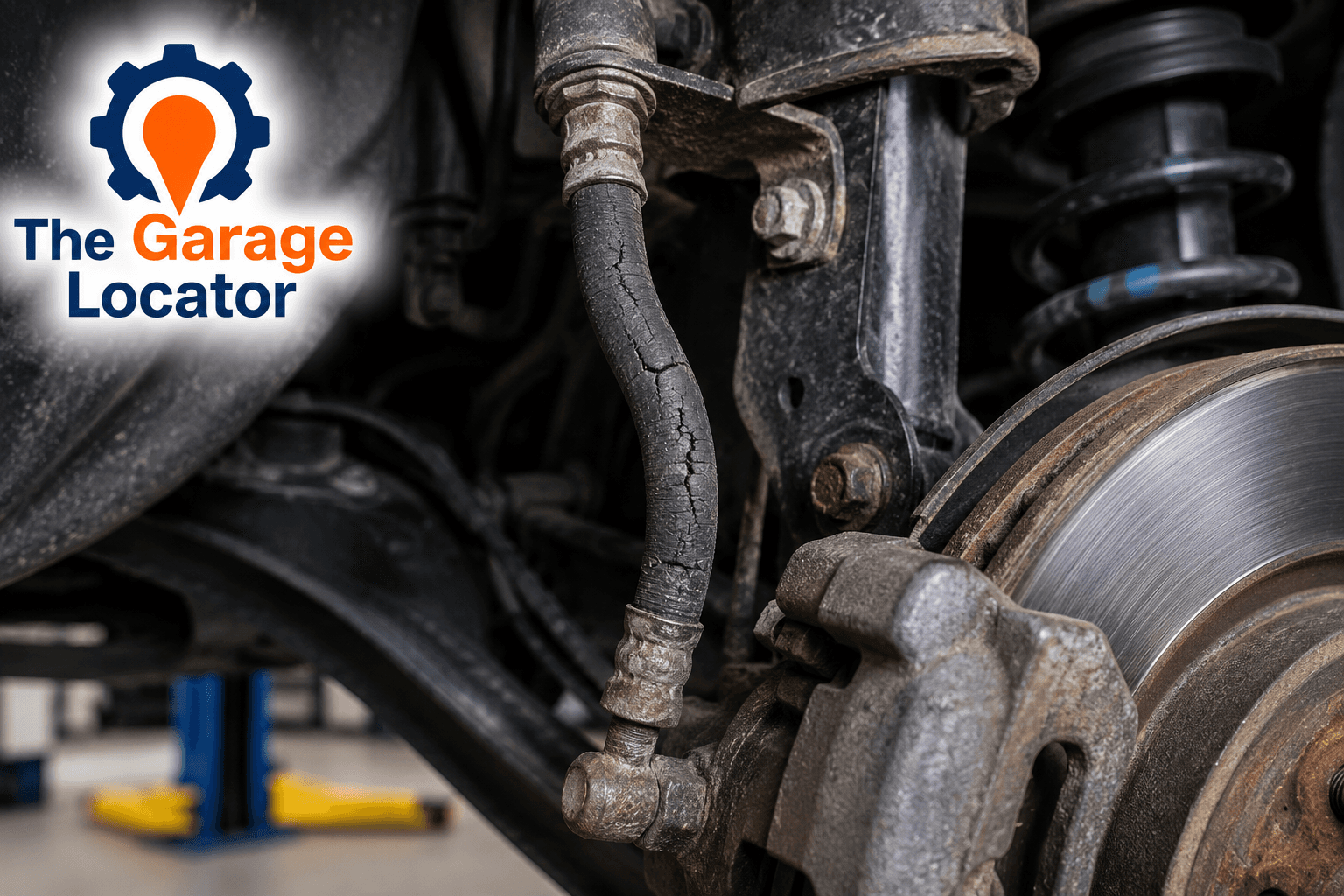
A brake hose deteriorated MOT advisory means the tester has found signs of ageing, wear or damage on one of the vehicle's flexible brake hoses, but the condition has not reached the failure threshold recorded at that test.
It should not be ignored.
Brake hoses carry pressurised brake fluid between rigid brake pipes and moving components around the wheels. If deterioration becomes excessive, the hose can fail an MOT. More serious damage or hydraulic fluid leakage can also compromise braking performance.
This guide explains what a deteriorated brake hose advisory means, when it can become an MOT failure, whether the vehicle is safe to drive, symptoms to watch for and typical UK replacement costs.
In this guide
- What a brake hose deterioration advisory means
- What brake hoses do
- Brake hose vs brake pipe
- Whether a deteriorated brake hose will fail an MOT
- Common MOT wording
- Whether it's safe to drive
- Symptoms of a deteriorating brake hose
- Common causes
- How garages inspect brake hoses
- Typical UK replacement costs
- Repair times
- Whether hoses should be replaced in pairs
- Used-car buying advice
- Frequently asked questions
What does a brake hose deteriorated advisory mean?
A brake hose deterioration advisory normally means the MOT tester has noticed ageing or damage to a flexible brake hose, but has not considered it excessive enough to record a failure at that inspection.
Published MOT histories can contain wording such as:
- Flexible brake hose deteriorated
- Front flexible brake hose deteriorated
- Rear flexible brake hose deteriorated
- Nearside Front Flexible brake hose deteriorated
- Offside Rear Flexible brake hose showing signs of deterioration
- Brake hose beginning to perish
- Flexible brake hose slightly cracked
The exact wording can vary.
The important distinction is between minor deterioration and a hose that has become excessively damaged, deteriorated, insecure, twisted, stretched, chafing or leaking.
If you're trying to understand an advisory from a previous test, use our Free MOT History Checker to review the vehicle's complete MOT record.
What does a brake hose do?
A brake hose is a flexible part of the hydraulic braking system.
Rigid metal brake pipes carry brake fluid around much of the vehicle, but they cannot simply run rigidly to components that move with the steering and suspension.
Flexible brake hoses bridge that gap.
They are designed to:
- Carry pressurised brake fluid
- Allow steering movement
- Allow suspension movement
- Maintain hydraulic braking pressure
- Flex repeatedly without leaking
- Withstand demanding conditions around the wheel and suspension
When you press the brake pedal, hydraulic pressure is transmitted through the braking system.
That is why the condition of the hoses matters even when deterioration initially produces no noticeable driving symptoms.
What's the difference between a brake hose and a brake pipe?
Brake hoses and brake pipes are parts of the same hydraulic system, but they are not the same component.
| Component | Main characteristic |
|---|---|
| Brake pipe | Rigid metal hydraulic line |
| Brake hose | Flexible hydraulic connection |
| Brake pipe purpose | Carries brake fluid through fixed areas of the vehicle |
| Brake hose purpose | Carries brake fluid while allowing steering and suspension movement |
Brake pipes are particularly vulnerable to corrosion.
Flexible hoses can instead deteriorate through ageing, cracking, chafing, movement and environmental exposure.
A vehicle can have problems with either component — or both at the same time.
If your MOT mentions corrosion of the rigid lines, read our Brake Pipe Corrosion Advisory guide.
Will a deteriorated brake hose fail an MOT?
It can.
A hose showing relatively minor ageing or surface deterioration may pass with an advisory.
Once deterioration becomes excessive, the outcome changes.
The MOT inspection criteria cover problems including a flexible brake hose that is:
- Excessively damaged
- Excessively deteriorated
- Insecure
- Excessively twisted
- Excessively stretched
- Chafing
- Leaking hydraulic fluid
A hose that has become excessively damaged or deteriorated can result in a Major defect.
Fluid leakage is more serious and needs urgent attention, with the precise MOT classification depending on the defect and its severity.
| Condition | Possible MOT outcome |
|---|---|
| Minor ageing or surface deterioration | May pass or receive an advisory |
| Slight cracking without excessive deterioration | May receive an advisory |
| Excessively deteriorated hose | Major defect |
| Excessively damaged or insecure hose | Major defect |
| Excessive twisting, stretching or chafing | Major defect |
| Hydraulic fluid leakage | MOT failure; severity matters |
An advisory therefore doesn't mean the hose has already failed.
It means there is a condition worth monitoring or repairing before it progresses to the rejection threshold.
For more information about MOT classifications, read MOT Advisory Codes Explained: What Every MOT Warning Means.
Is a deteriorated brake hose dangerous?
Minor surface deterioration is not the same as an immediately dangerous brake-system failure.
However, brake hoses are safety-critical components.
They need to withstand hydraulic pressure every time the brakes are applied.
As deterioration progresses, potential problems can include:
- Deeper cracking
- Chafing
- Weakening of the hose
- Hydraulic fluid leakage
- Loss of braking pressure
- Reduced braking performance
The condition therefore deserves more attention than a purely cosmetic advisory.
A hose with minor deterioration may provide time to arrange replacement, but evidence of leaking brake fluid or a change in braking performance requires urgent professional assessment.
Can you drive with a deteriorated brake hose?
A vehicle that has passed its MOT with a minor brake-hose deterioration advisory may still be driveable, but the advisory should not be treated as proof that the hose will remain safe indefinitely.
Arrange inspection or replacement sooner if:
- Cracking is becoming more obvious
- The advisory has appeared repeatedly
- The hose is rubbing against another component
- Fluid appears around the hose or fitting
- Brake fluid level is dropping
- The brake pedal feels different
- Braking performance changes
- A brake warning light appears
If there is evidence of hydraulic fluid leakage or significant loss of braking performance, do not continue normal driving.
Have the vehicle professionally assessed.
An MOT only records the condition found at the time of the test.
What are the symptoms of a deteriorated brake hose?
One of the difficulties with brake-hose deterioration is that there may be no obvious symptoms at first.
Possible signs as the problem becomes more serious include:
- Visible cracks in the hose
- Perished or damaged outer rubber
- Chafing marks
- Brake fluid around the hose
- Falling brake fluid level
- Soft or unusual brake-pedal feel
- Reduced braking performance
- Increased stopping distance
- Brake warning lights
Some of these symptoms can have other causes.
A soft brake pedal or fluid loss, for example, does not prove that a flexible hose is responsible.
The complete braking system should be inspected.
Why do brake hoses deteriorate?
Brake hoses work in a demanding environment.
Common contributing factors include:
- Age
- Repeated flexing
- Heat
- Road salt
- Water and road contamination
- Stone damage
- High mileage
- Chafing
- Incorrect routing
- Corrosion around fittings
- Suspension movement
Older original hoses can develop surface cracking as the material ages.
Road salt and corrosion around the fittings can also make eventual replacement more difficult.
Can road salt damage brake hoses?
Road salt can contribute to deterioration around the braking system.
The flexible hose itself is designed to tolerate harsh conditions, but the complete assembly includes fittings, clips and connections that are continually exposed underneath the vehicle.
Salt and moisture can accelerate corrosion around these areas.
This is particularly relevant on vehicles driven year-round on UK roads.
The same conditions can affect rigid brake pipes, which is why hose deterioration and brake pipe corrosion are worth considering together.
Can a brake hose deteriorate without leaking?
Yes.
This is an important distinction.
A deteriorated hose does not automatically mean brake fluid is already escaping.
The outer surface may show:
- Ageing
- Minor cracking
- Perishing
- Chafing
- Other deterioration
before a hydraulic leak develops.
That is precisely why an MOT advisory can be useful: it can identify deterioration before it progresses into a more serious braking defect.
How urgent is a brake hose advisory?
Urgency depends on the condition actually found.
| Situation | Recommended response |
|---|---|
| Minor surface deterioration | Arrange inspection and monitor |
| Repeated deterioration advisory | Consider replacement before it worsens |
| Visible cracking becoming significant | Arrange replacement promptly |
| Hose rubbing or chafing | Have it inspected promptly |
| Fluid visible around hose | Urgent inspection |
| Soft pedal or changed braking performance | Urgent professional assessment |
| Significant hydraulic fluid leak | Do not continue normal driving |
A repeated advisory deserves particular attention because it can show that deterioration has persisted across multiple MOT tests.
Our How Many MOT Advisories Are Too Many? guide explains why patterns across the MOT history can be more useful than simply counting individual warnings.
How does a garage inspect a deteriorated brake hose?
A garage should inspect the flexible hose itself as well as its fittings, routing and surrounding braking components.
Checks can include:
- Looking for cracking or perishing
- Checking for chafing
- Looking for bulges or other physical damage
- Checking whether the hose is twisted or stretched
- Inspecting the hose routing
- Checking retaining clips and mounting points
- Looking for brake fluid leakage
- Inspecting connections and unions
- Checking nearby rigid brake pipes
- Checking the brake fluid level
- Comparing hoses on the opposite side
- Inspecting related brake components
The hose should be able to move correctly as the suspension and steering operate without rubbing, stretching or becoming trapped.
If one hose has deteriorated because of age, it is sensible to inspect the remaining flexible hoses at the same time.
How is a deteriorated brake hose repaired?
A deteriorated flexible brake hose is normally replaced.
The exact procedure depends on the vehicle, but a typical repair involves:
- Raising and safely supporting the vehicle
- Removing the wheel where necessary
- Identifying the affected brake hose
- Disconnecting the hose from the rigid brake pipe and brake component
- Removing retaining clips or brackets
- Installing the replacement hose
- Ensuring the hose is correctly routed and not twisted
- Reconnecting the hydraulic system
- Bleeding air from the braking system
- Checking carefully for leaks
- Confirming correct brake operation
Correct routing is particularly important.
A replacement hose must have enough movement for steering and suspension travel without rubbing against the tyre, suspension or other components.
Does the brake system need bleeding after replacing a hose?
Normally, yes.
Opening a hydraulic brake line can allow air into the braking system.
Air compresses much more easily than brake fluid, which can result in a soft or ineffective brake pedal.
The affected braking circuit therefore needs to be properly bled after hose replacement.
The garage should then confirm:
- Correct brake-pedal feel
- No hydraulic leaks
- Correct brake-fluid level
- Normal braking operation
Depending on the vehicle and condition of the fluid, the garage may also recommend a more comprehensive brake-fluid change.
How much does brake hose replacement cost in the UK?
Typical UK costs are approximately:
| Repair | Typical cost |
|---|---|
| One brake hose | £90–£160 |
| Pair of brake hoses | £170–£280 |
| Brake fluid bleed | £40–£70 |
For a straightforward single-hose repair, approximately £90–£180 is a reasonable article-level starting range.
These figures are indicative rather than quotations.
Actual cost depends on factors including:
- Vehicle make and model
- Front or rear hose
- Labour rates
- Parts quality
- Accessibility
- Corrosion around connections
- Seized brake-pipe unions
- Whether additional hoses require replacement
- Whether brake fluid is replaced
Older vehicles with heavily corroded fittings can take longer because separating the flexible hose from the rigid brake pipe may be more difficult.
How long does brake hose replacement take?
Replacing one flexible brake hose commonly takes around 45–90 minutes in straightforward circumstances.
Replacing a pair may take approximately 1–2 hours.
Additional labour can be required when:
- Brake-pipe unions are seized
- Fittings are heavily corroded
- Retaining clips are damaged
- Access is difficult
- Related brake pipes require repair
- Additional bleeding is necessary
The garage should also allow time to check for leaks and confirm correct brake operation after the hydraulic system has been reassembled.
Do brake hoses need replacing in pairs?
Not necessarily.
Unlike brake pads or discs, there is no simple rule that every brake-hose replacement must automatically be performed in axle pairs.
However, if one original hose has deteriorated because of age, the hose on the opposite side may have experienced similar:
- Mileage
- Age
- Heat
- Road conditions
- Suspension movement
- Environmental exposure
It is therefore sensible to inspect the opposite hose carefully.
If several hoses show similar cracking or deterioration, replacing more than one at the same time may be appropriate.
The decision should be based on their actual condition rather than automatically replacing parts that remain serviceable.
What else should be checked when replacing a brake hose?
A brake-hose advisory is a good reason to inspect the wider braking system.
A garage may also check:
- Rigid brake pipes
- Brake calipers
- Brake pads
- Brake discs
- Brake fluid
- Hose retaining clips
- Hydraulic connections
- Nearby suspension components
This does not mean all these parts need replacing.
The purpose is to identify related deterioration, leaks or wear while the braking system is already being inspected.
If your MOT also mentions worn friction material, see our Brake Pads Wearing Thin guide.
For damaged or deteriorated discs, read Brake Disc Worn, Pitted or Scored.
Can a deteriorated brake hose affect braking performance?
Minor surface deterioration may produce no noticeable difference in braking.
That changes if the condition progresses.
A badly damaged hose or hydraulic leak can interfere with the brake system's ability to transmit pressure correctly.
Possible warning signs include:
- Soft brake pedal
- Falling brake-fluid level
- Reduced braking performance
- Increased stopping distance
- Brake warning lights
- Fluid around the affected hose
Any significant change in braking performance requires urgent investigation.
Do not wait for the next MOT to diagnose a braking problem.
What happens if you ignore a deteriorated brake hose?
A deterioration advisory may remain relatively minor for some time, but the condition can progress.
Possible consequences include:
- Increasing cracking
- Chafing
- MOT failure
- Hydraulic fluid leakage
- Reduced braking performance
- Increased stopping distance
- Loss of braking pressure
- More expensive repairs if connected components are damaged
A possible MOT-history progression is:
Minor deterioration → repeated advisory → excessive deterioration → hydraulic leak → MOT failure
There is no reliable timetable for that progression.
This is why a repeated advisory is useful evidence that the condition deserves further attention.
Is a repeated brake hose advisory a bad sign?
It deserves investigation.
One deterioration advisory on an older vehicle does not automatically indicate serious neglect.
However, the same hose warning appearing on several consecutive MOT tests can suggest that the underlying deterioration has remained unresolved.
Look at:
- How many times the advisory appears
- Whether the wording becomes more severe
- Whether more than one hose becomes affected
- Whether brake-pipe corrosion also appears
- Whether any hydraulic leaks are subsequently recorded
- Whether repair invoices show that the hoses were replaced
Repeated braking advisories are more concerning when several different components are involved.
For example:
Brake hose deterioration + brake pipe corrosion + worn pads + deteriorated discs
suggests a broader brake-system inspection would be sensible.
Our Brake Caliper Binding guide covers another brake fault that can appear alongside abnormal brake wear.
Should you buy a used car with a brake hose advisory?
A brake-hose deterioration advisory should not automatically stop you buying a used car.
Flexible hoses are replaceable components, and the repair is usually relatively modest compared with many major vehicle faults.
However, you should establish whether the advisory is an isolated ageing component or part of wider brake-system deterioration.
Before buying, check:
- Which hose is affected
- Whether more than one hose is deteriorated
- Whether the advisory has appeared repeatedly
- Whether brake pipes are corroded
- Whether there are brake-fluid leaks
- Whether pads or discs also have advisories
- Whether repair invoices are available
- Whether the brake pedal feels normal
- Whether any brake warning lights are displayed
A single deterioration advisory on an otherwise well-maintained vehicle is very different from several unresolved braking defects appearing across multiple MOTs.
Use our Free MOT History Checker to examine the complete sequence rather than relying only on the latest MOT.
Can a brake hose advisory be used to negotiate the price?
Yes, if the repair remains outstanding.
Brake-hose replacement represents a foreseeable cost that can reasonably be considered when assessing a used vehicle.
Before negotiating, ideally obtain a quotation and establish:
- Whether one or several hoses need replacing
- Whether the rigid brake pipes are also corroded
- Whether brake fluid replacement is included
- Whether seized unions could increase labour
- Whether any other braking repairs are required
A simple single-hose replacement may be relatively inexpensive.
The cost can increase if corrosion has affected the connected brake pipes or several parts of the braking system require attention.
For a broader approach to assessing these warnings before purchase, see Buying a Used Car With MOT Advisories.
Brake hose deterioration vs brake pipe corrosion
These two MOT warnings are related but refer to different components.
| Brake hose deterioration | Brake pipe corrosion |
|---|---|
| Affects flexible hydraulic hoses | Affects rigid metal hydraulic pipes |
| Often involves ageing, cracking or chafing | Primarily involves corrosion of metal |
| Hose flexes with steering and suspension | Pipe is normally fixed to the vehicle |
| Severe deterioration can cause MOT failure | Serious corrosion can cause MOT failure |
| Replacement usually involves a flexible hose | Repair may involve replacing or manufacturing sections of rigid pipe |
Both components carry brake fluid and are therefore safety-critical.
If both appear in the same MOT history, the wider hydraulic braking system deserves careful inspection.
Quick decision guide
| Situation | Recommended action |
|---|---|
| Minor surface deterioration with no symptoms | Arrange inspection and monitor |
| First brake-hose advisory | Have the hose checked and plan for replacement if necessary |
| Same advisory appearing repeatedly | Consider replacement before deterioration progresses |
| Visible cracking or significant perishing | Arrange replacement promptly |
| Hose rubbing, stretched or twisted | Have it inspected promptly |
| Brake fluid visible around the hose | Urgent professional inspection |
| Soft pedal or reduced braking performance | Stop using the vehicle normally and have it assessed |
| Significant hydraulic fluid leak | Do not continue normal driving |
| Buying a car with one minor hose advisory | Check condition and obtain a repair estimate |
| Several brake-system advisories together | Arrange a comprehensive brake inspection |
Frequently Asked Questions
What does a brake hose deteriorated advisory mean?
It means the MOT tester found signs of deterioration on one of the vehicle's flexible brake hoses, but the condition was not recorded as severe enough to fail the MOT at that inspection.
The hose should still be monitored and repaired before deterioration becomes excessive.
Is a deteriorated brake hose dangerous?
Minor surface deterioration is not necessarily an immediate danger.
However, brake hoses carry pressurised hydraulic fluid and are safety-critical components.
If deterioration becomes severe, the hose can leak or otherwise compromise the braking system.
Can you drive with a deteriorated brake hose?
A vehicle that has passed with a minor deterioration advisory may normally allow time to arrange an inspection or repair.
Do not continue normal driving if there is brake-fluid leakage, a soft or abnormal brake pedal, significantly reduced braking performance or another indication that the hydraulic system may be compromised.
Will a brake hose advisory fail the next MOT?
Not automatically.
If the condition remains minor, it may still not meet the MOT failure threshold.
However, deterioration can progress.
A flexible brake hose that becomes excessively damaged or deteriorated can result in a Major defect, so a repeated advisory should not simply be ignored until the next test.
How much does brake hose replacement cost?
Typical UK costs are approximately £90–£160 for one brake hose and £170–£280 for a pair.
A brake-fluid bleed may cost approximately £40–£70 where charged separately.
Actual prices depend on the vehicle, labour rate, accessibility and the condition of the connected brake pipes and fittings.
How long does it take to replace a brake hose?
A straightforward single-hose replacement commonly takes around 45–90 minutes.
Replacing a pair may take approximately 1–2 hours.
Seized unions, corrosion or additional brake-system repairs can increase labour time.
What causes brake hoses to deteriorate?
Common contributing factors include:
- Age
- Heat
- Repeated flexing
- Road salt
- Water and road contamination
- Stone damage
- High mileage
- Chafing
- Incorrect routing
- Corrosion around fittings
The flexible material naturally ages over time, which is why deterioration is more common on older vehicles.
Do brake hoses need replacing in pairs?
Not automatically.
However, if one hose has deteriorated because of age, the corresponding hose on the opposite side may have experienced similar conditions.
The remaining hoses should therefore be inspected carefully.
Replace additional hoses when their condition justifies it rather than assuming every hose must always be replaced as a pair.
Is brake fluid changed when a brake hose is replaced?
The hydraulic system normally needs to be bled after a brake hose is disconnected and replaced.
Whether a complete brake-fluid change is performed at the same time depends on the age and condition of the fluid and the garage's recommendation.
Can a deteriorated brake hose leak?
Yes.
Deterioration does not automatically mean the hose is already leaking, but worsening damage can eventually result in hydraulic fluid escaping.
Visible fluid around a brake hose or fitting requires urgent investigation.
What does a leaking brake hose look like?
Possible signs include wetness around the hose or fittings, visible brake fluid and a falling brake-fluid level.
However, identifying the source of a hydraulic leak can require professional inspection.
Do not assume that every wet component around a wheel is brake fluid.
Can a brake hose cause a soft brake pedal?
A hydraulic leak can contribute to abnormal or soft brake-pedal behaviour.
However, a soft pedal can have several causes.
Because it can indicate a braking-system problem, a noticeable change in pedal feel should be professionally investigated rather than diagnosed from the MOT history alone.
Can a damaged brake hose affect only one wheel?
Brake hoses connect hydraulic lines to individual braking components, so a fault can initially be associated with one particular wheel or part of the braking system.
The complete hydraulic system should still be inspected because other hoses and components may have similar age-related deterioration.
Should I buy a car with a brake hose advisory?
A single brake-hose deterioration advisory should not automatically prevent you from buying a vehicle.
Check whether it has appeared repeatedly, whether other brake defects are recorded and whether there is evidence that repairs have already been completed.
Obtain a repair estimate if the work remains outstanding.
What is the difference between a brake hose and a brake pipe?
A brake pipe is normally a rigid metal hydraulic line.
A brake hose is flexible so that it can move with the steering and suspension.
Both carry brake fluid, but they suffer from different types of deterioration.
For rigid-line corrosion, see our Brake Pipe Corrosion Advisory guide.
Can a brake hose advisory disappear from the next MOT?
The same advisory may not appear on a later test if the hose has been replaced or the condition is not recorded again.
However, the original advisory remains part of that historical MOT result.
A later test without the advisory does not prove by itself that replacement took place.
Repair invoices provide stronger evidence.
How can I check previous brake hose advisories?
Review the vehicle's complete MOT history.
Our Free MOT History Checker lets you examine previous MOT advisories, failures and mileage records.
Pay particular attention to repeated brake-hose warnings and related defects involving brake pipes, pads, discs and calipers.
Final thoughts
A brake hose deteriorated MOT advisory means deterioration has been identified in a flexible part of the hydraulic braking system, but it was not recorded as severe enough to fail the vehicle at that test.
That makes the advisory an early warning rather than something to ignore.
Minor deterioration does not mean the hose is already leaking, but excessive damage or deterioration can become an MOT failure, and hydraulic fluid leakage requires urgent attention.
For a straightforward replacement, typical UK costs are approximately £90–£160 for one hose, although corrosion, seized fittings, additional hoses or brake-fluid work can increase the final bill.
If you're buying a used vehicle, look at the pattern across its MOT history. One ageing hose is considerably less concerning than repeated brake warnings involving hoses, pipes, pads, discs and other hydraulic components.
Use our Free MOT History Checker to review the complete history before making a decision.
For help understanding other MOT warnings, read MOT Advisory Codes Explained: What Every MOT Warning Means.