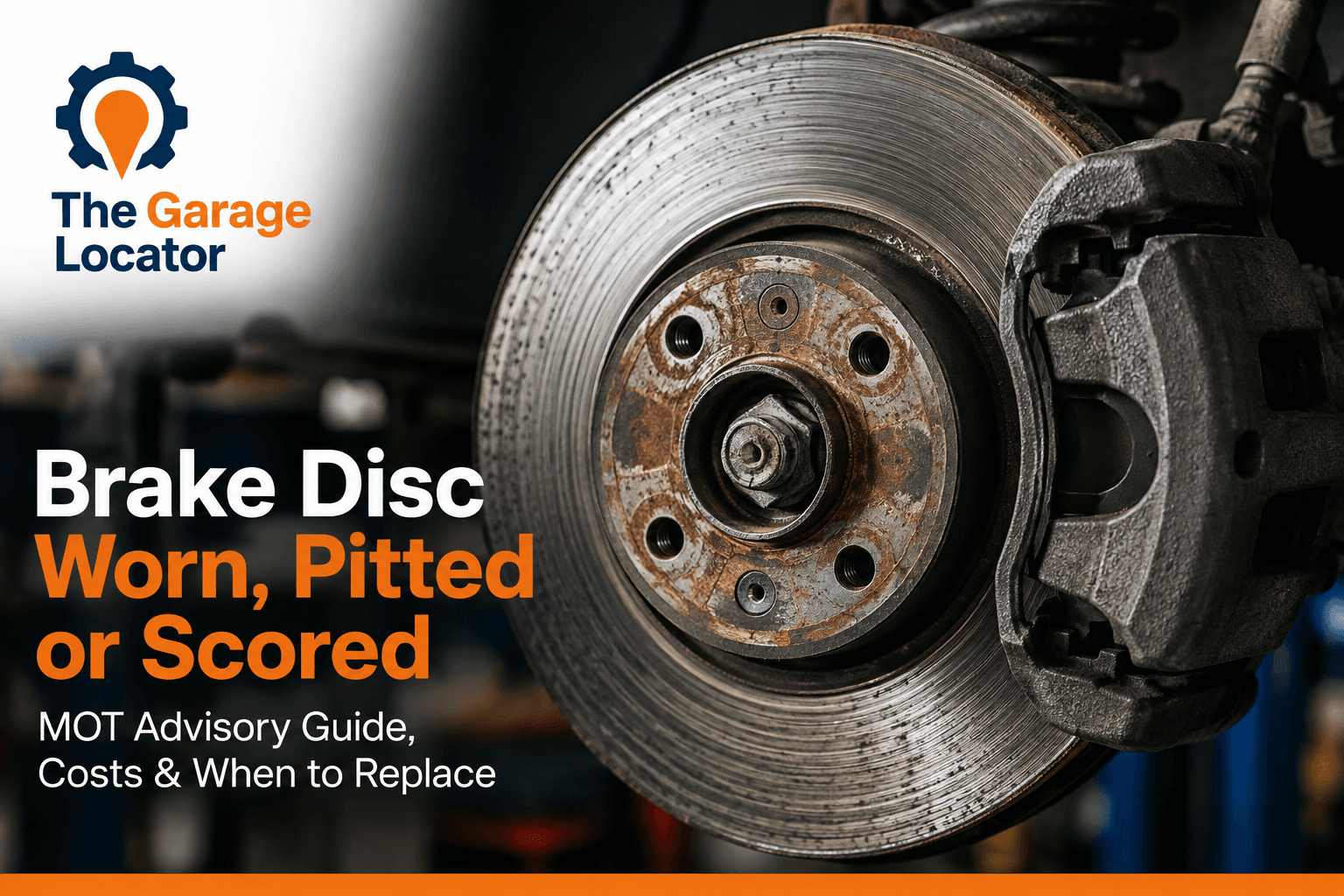
Seeing "brake disc worn, pitted or scored" on an MOT history can sound serious, particularly if you're buying a used car and don't know how badly the brakes have deteriorated.
If the issue has been recorded as an advisory, the vehicle passed its MOT, but the tester noticed deterioration in one or more brake discs that may need monitoring or repair.
The important question is how far that deterioration has progressed.
A brake disc can develop surface corrosion, pitting, scoring and general wear without automatically failing an MOT. However, significantly worn brake discs can become a Major defect, while a disc that is insecure, fractured or otherwise likely to fail can be classed as Dangerous.
Quick facts
- MOT result
- Usually passes when recorded as an advisory
- Safe to drive
- Often yes if braking remains normal, but arrange an inspection
- Repair urgency
- Depends on the amount of wear, pitting or scoring
- Typical repair
- Brake discs and pads are often replaced together on the affected axle
- Future MOT risk
- Can become a Major or Dangerous defect if deterioration becomes severe
What Does "Brake Disc Worn, Pitted or Scored" Mean?
Brake discs are the circular metal components behind your wheels that the brake pads clamp against when you press the brake pedal.
Every time the brakes are applied, friction between the pads and discs slows the vehicle. That friction gradually wears both components.
An MOT advisory describing a brake disc as worn, pitted or scored means the tester has noticed deterioration but has not considered it severe enough to meet the MOT failure criteria at the time of the test.
This can include:
- general disc wear
- grooves or scoring on the braking surface
- corrosion or pitting
- an uneven braking surface
- a noticeable lip around the edge of the disc
An advisory should therefore be treated as an early warning rather than an MOT failure.
If you're unfamiliar with advisory notices, read our guide to What Are MOT Advisories?.
Common MOT Wording for Worn, Pitted or Scored Brake Discs
Drivers may encounter several versions of the same basic defect wording on an MOT history.
Common examples include:
- Brake disc worn, pitted or scored, but not seriously weakened
- Front brake disc worn, pitted or scored
- Rear brake disc worn, pitted or scored
- Nearside front brake disc worn, pitted or scored
- Offside front brake disc worn, pitted or scored
- Brake disc worn
- Brake disc pitted
- Brake disc scored
The position matters because it identifies which wheel or axle is affected.
A vehicle may also receive similar advisories on both brake discs on the same axle.
What Does "But Not Seriously Weakened" Mean?
The phrase "but not seriously weakened" can sound alarming, but it is important to understand the context.
It does not mean that the tester believes the brake disc is about to fail.
It indicates that wear, pitting or scoring has been identified without the condition being severe enough to meet the relevant MOT failure criteria at the time of the test.
An MOT inspection assesses the vehicle's condition when it is presented for testing.
It does not guarantee how long the brake disc will remain serviceable afterwards.
Good to know
Why Do Brake Discs Become Worn?
Brake discs are wear components.
Every time the brakes are applied, a very small amount of material can gradually be worn from the disc and brake pads.
Common causes of brake-disc wear include:
- normal braking over many thousands of miles
- frequent stop-start driving
- aggressive or heavy braking
- worn brake pads
- sticking brake calipers
- seized slider pins
- corrosion
- vehicles being left unused for long periods
A car used predominantly in urban traffic may wear its brakes differently from a vehicle covering long motorway journeys.
The condition of the brake pads is particularly important.
Continuing to drive after the pads have become excessively worn can damage the disc surface and significantly increase the eventual repair cost.
Read our guide to Brake Pads Wearing Thin if the MOT history also contains a brake-pad advisory.
What Are Pitted Brake Discs?
Pitting describes areas of corrosion or deterioration in the surface of the brake disc.
Brake discs are exposed to moisture, so light surface rust is extremely common, particularly after a vehicle has been parked overnight or left standing in damp weather.
Normal braking can often remove light surface corrosion.
Deeper pitting is different.
Vehicles that are driven infrequently can develop more established corrosion because the braking surfaces do not receive enough regular use to keep them clean.
Over time this can leave an uneven or pitted braking surface.
What Are Scored Brake Discs?
Scoring means grooves or channels have developed across the braking surface of the disc.
Light marks can occur through normal use, but deeper scoring may indicate a problem.
Possible causes include:
- badly worn brake pads
- debris trapped between the pad and disc
- damaged brake-pad friction material
- uneven pad wear
- sticking brake components
- excessive brake-disc wear
Severe scoring can reduce the quality of contact between the brake pad and disc and may mean the affected components require replacement.
What Is a Brake Disc Lip?
As a brake disc wears, the brake pads normally contact most of the disc's braking surface but do not reach its extreme outer edge.
Over time this can leave a raised ridge around the outside of the disc.
This is commonly called a brake disc lip.
A lip by itself does not tell you whether the disc needs replacing.
The actual disc thickness, overall condition and manufacturer's specifications need to be considered.
Will Worn or Pitted Brake Discs Fail an MOT?
They can.
The MOT inspection rules distinguish between relatively minor deterioration and brake discs that have become sufficiently worn or damaged to meet the failure criteria.
A brake disc that is significantly and obviously worn can be classed as a Major defect.
A disc that is insecure, fractured or otherwise likely to fail can be classed as Dangerous.
This is different from an advisory where wear, pitting or scoring has been observed but has not reached the relevant failure threshold.
Does a Brake Disc Have a Minimum MOT Thickness?
This is an important distinction.
Vehicle manufacturers specify minimum brake-disc thicknesses for servicing and replacement.
However, a manufacturer's recommended replacement limit and the MOT inspection criteria are not exactly the same thing.
The MOT assessment considers whether the brake disc meets the relevant defect criteria based on its actual condition.
This means a disc reaching a manufacturer's service limit should not be treated as exactly the same thing as an MOT failure threshold.
⚠️ Important warning
Is It Safe to Drive With Pitted or Scored Brake Discs?
It depends on their condition.
A minor advisory with completely normal braking may not require the vehicle to be taken off the road immediately.
However, brakes are safety-critical components, so deterioration should not simply be ignored because the vehicle passed its MOT.
Arrange an inspection if the advisory has appeared or if you notice:
- vibration when braking
- steering-wheel judder
- grinding noises
- scraping noises
- the vehicle pulling when braking
- unusually long stopping distances
- a burning smell near a wheel
- excessive heat from one wheel
- a brake warning light
If braking performance is seriously affected or you believe the vehicle may be unsafe, do not continue driving it simply because its previous MOT was a pass.
Can Pitted Brake Discs Clean Themselves Up?
Sometimes light surface corrosion can.
After a vehicle has been standing, a thin layer of rust can develop on the discs.
Normal braking may remove light surface corrosion fairly quickly.
Deeper pitting is different.
Once corrosion has significantly damaged the braking surface, normal driving may not restore the disc.
A mechanic can inspect the braking surface and determine whether the discs remain serviceable or require replacement.
Why Do Cars That Sit Unused Develop Brake Disc Corrosion?
Brake discs are commonly made from cast iron and are exposed to moisture.
Regular braking continually cleans much of the braking surface.
When a vehicle sits unused, that cleaning action stops.
Moisture can remain on the disc and corrosion can develop.
This is why a low-mileage car is not automatically immune from brake-disc problems.
A vehicle that has spent long periods parked outside can sometimes develop more brake-disc corrosion than a higher-mileage vehicle that is used regularly.
Can Worn Brake Pads Damage Brake Discs?
Yes.
Brake pads contain friction material designed to contact the brake disc.
As that material wears away, the pad eventually reaches the end of its useful life.
If severely worn pads continue to be used, the disc surface can become damaged.
This can turn what might have been a relatively straightforward brake-pad replacement into a more expensive disc-and-pad repair.
Our Brake Pads Wearing Thin guide explains brake-pad advisories, replacement costs and MOT failure risk in more detail.
Can a Binding Brake Caliper Damage the Disc?
Yes.
A sticking or binding brake caliper can prevent a brake pad from fully releasing from the disc.
Continuous friction creates heat and can cause:
- accelerated brake-pad wear
- uneven brake-disc wear
- scoring
- overheating
- reduced fuel economy
- brake imbalance
If one brake disc is deteriorating much faster than the equivalent disc on the other side of the axle, the underlying braking system should be inspected rather than simply replacing the worn disc.
Should Brake Discs and Pads Be Replaced Together?
Often they are.
If the brake discs require replacement, fitting new pads at the same time is common because the existing pads have worn against the old disc surfaces.
Brake components on the same axle also need to provide consistent braking characteristics.
The correct repair depends on the condition of the existing pads and discs, so the braking system should be inspected before parts are ordered.
Should Brake Discs Be Replaced in Pairs?
Brake discs are normally replaced as an axle pair — both front discs or both rear discs — rather than replacing only one side.
This helps maintain consistent braking characteristics across the axle.
The brake pads on that axle are also commonly replaced at the same time.
How Much Does Brake Disc Replacement Cost in the UK?
Brake-disc replacement cost varies considerably depending on the vehicle, disc size, parts used, labour rates and whether the brake pads are also being replaced.
As a broad guide, replacing brake discs and pads on one axle will commonly cost a few hundred pounds on a mainstream vehicle.
Typical indicative costs are:
| Repair | Typical indicative cost |
|---|---|
| Front brake discs and pads | Around £180–£400 |
| Rear brake discs and pads | Around £170–£380 |
These are broad estimates rather than fixed prices.
Premium vehicles, performance braking systems, large SUVs and vehicles requiring specialist components can cost considerably more.
Repair costs can also increase if:
- brake calipers require attention
- slider pins are seized
- bolts or fixings are badly corroded
- an electronic parking brake requires additional procedures
- other braking defects are discovered
For a wider breakdown, see our UK Brake Repair Cost Guide.
How Long Does Brake Disc Replacement Take?
A straightforward brake-disc and pad replacement on one axle can often be completed in approximately 1–3 hours.
The actual workshop time depends on the vehicle and the condition of the braking system.
The repair may take longer if:
- bolts or fixings are seized
- brake calipers require repair
- slider pins are seized
- an electronic parking brake requires additional procedures
- severe corrosion is present
- other brake defects are discovered
The garage should inspect the complete braking assembly rather than assuming the discs are the only components requiring attention.
Should I Replace Brake Discs Immediately After an Advisory?
Not automatically.
An advisory tells you that deterioration has been identified. It does not tell you precisely how much usable life remains.
The sensible next step is to have the brakes inspected.
A garage can check:
- brake-disc condition
- brake-disc thickness
- brake-pad thickness
- uneven wear
- brake-caliper operation
- slider movement
- signs of overheating
- overall braking performance
This provides far more useful information than trying to estimate remaining brake-disc life from MOT wording alone.
What If the Same Brake Disc Advisory Appears Every Year?
Repeated advisories deserve more attention.
For example:
2024: Brake disc worn, pitted or scored.
2025: Brake disc worn, pitted or scored.
2026: Brake disc worn, pitted or scored.
A repeated advisory can suggest that the condition has remained present or continued developing without the underlying issue being fully resolved.
When buying a used car, repeated brake advisories can also provide useful information about how maintenance has been handled.
A single wear advisory is very different from a vehicle accumulating the same brake defect over several MOT tests.
Use our Free MOT History Checker to examine previous MOT tests rather than looking only at the latest certificate.
Should You Buy a Car With a Brake Disc Advisory?
A brake-disc advisory does not automatically make a used car a bad purchase.
Brake discs and pads are normal wear components.
What matters is:
- how severe the deterioration is
- whether other brake advisories are present
- whether the advisory has appeared repeatedly
- whether the car brakes normally
- the likely repair cost
- whether the purchase price reflects work that may be required
Is a Repeated Brake Disc Advisory a Red Flag When Buying a Car?
Not necessarily, but it deserves investigation.
Brake discs are consumable components, so eventual replacement is normal.
What matters is the pattern.
For example, one advisory followed by a clean MOT the following year may indicate that the issue was repaired.
The same advisory appearing repeatedly over several years could indicate delayed maintenance.
It becomes more significant if the MOT history also contains:
- brake pads wearing thin
- brake imbalance
- binding brakes
- brake pipe corrosion
- tyre defects
- suspension problems
Looking at the complete MOT history gives you much more information than reading one certificate in isolation.
What Other MOT Advisories Should You Check For?
Brake-disc deterioration often appears alongside other braking issues.
Look through the MOT history for:
- brake pads wearing thin
- brake pipe corrosion
- brake hose deterioration
- brake caliper problems
- brake imbalance
- parking-brake issues
The combination can matter more than any single advisory.
A vehicle repeatedly showing several braking advisories deserves a more thorough inspection than one showing an isolated wear item.
Brake Disc Advisory vs Brake Pad Advisory
These two advisories are related but describe different components.
Brake pad advisory
The friction material that presses against the brake disc is wearing thin.
Brake disc advisory
The metal braking surface itself has become worn, pitted or scored.
A vehicle can have either advisory independently or both at the same time.
When both appear together, having the entire brake assembly inspected is sensible.
Read our complete guide to Brake Pads Wearing Thin.
Brake Disc Advisory vs Brake Pipe Corrosion
These should not be confused.
Brake discs are friction components located at the wheels.
Brake pipes carry hydraulic brake fluid through the braking system.
Corrosion affecting brake pipes can eventually compromise the hydraulic braking system and has different MOT considerations.
Read our guide to Brake Pipe Corrosion if that wording appears in the vehicle's MOT history.
Can Brake Disc Problems Cause Brake Judder?
Yes.
Uneven disc surfaces, excessive wear and other braking-system problems can sometimes cause vibration or judder during braking.
Drivers may feel this through:
- the brake pedal
- the steering wheel
- the vehicle body
However, brake judder can have several causes.
The brakes should be inspected rather than assuming the discs are responsible.
Can Brake Disc Wear Cause a Grinding Noise?
It can, particularly when brake-pad wear is also involved.
Grinding or harsh scraping noises should not be treated as a normal MOT advisory symptom.
They may indicate more advanced wear or another braking-system fault.
If you hear grinding when braking, arrange an inspection promptly.
Check the Vehicle's Full MOT History
One advisory tells you what the tester observed on one particular day.
The vehicle's complete MOT history tells you much more.
Look for:
- repeated brake-disc advisories
- brake-pad wear
- brake-pipe corrosion
- previous MOT failures
- tyre wear
- suspension advisories
- mileage inconsistencies
- defects that disappear and later return
A developing pattern is often more informative than one isolated MOT result.
Use The Garage Locator's Free MOT History Checker to review previous tests before buying a used vehicle.
Frequently Asked Questions
Is a brake disc worn, pitted or scored advisory serious?
It means deterioration has been identified but was not severe enough to meet the relevant MOT failure criteria when recorded as an advisory. Because brakes are safety-critical, the condition should still be inspected rather than ignored.
Will pitted brake discs fail an MOT?
Not automatically. The severity of the deterioration matters. A significantly and obviously worn brake disc can result in a Major defect.
Can scored brake discs pass an MOT?
Yes, depending on the severity. The presence of scoring alone does not automatically mean the vehicle will fail its MOT.
What does "brake disc worn, pitted or scored but not seriously weakened" mean?
It means wear, pitting or scoring has been identified, but the tester did not consider the condition severe enough to meet the relevant failure criteria at that test.
Can I drive with a brake disc advisory?
Often yes if the issue is genuinely advisory-level and the vehicle brakes normally. However, arrange an inspection and do not ignore worsening symptoms.
How much does it cost to replace brake discs?
Costs vary by vehicle. Brake discs and pads on one axle commonly cost a few hundred pounds on mainstream cars, while larger, premium or performance braking systems can cost considerably more.
Should brake discs be replaced in pairs?
Brake discs are normally replaced as an axle pair to help maintain consistent braking characteristics.
Do you replace brake pads with brake discs?
It is common to fit new brake pads when replacing brake discs, particularly because the existing pads have worn against the old disc surfaces.
Can a sticking brake caliper cause scored brake discs?
Yes. A binding caliper can keep a brake pad in contact with the disc, producing excessive heat and accelerated or uneven wear.
Can low-mileage cars have pitted brake discs?
Yes. Cars that spend long periods standing can develop brake-disc corrosion because moisture remains on the braking surfaces without regular braking to clean them.
Is a brake disc lip an MOT failure?
Not automatically. A lip can develop as a brake disc wears, but the complete condition of the disc determines whether further action is required.
Should I buy a used car with a brake-disc advisory?
It is not automatically a reason to walk away. Check the complete MOT history, inspect the braking system and obtain a repair quote before deciding.
The Bottom Line
A "brake disc worn, pitted or scored" MOT advisory means deterioration has been identified but the brake disc did not meet the relevant MOT failure criteria at the time of the test.
That does not mean the issue should be ignored.
Brake discs continue to wear, corrosion can progress and faults elsewhere in the braking system can accelerate deterioration.
If the advisory has appeared repeatedly, is accompanied by worn brake pads or other brake defects, or the vehicle shows symptoms such as juddering, grinding or pulling under braking, arrange a professional inspection.
If you're considering buying the vehicle, check its full MOT history first.
A single brake-disc advisory may simply represent normal wear.
A pattern of unresolved braking defects can tell a very different story.