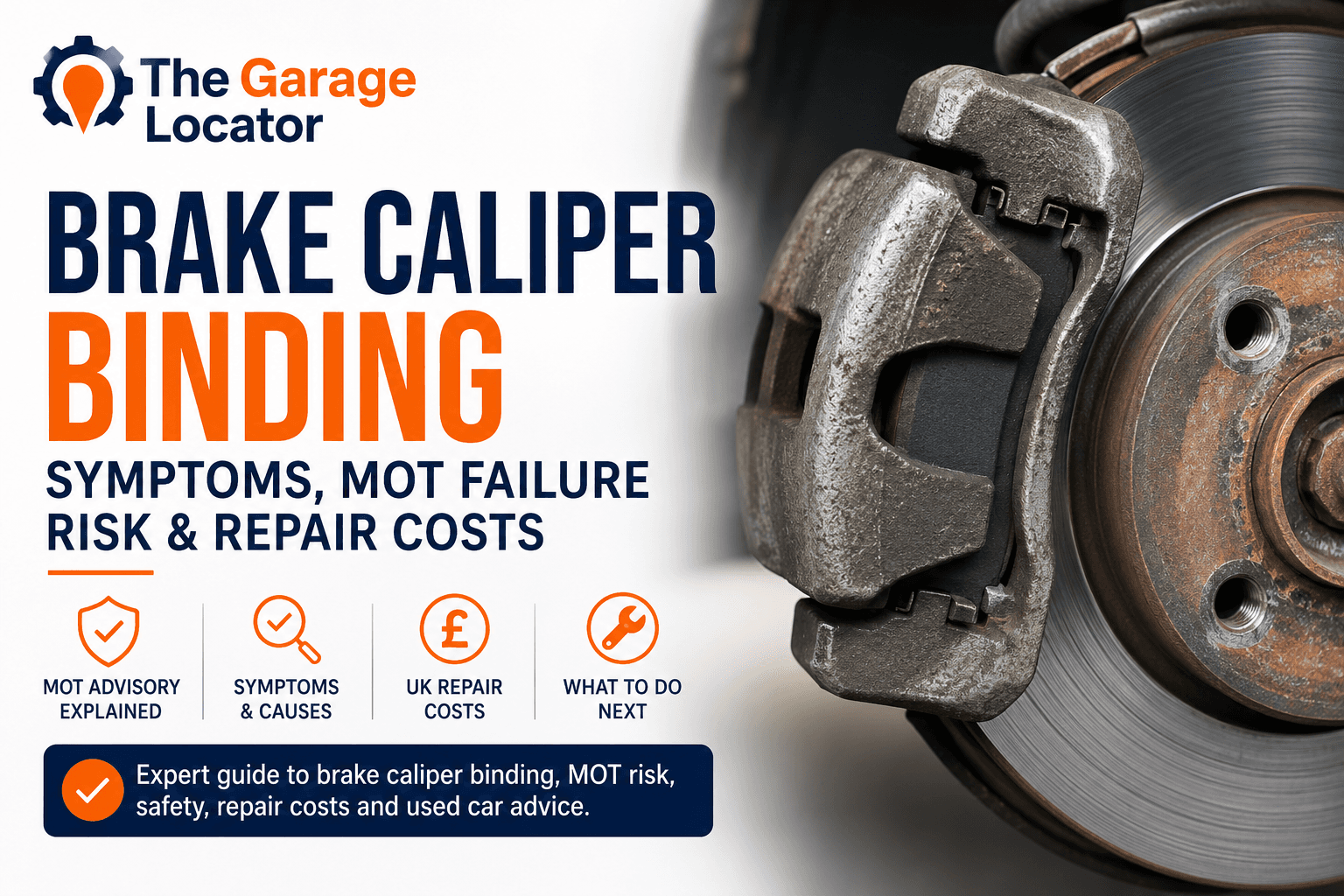
A binding brake caliper means the brake is not releasing properly after you take your foot off the brake pedal.
Instead of the brake pads releasing normally, they continue rubbing against the brake disc. This can generate excessive heat, accelerate pad and disc wear and eventually affect braking performance.
If you've seen "brake binding slightly", "brake caliper beginning to bind" or similar wording on an MOT history, it does not automatically mean the vehicle failed its MOT.
Slight binding may be recorded as an advisory. More serious binding that affects braking performance or brake balance can result in a Major MOT defect.
At a glance
- Current MOT result
- Slight binding may be recorded as an advisory
- MOT failure risk
- Major if braking performance or balance is significantly affected
- Repair priority
- Arrange inspection and repair soon
- Typical repair cost
- Approximately £80–£350 depending on the fault
If you're looking at a used car with a brake advisory, use our free MOT History Checker to see whether brake problems have appeared repeatedly in its MOT history.
What Does Brake Caliper Binding Mean?
A brake caliper's job is to press the brake pads against the brake disc when you apply the brakes.
When you release the brake pedal, pressure should release and the pads should stop applying significant braking force to the disc.
With a binding or sticking caliper, that does not happen correctly.
The brake may remain partially applied even though your foot is no longer on the pedal.
This is also commonly described as:
- a sticking brake caliper
- a seized brake caliper
- brake drag
- a brake not releasing fully
- a binding brake
The severity can vary considerably.
A small amount of drag may initially produce few noticeable symptoms. A badly seized caliper can generate substantial heat and significantly affect the way the vehicle brakes.
Binding does not always mean the caliper needs replacing
Is a Binding Brake Caliper an MOT Failure?
It can be.
The important distinction is how severely the binding affects the braking system.
Slight brake drag that does not significantly affect braking performance may be recorded as an advisory.
More serious binding can result in a Major defect where the brake is not releasing correctly or braking performance is significantly affected.
That means these two situations should not be treated as equivalent:
Advisory-type situation
Brake binding slightly
or:
Brake caliper beginning to bind
More serious situation
Brake binding excessively
or a defect where braking performance or balance is affected.
What Are the Symptoms of a Sticking Brake Caliper?
A binding caliper is not always obvious from the driver's seat.
As the fault becomes more severe, you may notice:
One of the more useful clues is a significant temperature difference between wheels after driving.
A binding brake creates continuous friction, which generates heat.
However, do not touch a wheel, brake disc or caliper to test its temperature. Braking components can become extremely hot.
If one wheel appears to be overheating, have the vehicle inspected.
Is It Safe to Drive With a Binding Brake Caliper?
That depends on the severity of the binding.
Minor brake drag may allow the vehicle to continue driving for a short period while an inspection is arranged.
But brake binding is not something to ignore.
A sticking brake can deteriorate, overheat surrounding components and affect braking balance.
Is it safe to drive?
Brake faults can worsen and should be assessed according to their current symptoms rather than relying solely on an old MOT result.
Driving guidance
- Arrange a garage inspection soon if slight brake binding has been identified.
- Avoid delaying repair if the advisory has appeared repeatedly.
- Stop driving and seek professional inspection if a wheel overheats, there is a burning smell, the vehicle pulls strongly or braking performance changes.
What Causes a Brake Caliper to Bind?
There is no single cause.
The caliper assembly contains several components that must move correctly and withstand heat, water, road dirt and corrosion.
Diagnosis guide
Common causes of brake caliper binding
Corroded caliper piston
Seized or corroded slider pins
Damaged or torn dust seals
General corrosion
Old or contaminated brake fluid
Insufficient lubrication of moving components
Road salt and moisture
Long periods without driving
Damaged or internally restricted flexible brake hose
Worn brake components
Correct diagnosis is important because replacing the complete caliper is not always necessary.
Can Seized Slider Pins Cause Brake Binding?
Yes.
Slider pins allow many brake calipers to move correctly as the brakes are applied and released.
If the pins become:
- corroded
- contaminated
- dry
- damaged
the caliper may not move freely.
That can leave a brake pad rubbing against the disc after the pedal has been released.
In some cases, cleaning and correctly lubricating the slider mechanism can resolve the problem.
In others, damaged components need replacement.
This is why a garage should inspect the complete braking assembly before assuming the caliper itself has failed.
Can the Caliper Piston Seize?
Yes.
The caliper piston moves when hydraulic pressure is applied to the brakes.
Corrosion or deterioration around the piston and seal can prevent it from retracting correctly.
When this happens, pressure can remain on the brake pad.
A severely seized piston may require:
- caliper rebuilding, where appropriate
- replacement seals
- replacement of the complete caliper
The correct repair depends on the condition and design of the component.
Can a Brake Hose Cause a Caliper to Stick?
Yes.
A flexible brake hose can sometimes deteriorate internally.
This can restrict the return of brake fluid after the pedal is released, effectively leaving hydraulic pressure acting on the caliper.
That can produce symptoms similar to a seized caliper.
This is particularly important because replacing the caliper without identifying a restricted hose may fail to solve the underlying problem.
If binding persists, the garage should consider the wider hydraulic system as part of the diagnosis.
Does Old Brake Fluid Cause Calipers to Seize?
Brake fluid absorbs moisture over time.
Moisture and contamination within the braking system can contribute to internal corrosion.
That does not mean old brake fluid is responsible for every seized caliper, but brake-fluid condition is one factor worth checking when investigating braking problems.
Follow the vehicle manufacturer's servicing requirements for brake-fluid replacement.
Why Are Cars That Sit Unused Prone to Sticking Brakes?
Vehicles that spend long periods standing can be more susceptible to corrosion around braking components.
Brakes normally experience:
- moisture
- road dirt
- salt
- repeated heating and cooling
Regular movement can help keep some components operating freely.
When a vehicle remains unused for extended periods, corrosion can develop around discs, slider mechanisms and other components.
This is one reason low annual mileage does not automatically mean a car's brakes will be in better condition.
Can Road Salt Cause Brake Caliper Problems?
Road salt and moisture can accelerate corrosion of exposed braking components.
UK vehicles are particularly exposed during winter.
Over time, corrosion can affect:
- slider pins
- caliper bodies
- pistons
- brake pipes
- discs
- fasteners
This also creates a useful MOT-history connection.
A vehicle showing repeated brake binding alongside brake pipe corrosion or heavily corroded brake components may deserve a more thorough braking-system inspection.
Read our guide to Brake Pipe Corrosion for more information.
Can a Binding Caliper Damage Brake Pads?
Yes.
A binding caliper can keep one or more pads rubbing against the brake disc.
That creates accelerated friction wear.
As a result, you may find:
- one pad substantially thinner than another
- one side of the vehicle wearing pads faster
- pads becoming overheated
- replacement pads being damaged prematurely
This is why simply replacing worn pads without identifying the cause of abnormal wear can be a mistake.
See our guide to Brake Pads Wearing Thin if your MOT history contains both faults.
Can a Binding Caliper Damage Brake Discs?
Yes.
Continuous friction generates heat.
Excessive heat can contribute to:
- accelerated disc wear
- scoring
- surface damage
- heat-related deterioration
- vibration or braking problems
A relatively inexpensive binding fault can therefore become a more expensive repair if it damages the pads and discs.
If the MOT also mentions disc deterioration, read Brake Disc Worn, Pitted or Scored.
⚠️ Do not replace worn pads without finding the cause
Can Brake Binding Cause the Car to Pull to One Side?
Yes.
If one wheel is experiencing more braking force than the opposite wheel, the vehicle may pull.
This can be particularly noticeable:
- while braking
- after the brakes become hot
- when the binding becomes severe
However, pulling can have several causes, including tyres, alignment, suspension and other braking faults.
It should therefore be diagnosed rather than assumed to be a caliper problem.
Why Does a Binding Brake Make a Wheel Hot?
Friction creates heat.
Normally, the brake pads contact the disc when you brake and release afterwards.
With a binding brake, friction continues while the vehicle is moving.
That can make the affected:
- disc
- pads
- caliper
- wheel area
much hotter than normal.
Severe overheating can damage components and should be treated seriously.
⚠️ Burning smell or excessive heat needs urgent attention
Can Brake Binding Reduce Fuel Economy?
Potentially.
A binding brake creates resistance.
The engine has to work against that additional drag to move the vehicle.
The effect depends on how severely the brake is binding, but persistent brake drag can contribute to increased fuel consumption.
You may also notice the vehicle does not roll as freely as expected.
How Much Does Brake Caliper Binding Cost to Repair in the UK?
The cost depends on why the brake is binding.
A sticking slider mechanism can be considerably cheaper to repair than a failed caliper requiring replacement.
Typical planning costs from our current UK research are:
- Slider-pin service: approximately £80–£140
- Caliper rebuild: approximately £120–£220
- Replacement brake caliper: approximately £180–£350
- Pads and discs if also damaged: approximately £250–£500
Typical brake caliper repair cost
£80–£350
For the binding fault itself, approximately **£80–£350** is a useful broad planning range. Costs can increase if overheating or continued driving has damaged the brake pads, discs, hoses or other components.
Actual prices depend on the vehicle, parts required, labour rates and the extent of the damage.
How Long Does Brake Caliper Repair Take?
Minor slider-pin servicing can often be completed relatively quickly.
Caliper replacement takes longer because the hydraulic braking system may need to be opened and subsequently bled.
Repair time
Typical repair time
- Minor caliper/slider service
- 45–90 minutes
- Caliper replacement
- 1–2 hours
- Additional brake repairs
- Longer if pads, discs or hoses also need replacement
- Typical turnaround
- Often same day when parts are available
Extra time may be required where corrosion makes components difficult to remove or brake pipes, bleed nipples or other parts also need attention.
Does a Binding Caliper Always Need Replacing?
No.
This is one of the most important misconceptions about the fault.
A brake may bind because of:
- seized slider pins
- corrosion
- damaged seals
- a restricted brake hose
- a seized piston
Some faults can be serviced or repaired.
Others require complete caliper replacement.
The correct approach is diagnosis first, parts second.
💷 Get the cause diagnosed before authorising parts
Should Brake Calipers Be Replaced in Pairs?
Not automatically.
Unlike some service items, a failed caliper does not universally mean the caliper on the opposite side must also be replaced.
The decision depends on:
- condition of the opposite caliper
- vehicle manufacturer guidance
- age and condition of the braking system
- whether other components are also worn
- the garage's inspection findings
Pads or discs may have different replacement considerations, particularly where axle balance and wear are concerned.
Ask the garage to explain what needs replacing and why.
How Soon Should Brake Caliper Binding Be Repaired?
The urgency depends on the symptoms.
Minor drag with no other symptoms
Arrange inspection and repair soon.
Repeated MOT advisory
Do not continue postponing it. Have the underlying cause repaired before it progresses.
Vehicle pulling under braking
Arrange urgent inspection.
Hot wheel or burning smell
Stop driving and have the braking system inspected.
Changed or reduced braking performance
Treat it as an urgent safety issue.
The important point is that a brake advisory is not a guarantee that the fault will remain minor.
What Happens If You Ignore a Binding Brake Caliper?
A sticking caliper can become considerably more expensive if ignored.
Possible consequences include:
- accelerated brake-pad wear
- damaged brake discs
- overheating
- increased fuel consumption
- brake imbalance
- deterioration of brake fluid
- reduced braking performance
- MOT failure
A common progression can look like:
Minor brake drag
↓
Brake binding advisory
↓
Accelerated pad/disc wear
↓
Brake imbalance or reduced performance
↓
Major MOT failure
Not every vehicle follows this progression, but it demonstrates why repeated brake-binding advisories deserve attention.
What Does Repeated Brake Binding in MOT History Mean?
One advisory may represent a developing fault that was subsequently repaired.
Repeated advisories are more significant.
For example:
2024: Front brake binding slightly
2025: Front brake binding
2026: Brake performance affected / failure
That pattern suggests the underlying problem may have persisted or deteriorated.
When assessing a used car, compare:
- affected wheel or axle
- mileage between MOTs
- brake pad advisories
- disc advisories
- brake pipe corrosion
- brake hose defects
- brake imbalance
- later MOT failures
The pattern matters more than one isolated line on an MOT certificate.
Use our free MOT History Checker to review the complete timeline.
Is Brake Caliper Binding a Red Flag When Buying a Used Car?
Not automatically.
Brake caliper faults are generally repairable.
A single historical advisory that disappeared after repair is very different from a brake problem appearing year after year.
A used car with a binding-caliper advisory may still be a perfectly reasonable purchase if the repair cost is understood and the rest of the vehicle checks out.
Can You Negotiate the Price Because of a Binding Caliper?
Potentially.
The sensible approach is to base negotiation on an actual likely repair cost.
For example, establish whether the car needs:
- a slider service
- a rebuilt caliper
- a replacement caliper
- brake pads
- brake discs
- a flexible brake hose
- brake-fluid work
A £100 service and a £500 brake overhaul are very different negotiating positions.
Obtain a garage quote before deciding what adjustment to the purchase price is reasonable.
What Should a Garage Inspect?
A proper inspection should look beyond the caliper itself.
Depending on the symptoms, the garage may inspect:
Correct diagnosis reduces the risk of replacing parts that were not causing the fault.
What Other MOT Brake Faults Should You Look For?
Brake binding often makes more sense when viewed alongside other braking defects.
Look for:
- Brake pads wearing thin
- Brake disc worn, pitted or scored
- Brake pipe corrosion
- brake hose deterioration
- brake-fluid leaks
- brake imbalance
- parking-brake defects
Three of these already have detailed guides:
This is why looking at the full MOT history is more useful than judging one advisory in isolation.
Brake Caliper Binding and Brake Imbalance
A binding brake can contribute to unequal braking force between wheels.
If one brake is partially applied or operating differently from the brake on the opposite side, brake balance can be affected.
That can turn what began as relatively minor brake drag into a more significant MOT problem.
If a vehicle's history progresses from:
Brake binding slightly
to:
Brake imbalance
that deserves investigation before purchase.
Frequently Asked Questions
What does a brake caliper binding advisory mean?
It means a brake is not releasing as freely as it should. Slight binding may be recorded as an advisory where braking performance is not significantly affected.
Is a sticking brake caliper dangerous?
It can become dangerous if it causes significant overheating, pulling, brake imbalance or reduced braking performance. Minor binding should still be inspected and repaired before it deteriorates.
Can you drive with a binding brake caliper?
Minor drag may allow short-term driving while repair is arranged, but you should not ignore it. Stop driving if the wheel overheats, you smell burning, the vehicle pulls strongly or braking performance changes.
How much does brake caliper repair cost?
Our current UK research suggests approximately £80–£140 for a slider-pin service, £120–£220 for some caliper rebuilds and around £180–£350 for caliper replacement. Additional pad or disc replacement can increase the bill.
Will a binding brake caliper fail the MOT?
It can. Slight binding may be advisory territory, but binding that significantly affects braking performance or brake balance can result in a Major MOT defect.
What causes brake calipers to seize?
Possible causes include corroded pistons, seized slider pins, damaged seals, corrosion, contaminated brake fluid, restricted flexible hoses and long periods without use.
Can a sticking caliper damage brake discs?
Yes. Continuous friction generates heat and can accelerate disc and pad wear. Continued driving can therefore turn a relatively small fault into a more expensive brake repair.
Should brake calipers be replaced in pairs?
Not automatically. The opposite caliper should be inspected, and the repair decision should take account of its condition and the vehicle manufacturer's requirements.
How do I know if my brake caliper is sticking?
Possible signs include pulling to one side, one wheel becoming unusually hot, a burning smell, excessive brake dust, uneven pad wear, squealing and the vehicle feeling resistant to rolling freely.
Should I buy a car with a brake caliper advisory?
It is not automatically a reason to reject the vehicle. Check whether the advisory is repeated, inspect related brake defects and obtain a repair quote. Persistent brake problems or evidence of overheating deserve more caution.
Check the Full MOT History Before You Buy
A brake caliper binding advisory should not automatically make you walk away from a used car.
But it should not be ignored either.
Slight binding may begin as an advisory, while worsening brake drag can damage pads and discs, create excessive heat, affect brake balance and eventually cause an MOT failure.
For an existing owner, the sensible approach is to have the brake inspected before a relatively small fault develops into a larger repair.
For a used-car buyer, look at the pattern.
Check whether brake binding has appeared repeatedly and whether the same MOT history also contains brake pad wear, disc deterioration, brake pipe corrosion, brake hose problems or brake imbalance.
Use The Garage Locator's free MOT History Checker to review the vehicle's previous MOT tests, advisories, failures and mileage history before making your decision.