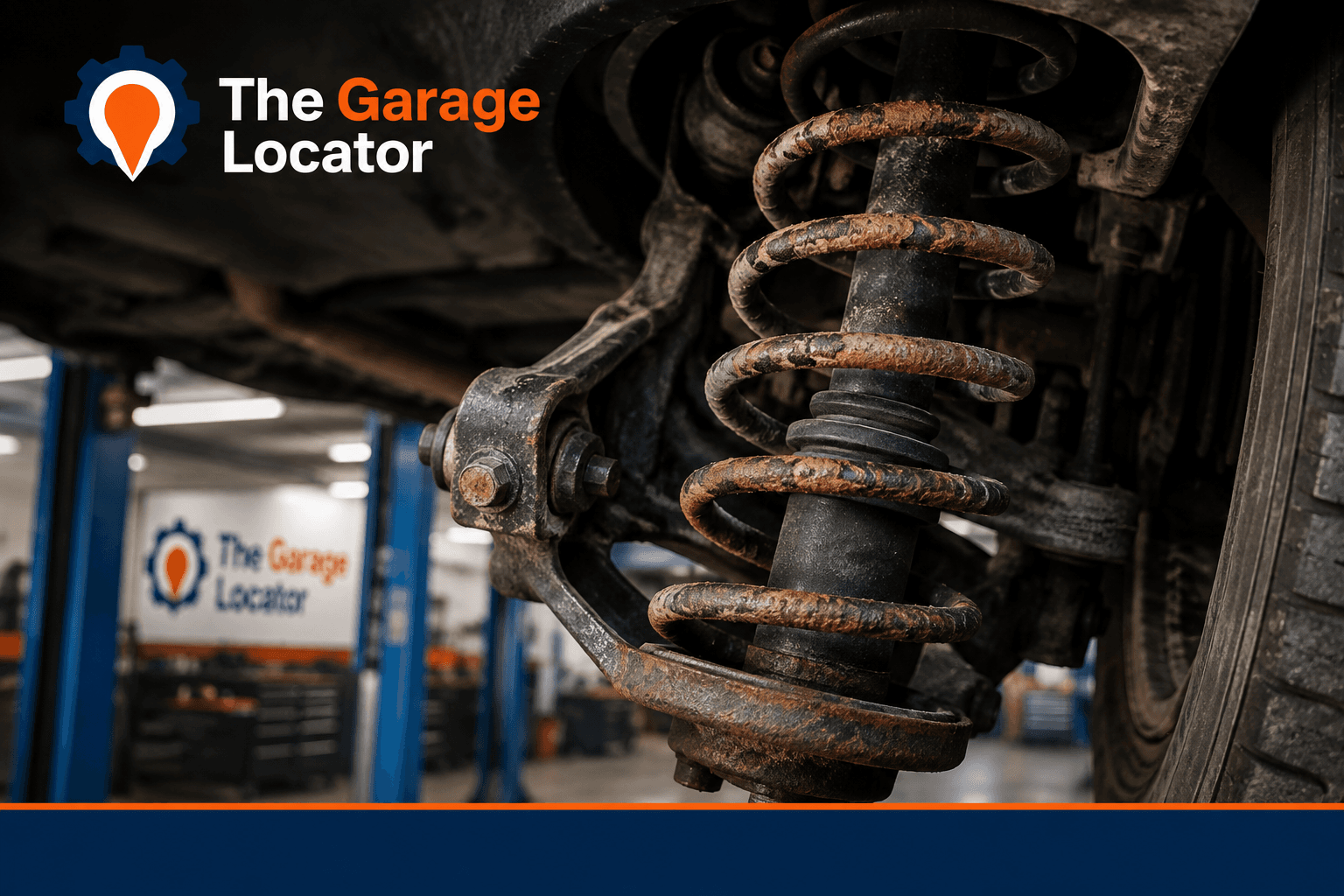
A coil spring corroded MOT advisory means the tester found visible rust or corrosion on one of your vehicle's suspension springs, but did not consider the spring seriously weakened enough to fail the MOT at the time of the test.
The vehicle may have passed, but the advisory is worth taking seriously.
Coil springs support the vehicle's weight and play an important role in ride height, handling and keeping the tyres in contact with the road. As corrosion progresses, a spring can weaken and eventually fracture.
This guide explains what a coil spring corrosion advisory means, when corrosion becomes an MOT failure, whether the vehicle is safe to drive, symptoms of a damaged spring and how much coil spring replacement typically costs in the UK.
In this guide
- What a coil spring corrosion advisory means
- Common MOT advisory wording
- Whether a corroded coil spring will fail an MOT
- Surface corrosion vs serious corrosion
- What coil springs do
- Symptoms of a worn or broken spring
- Whether it's safe to drive
- How quickly the advisory should be repaired
- Why coil springs corrode
- How garages inspect coil springs
- Coil spring replacement costs
- Whether springs should be replaced in pairs
- Buying a used car with a spring advisory
- Frequently asked questions
What does a coil spring corroded MOT advisory mean?
A coil spring corrosion advisory means an MOT tester has found corrosion on a suspension spring, but the condition was not considered serious enough to meet the MOT failure criteria on the day of the inspection.
Typical MOT wording can include:
- Coil spring corroded
- Front coil spring corroded
- Rear coil spring corroded
- Nearside front coil spring corroded
- Offside front coil spring corroded
- Nearside rear coil spring corroded
- Offside rear coil spring corroded
- Coil spring corroded but not seriously weakened
- Suspension coil spring corroded
- Coil spring has surface corrosion
The important distinction is the severity of the corrosion.
Surface corrosion does not automatically mean a spring has failed.
However, corrosion that has seriously weakened the spring can result in an MOT failure.
If you're reviewing the history of a used vehicle, our Free MOT History Checker can help you identify whether spring corrosion or other suspension problems have appeared on previous MOT tests.
Will a corroded coil spring fail an MOT?
Not necessarily.
A vehicle can pass its MOT with a coil spring corrosion advisory when the tester does not consider the corrosion serious enough to have substantially weakened the spring.
However, the MOT inspection criteria become much more serious when the spring's structural condition deteriorates.
| Coil spring condition | Likely MOT outcome |
|---|---|
| Surface corrosion without serious weakening | May receive an advisory |
| Corrosion noted but spring remains structurally sound | May receive an advisory |
| Spring seriously weakened by corrosion or damage | Major defect — MOT fail |
| Spring fractured or broken | Major defect — MOT fail |
| Spring insecure or incorrectly seated | Major defect — MOT fail |
There isn't a simple rust measurement that determines whether a coil spring passes or fails.
The tester assesses the condition of the spring and whether corrosion or damage has weakened it sufficiently to meet the MOT rejection criteria.
If you're unsure what the different MOT classifications mean, read our MOT Advisory Codes Explained guide.
Surface rust vs serious coil spring corrosion
Not all rust on a suspension spring means the spring needs immediate replacement.
Coil springs normally have a protective coating designed to shield the metal from water, road salt and dirt.
Over time, that coating can become damaged.
Once exposed metal begins to rust, you might initially see:
- Light surface rust
- Flaking paint
- Small areas of corrosion
- Rust concentrated around the lower coils
At this stage, the spring may still be structurally sound.
More advanced corrosion is different.
As corrosion penetrates the metal, the spring can lose material and strength. Repeated compression and extension then place stress on the weakened area.
Eventually, the spring can fracture.
This is why an MOT advisory for corrosion is useful: it can identify deterioration before the spring reaches the failure threshold.
What does a coil spring do?
Coil springs form part of the vehicle's suspension system.
They support the vehicle's weight while allowing the wheels and suspension to move over bumps and uneven road surfaces.
Working together with the shock absorbers, coil springs help:
- Maintain vehicle ride height
- Absorb road impacts
- Keep the tyres in contact with the road
- Maintain stable handling
- Support passengers and loads
- Improve ride comfort
During normal driving, each spring compresses and extends thousands of times.
That means a corroded spring is not simply a cosmetic issue.
The spring remains under repeated mechanical stress every time the vehicle is driven.
What are the symptoms of a corroded or broken coil spring?
A coil spring can be corroded without producing any obvious symptoms.
In fact, many drivers first discover spring corrosion when it appears on an MOT or service report.
As deterioration becomes more serious, possible symptoms include:
- Knocking or clunking from the suspension
- Vehicle sitting lower on one side
- Uneven ride height
- Poor ride quality
- Steering pulling to one side
- Excessive bouncing
- Instability over bumps
- Tyre rubbing
- Unusual suspension noises
A broken spring can sometimes be surprisingly difficult to notice.
The fractured section may remain trapped in the spring seat, particularly when the break occurs near the bottom coil.
If your vehicle suddenly sits unevenly, develops a new suspension noise or its handling changes, arrange an inspection.
Is it safe to drive with a corroded coil spring?
It depends on the severity of the corrosion.
A vehicle that has simply received an advisory for surface corrosion and has no other symptoms can normally continue to be driven while you arrange an inspection or repair.
However, you should not assume that the condition will remain unchanged until the next MOT.
Arrange an inspection sooner if:
- Knocking or clunking develops
- The vehicle begins sitting unevenly
- Ride height changes
- Steering or handling changes
- Tyre rubbing occurs
- The advisory has appeared repeatedly
- Other suspension advisories are present
Do not continue driving if the spring has broken, part of the spring has become loose, the spring is interfering with a tyre or the vehicle's handling has changed significantly.
A broken or seriously weakened suspension spring requires repair.
How quickly should a coil spring corrosion advisory be repaired?
There is no single repair deadline that applies to every advisory.
For light surface corrosion with no symptoms, you normally have time to arrange an inspection rather than treating the advisory as an emergency.
However, repeated corrosion advisories deserve more attention.
A sensible approach is:
| Condition | What to do |
|---|---|
| Light surface corrosion | Monitor and arrange inspection |
| First corrosion advisory | Have the spring checked during servicing or soon afterwards |
| Repeated advisory | Consider replacement before the next MOT |
| Increasing suspension noise or uneven ride height | Arrange inspection promptly |
| Seriously weakened spring | Repair required — MOT failure |
| Broken spring | Repair immediately |
If the same coil spring corrosion warning has appeared across several MOT tests, don't assume that repeated passes mean the spring is safe indefinitely.
The condition may be progressively deteriorating.
Our guide to How Long Do MOT Advisories Stay on Record? explains why repeated warnings in a vehicle's MOT history can be particularly useful when assessing its maintenance history.
Why do coil springs corrode?
Coil springs operate in one of the harshest areas of a vehicle.
They are continually exposed to water, road salt, dirt, grit and debris thrown up by the tyres.
Common causes and contributing factors include:
- Road salt
- Water and moisture
- Stone chips
- Damage to the protective coating
- Vehicle age
- Mud accumulation
- Poor drainage around the spring seat
- Previous impact damage
- Metal fatigue
Corrosion often begins after the spring's protective coating becomes chipped or damaged.
Once bare metal is exposed, moisture and road salt can accelerate rusting.
The lower coils can be particularly vulnerable because water, salt and debris can collect around the spring seat.
Can road salt cause coil spring corrosion?
Yes.
Road salt is highly effective at accelerating corrosion when it reaches exposed metal.
During winter, salty water can repeatedly coat suspension components underneath the vehicle.
A spring with an intact protective coating has some protection, but stone chips and age-related deterioration can expose the steel underneath.
This is one reason spring corrosion is common on older UK vehicles.
Can a corroded coil spring suddenly break?
It can.
Corrosion removes material from the spring and can create weakened areas that remain under repeated mechanical stress while driving.
Eventually, a sufficiently weakened spring can fracture.
However, an advisory for surface corrosion does not mean the spring is about to snap immediately.
The difficulty is predicting exactly how quickly deterioration will progress.
A repeated advisory, worsening corrosion, new suspension noises or a change in ride height are all good reasons to have the spring inspected.
How can you tell if a coil spring has broken?
Possible signs include:
- A new knocking or clunking noise
- One corner of the vehicle sitting lower
- Uneven ride height
- Changes in steering or handling
- Tyre rubbing
- Metallic noises over bumps
- A visibly fractured spring
- A loose section of spring
A broken spring is not always obvious from the driver's seat.
The fracture often occurs around a lower coil, and the broken section can remain trapped within the spring seat.
That means a vehicle can sometimes continue to appear relatively normal even though part of the spring has fractured.
If you suspect a broken spring, have the suspension inspected rather than relying on symptoms alone.
How does a garage inspect a corroded coil spring?
A garage will normally inspect the spring visually while also checking its position and surrounding suspension components.
The inspection can include:
- Looking for heavy corrosion or loss of material
- Checking for fractured coils
- Inspecting the protective coating
- Looking closely at the lower coils
- Checking whether the spring is correctly seated
- Inspecting the spring seat
- Comparing vehicle ride height
- Checking nearby suspension components
- Looking for evidence of tyre contact
The garage may also inspect the shock absorber, top mount, anti-roll bar links and suspension bushes while working in the same area.
This is useful because suspension components often deteriorate at similar ages and mileages.
If your MOT has also mentioned suspension-bush wear, see our Suspension Arm Bush Deteriorated guide.
How is a corroded coil spring repaired?
A seriously corroded or broken coil spring is normally replaced.
Rust cannot simply be removed from a structurally weakened spring to restore its original strength.
The repair procedure varies according to the vehicle and whether the affected spring is at the front or rear.
A typical replacement can involve:
- Raising and safely supporting the vehicle
- Removing the wheel
- Removing or releasing suspension components
- Compressing the spring where required
- Removing the old spring
- Inspecting the spring seat and surrounding components
- Installing the replacement spring
- Reassembling the suspension
- Checking ride height and suspension operation
Front spring replacement can require dismantling part of the strut assembly.
Because compressed suspension springs store substantial energy, spring replacement requires appropriate equipment and should normally be carried out by a competent garage.
How much does coil spring replacement cost in the UK?
Typical UK replacement costs are approximately:
| Repair | Typical cost |
|---|---|
| One front coil spring | £180–£320 |
| Pair of front coil springs | £300–£500 |
| One rear coil spring | £140–£260 |
| Pair of rear coil springs | £250–£450 |
| Wheel alignment, if required | £40–£100 |
These are indicative prices rather than quotations.
The actual cost depends on factors including:
- Vehicle make and model
- Front or rear suspension
- Labour rates
- Spring design
- Parts quality
- Accessibility
- Seized or corroded fasteners
- Whether additional suspension components need replacing
For most vehicles, budgeting approximately £180–£500 provides a reasonable starting range for the article's typical spring-replacement scenarios.
Why can front coil springs cost more to replace?
Front suspension assemblies are often more complicated than rear spring arrangements.
Replacing a front spring may require removal and dismantling of the suspension strut.
The mechanic may need to work around components such as:
- Shock absorbers
- Top mounts
- Bearings
- Anti-roll bar links
- Brake hoses
- ABS wiring
Specialist spring compressors may also be required.
Rear springs on some vehicles can be considerably quicker to remove and replace.
Vehicle design makes a major difference, however, so this is not universal.
How long does coil spring replacement take?
Replacing one coil spring commonly takes approximately 1–2 hours.
Replacing a pair may take around 2–3 hours in straightforward circumstances.
Additional labour may be required when:
- Suspension bolts are seized
- Corrosion makes components difficult to remove
- The strut needs dismantling
- Top mounts require replacement
- Other suspension faults are discovered
- Wheel alignment is required
A garage can provide a more accurate labour estimate after identifying the affected spring and inspecting the vehicle.
Should coil springs be replaced in pairs?
It is often worth considering.
Technically, it may be possible to replace only the damaged spring.
However, both springs on the same axle have normally experienced similar mileage, road conditions and loads.
If one spring has failed through age, fatigue or corrosion, the spring on the opposite side may also be approaching the end of its service life.
Replacing springs in axle pairs can also help maintain balanced:
- Ride height
- Suspension response
- Handling
- Spring performance
That doesn't mean every slightly corroded spring automatically requires both sides to be replaced.
Ask the garage to inspect the opposite spring and advise based on its condition.
What else should be checked when replacing a coil spring?
Spring replacement provides a good opportunity to inspect nearby suspension components.
Depending on the vehicle, these can include:
- Shock absorbers
- Top mounts
- Top-mount bearings
- Spring seats
- Bump stops
- Anti-roll bar links
- Suspension arm bushes
- Ball joints
- Tyres
Wheel alignment may also be recommended after certain suspension repairs.
This does not mean all these parts need replacing.
The purpose of the inspection is to identify other deterioration while the suspension is already being worked on.
What happens if you ignore a coil spring corrosion advisory?
Surface corrosion may remain relatively stable for some time, but it can also progress.
Potential consequences of continued deterioration include:
- Increasing corrosion
- Spring fracture
- MOT failure
- Uneven ride height
- Suspension noise
- Poorer handling
- Uneven tyre wear
- Tyre damage
- Damage to associated suspension components
- Higher repair costs
The most useful clue is often the vehicle's MOT history.
For example, a progression such as:
Coil spring corroded → same advisory again → seriously weakened → broken spring
suggests deterioration that was allowed to continue.
This is why repeated advisories deserve more attention than an isolated entry.
Should you buy a used car with a coil spring corrosion advisory?
A single coil spring corrosion advisory is not automatically a reason to reject a used car.
Spring replacement is a routine suspension repair.
Instead, assess the advisory alongside the vehicle's overall condition and maintenance history.
Before buying, check:
- Which spring is affected
- Whether one or both sides have corrosion
- Whether the advisory has appeared repeatedly
- Whether replacement invoices are available
- Whether the vehicle sits level
- Whether there are suspension noises
- Whether the tyres show abnormal wear
- Whether related suspension advisories are present
Repeated corrosion advisories without evidence of repair deserve closer investigation.
Use our Free MOT History Checker to see whether the warning has appeared on previous tests and whether other suspension defects have been recorded.
Can a coil spring advisory be used to negotiate the price of a used car?
Yes, when the repair remains outstanding.
A coil spring advisory represents a potential future expense, particularly if the spring is likely to require replacement soon.
Before negotiating, ideally:
- Obtain a garage quotation
- Establish whether one or both springs need replacing
- Check the condition of the shock absorbers
- Inspect the top mounts
- Check the tyres
- Look for other suspension advisories
Avoid assuming that the lowest possible spring-replacement price represents the complete repair.
If other components are worn or both springs require replacement, the actual cost can be higher.
For more guidance, see Buying a Used Car With MOT Advisories.
Coil spring vs shock absorber: what's the difference?
Coil springs and shock absorbers work together, but they perform different jobs.
The coil spring supports the vehicle's weight and allows the suspension to move as the wheel travels over bumps and uneven surfaces.
The shock absorber, also called a damper, controls that movement and prevents the suspension from continuing to bounce excessively.
This means a vehicle can have:
- A corroded or broken spring with a healthy shock absorber
- A leaking or worn shock absorber with a healthy spring
- Wear affecting both components
Because they operate together and are located close to each other, a garage should normally inspect both when significant suspension wear is found.
Is coil spring corrosion common?
Yes, particularly on older vehicles exposed to UK winter conditions.
Coil springs operate underneath the vehicle where they are repeatedly exposed to:
- Water
- Road salt
- Dirt
- Mud
- Stone impacts
The problem is not limited to one particular manufacturer or type of vehicle.
Age, mileage, road conditions and deterioration of the spring's protective coating all influence how quickly corrosion develops.
Where do coil springs commonly break?
A spring can fracture at different points, but the lower coils are particularly vulnerable.
Moisture, road salt and debris can collect around the lower spring and spring seat.
Corrosion may also begin where the protective coating has been damaged.
A broken end can sometimes remain trapped in the spring seat, which is one reason a driver may not immediately realise that a spring has fractured.
Can a broken coil spring damage a tyre?
Potentially, yes.
If part of a broken spring becomes displaced, it can move towards or contact the tyre.
That can create a serious safety problem.
Do not continue driving if:
- The spring is visibly broken and displaced
- A loose section is close to the tyre
- The tyre is rubbing against suspension components
- The vehicle suddenly sits significantly lower
- Handling has changed substantially
Have the vehicle recovered or professionally assessed if there is any concern about tyre contact or wheel safety.
Does coil spring corrosion affect wheel alignment?
Corrosion alone does not necessarily alter wheel alignment.
However, a weakened or broken spring can change ride height and suspension geometry.
Alignment may also need checking after certain suspension repairs.
A garage may therefore recommend wheel alignment when:
- Ride height was uneven
- Suspension components have been removed
- Tyres show abnormal wear
- Steering no longer feels centred
- Other suspension components are worn
Whether alignment is necessary depends on the vehicle and the repair performed.
Does a coil spring advisory stay on the MOT history?
Yes.
An advisory recorded during an MOT becomes part of that historical MOT test record.
Replacing the spring does not remove the old advisory from previous tests.
Instead, later MOT results can help show whether the problem was repaired.
For example:
2025 — Coil spring corroded
2026 — No spring advisory
That could be consistent with the spring having been replaced, although the MOT history alone does not prove that a repair occurred.
Invoices and service records provide stronger evidence.
Read How Long Do MOT Advisories Stay on Record? for a more detailed explanation.
Is a repeated coil spring advisory a bad sign?
It deserves closer investigation.
One corrosion advisory on an older vehicle is not unusual.
If essentially the same warning appears over several consecutive MOTs, it can suggest that the spring has continued to be used without replacement.
That doesn't automatically mean the vehicle is unsafe.
However, repeated warnings are useful when assessing:
- Maintenance history
- Future repair costs
- Whether deterioration is progressing
- How previous owners responded to advisories
This is especially important when buying a used car.
Our guide How Many MOT Advisories Are Too Many? explains why the pattern and severity of advisories matter more than simply counting them.
Quick decision guide
| Situation | Recommended action |
|---|---|
| First light-corrosion advisory with no symptoms | Monitor and arrange inspection |
| Same corrosion advisory appearing repeatedly | Have the spring inspected and budget for replacement |
| Knocking, clunking or uneven ride height | Arrange inspection promptly |
| Spring seriously weakened by corrosion | Repair required |
| Spring fractured or broken | Replace the spring |
| Loose spring section or possible tyre contact | Do not continue driving |
| Buying a car with one spring advisory | Check condition and obtain a repair estimate |
| Buying a car with repeated suspension advisories | Investigate carefully before purchase |
What does a coil spring corrosion advisory mean?
It means the MOT tester found corrosion on a suspension spring but did not consider the spring seriously weakened enough to meet the MOT failure criteria at the time of the test.
Will a corroded coil spring fail an MOT?
Surface corrosion does not automatically cause an MOT failure.
A spring that has been seriously weakened by corrosion or damage is a Major defect and will fail.
A fractured or broken spring is also a Major defect.
Can you drive with a corroded coil spring?
A vehicle with a light corrosion advisory and no significant symptoms can normally continue to be driven while an inspection or repair is arranged.
Do not continue driving if the spring is broken or displaced, is contacting a tyre, or the vehicle's handling has changed significantly.
How much does coil spring replacement cost?
Typical UK costs are approximately £180–£320 for one front spring and £140–£260 for one rear spring.
Replacing springs in pairs can typically cost around £300–£500 at the front or £250–£450 at the rear.
Prices vary considerably between vehicles and garages.
How long does coil spring replacement take?
A straightforward replacement commonly takes approximately 1–2 hours for one spring.
Replacing a pair may take around 2–3 hours.
Seized components, complicated suspension designs and additional repairs can increase labour time.
Should coil springs be replaced in pairs?
It can be sensible, particularly when the springs are the same age and one has failed because of corrosion or fatigue.
Replacing both springs on an axle can help maintain balanced ride height and suspension performance.
However, the opposite spring should be inspected rather than automatically assuming it needs replacement.
Why do coil springs rust?
Common causes include water, road salt, damaged protective coatings, stone chips, mud accumulation, age and repeated exposure to harsh road conditions.
Corrosion often starts where the spring's protective coating has been damaged.
Can a coil spring break without warning?
Yes.
Some drivers notice knocking, uneven ride height or handling changes beforehand, but a spring can fracture without an obvious warning from inside the vehicle.
A broken lower coil can sometimes remain trapped in the spring seat.
Is surface rust on a coil spring normal?
Some surface corrosion can develop as vehicles age and does not necessarily mean the spring has become structurally unsafe.
What matters is whether corrosion has progressed sufficiently to seriously weaken the spring.
Should I buy a car with a coil spring advisory?
One corrosion advisory should not automatically stop you buying the vehicle.
Check whether the advisory has appeared repeatedly, inspect the overall suspension condition and obtain a repair estimate.
A repeated warning without evidence of repair deserves more scrutiny.
What causes coil springs to snap?
Possible contributing factors include:
- Corrosion
- Metal fatigue
- Age
- Pothole impacts
- Damage to the protective coating
- Repeated heavy loading
- Harsh road conditions
Often several factors contribute rather than one single cause.
Can a broken spring damage other suspension components?
Potentially.
A broken or displaced spring can affect ride height, tyres and surrounding suspension components.
When replacing a spring, it is sensible for the garage to inspect the spring seat, shock absorber, top mount and nearby suspension parts.
Can a coil spring advisory disappear from the next MOT?
The old advisory remains permanently within that historical MOT result.
However, the same warning may not appear on the next test if the spring has been replaced or the tester does not find an advisory-level defect at that time.
If you're buying the vehicle, repair invoices are better evidence of replacement than simply assuming a missing later advisory proves the work was completed.
How can I check previous coil spring MOT advisories?
Review the vehicle's complete MOT history.
Our Free MOT History Checker lets you examine previous MOT tests, advisories, failures and recorded mileage.
Look for repeated spring warnings as well as related suspension and tyre defects.
A coil spring corroded MOT advisory means the spring showed visible corrosion but was not considered seriously weakened enough to fail the MOT at that inspection.
It should still be treated as an early warning.
Light surface corrosion may remain serviceable, but progressive corrosion can weaken the spring until it fractures or reaches the MOT failure threshold.
Pay particular attention to repeated advisories, knocking or clunking, uneven ride height, tyre rubbing and changes in handling.
If replacement is required, typical UK costs vary according to the vehicle and whether one spring or an axle pair is replaced.
And if you're considering buying a vehicle with this warning, don't judge it from one MOT result alone. Use our Free MOT History Checker to examine whether the corrosion is new, repeatedly recorded or accompanied by other suspension problems.
For help interpreting the severity of other MOT warnings, read MOT Advisory Codes Explained: What Every MOT Warning Means.