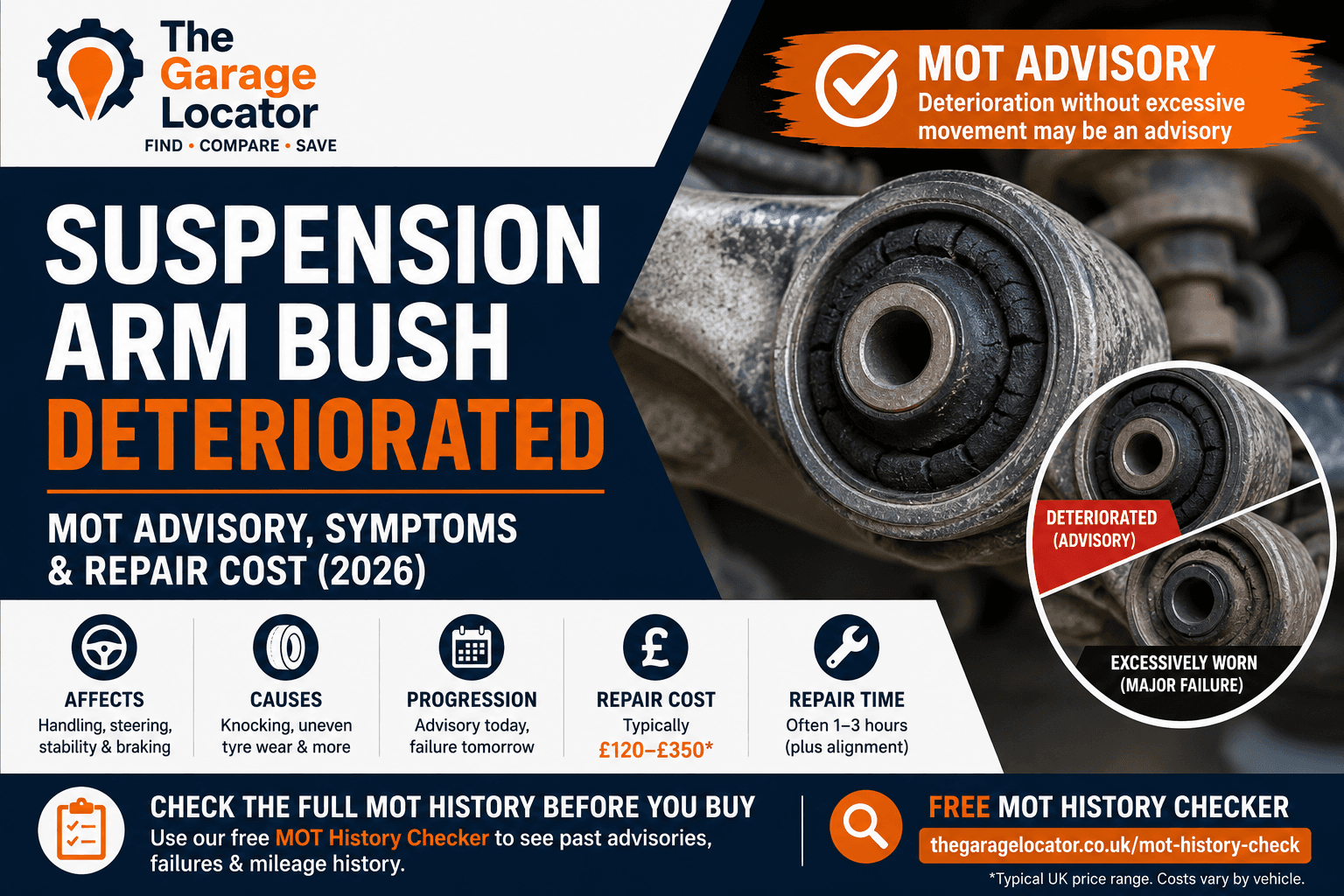
A suspension arm bush deteriorated MOT advisory means a rubber or bonded suspension bush has started to wear, crack or deteriorate, but the tester has not found enough excessive movement for it to meet the relevant MOT failure threshold.
It is a common age-and-mileage-related suspension issue.
A deteriorated bush does not necessarily need replacing immediately, but it should not be forgotten. As deterioration progresses, movement in the suspension joint can increase, potentially affecting handling, tyre wear and wheel alignment and eventually resulting in an MOT failure.
At a glance:
- Current MOT result: Deterioration without excessive movement may be recorded as an advisory.
- MOT failure risk: It can become a Major defect if wear results in excessive movement.
- Repair priority: Monitor the condition and arrange an inspection before deterioration becomes excessive.
- Typical repair cost: Approximately £120–£350 depending on the vehicle and repair method.
If you're considering a used car with suspension advisories, use our free MOT History Checker to see whether the problem has appeared repeatedly or progressed between tests.
What Does Suspension Arm Bush Deteriorated Mean?
Suspension bushes are flexible components fitted between suspension parts and their mounting points.
They allow controlled movement while helping reduce:
- vibration
- road noise
- harshness
- movement between metal suspension components
Many suspension bushes are manufactured from rubber or a similar flexible material bonded into a metal housing.
Over time, bushes can:
- crack
- split
- soften
- harden
- separate from their mounting
- become excessively worn
An MOT advisory commonly indicates that deterioration is visible but has not yet resulted in enough excessive movement to meet the relevant failure criteria.
A deteriorated suspension bush can therefore still pass an MOT.
The advisory is an early warning that wear has started and should be monitored.
What Does Not Resulting in Excessive Movement Mean?
You may see MOT wording such as:
Suspension arm pin or bush worn but not resulting in excessive movement
This means the tester identified wear or deterioration but did not consider the movement severe enough to meet the applicable MOT failure threshold at the time of the test.
It separates an advisory-stage problem from a more advanced suspension defect.
The bush may still have useful service life remaining, but its condition should be monitored.
Is a Deteriorated Suspension Bush an MOT Failure?
Not necessarily.
Visible deterioration can be recorded as an advisory when it has not created excessive movement or another relevant failure condition.
However, deterioration can progress.
If a suspension arm bush becomes sufficiently worn that it allows excessive movement, the defect can become a Major MOT failure.
The important distinction is:
- Deteriorated without excessive movement: potentially an advisory.
- Excessively worn: potentially a Major MOT defect.
An MOT advisory records the condition on the day of the test. It does not guarantee that the bush will remain within acceptable limits until the next annual MOT.
What Happens When a Suspension Bush Becomes Excessively Worn?
As the flexible material deteriorates, the suspension component can move more than intended.
This unwanted movement may affect:
- wheel position
- steering response
- vehicle stability
- tyre wear
- suspension geometry
- braking stability
A typical progression may be:
- The bush begins deteriorating.
- An MOT advisory is recorded.
- Movement gradually increases.
- Knocking, handling or tyre-wear symptoms develop.
- The bush becomes excessively worn.
- The vehicle receives a Major MOT failure.
Not every deteriorated bush will progress at the same rate, but an advisory should be treated as an early warning rather than ignored indefinitely.
What Are the Symptoms of Worn Suspension Arm Bushes?
Some deteriorated bushes produce very few noticeable symptoms initially.
As wear increases, possible symptoms include:
- knocking or clunking over bumps
- loose or vague steering
- the vehicle wandering on the road
- uneven tyre wear
- steering movement under braking
- reduced stability when cornering
- changes in wheel alignment
- creaking from the suspension
- the vehicle pulling to one side
These symptoms are not unique to suspension bushes.
Ball joints, track rod ends, anti-roll-bar components, dampers and other suspension or steering parts can produce similar behaviour.
A physical inspection is required to identify the actual fault.
Is It Safe to Drive With a Deteriorated Suspension Bush?
It is often possible to continue driving when the bush has only received an advisory and the vehicle has no significant handling symptoms.
However, the severity matters.
A slightly deteriorated bush is very different from a suspension joint allowing substantial uncontrolled movement.
Arrange an inspection if you notice:
- knocking or clunking
- vehicle wandering
- abnormal tyre wear
- changes in steering response
- instability under braking
- excessive suspension movement
Avoid continued driving if vehicle control appears to be affected.
An MOT advisory is not a lifetime assessment of the component. Suspension wear can continue after the test.
What Causes Suspension Arm Bushes to Deteriorate?
Suspension bushes operate in a demanding environment.
They are repeatedly compressed, twisted and loaded whenever the vehicle accelerates, brakes, corners or travels over uneven roads.
Common causes include:
- age-related rubber deterioration
- high mileage
- repeated suspension movement
- potholes and poor road surfaces
- road salt and moisture
- oil or chemical contamination
- heavy vehicle loads
- general suspension wear
- previous impact damage
In many cases, deterioration is simply the result of age and normal use rather than one specific event.
Do Potholes Damage Suspension Bushes?
They can contribute.
A significant pothole impact places a sudden load through the wheel and suspension.
Depending on the severity, this can affect:
- suspension bushes
- suspension arms
- ball joints
- springs
- dampers
- wheels
- tyres
- wheel alignment
One pothole does not automatically destroy a suspension bush.
However, repeated impacts can contribute to deterioration in components that are already ageing or worn.
If knocking, pulling or steering changes begin after a substantial impact, have the suspension inspected.
Can Worn Suspension Bushes Cause Uneven Tyre Wear?
Yes.
Suspension bushes help control the position of the wheel relative to the vehicle.
When excessive movement develops, wheel geometry can change while the vehicle is being driven.
This can contribute to abnormal tyre wear, including greater wear towards an inner or outer edge.
That creates an important MOT-history connection.
For example, a vehicle may show:
Suspension arm bush deteriorated
and later:
Tyre worn close to legal limit/worn on edge
That combination deserves closer inspection of the suspension, tyres and wheel alignment.
Read our guide to Tyre Worn Close to the Legal Limit if both types of advisory appear in the vehicle's history.
Can Worn Suspension Bushes Affect Wheel Alignment?
Yes.
Wheel alignment depends partly on suspension components maintaining the intended wheel position.
If a bush allows excessive movement, the wheel may not remain in its designed position during:
- acceleration
- braking
- cornering
- road impacts
This means a wheel-alignment adjustment alone may not solve the problem if a worn suspension component is allowing the wheel to move.
Important: If a suspension bush or joint has excessive movement, repair the mechanical wear before relying on wheel alignment as the solution.
Can Suspension Bushes Cause Knocking?
Yes.
Knocking or clunking is a common symptom associated with worn suspension components.
As a bush deteriorates, increased movement can allow suspension components to move more abruptly under load.
You may notice noise:
- over potholes
- over speed bumps
- when braking
- when accelerating
- during changes of direction
However, knocking can also come from anti-roll-bar links, ball joints, top mounts and other suspension components.
The source should be diagnosed rather than assumed.
Can Worn Suspension Bushes Affect Steering?
They can.
Suspension and steering geometry work together.
Excessive movement in a suspension arm can make the steering feel:
- vague
- less precise
- unstable
- inconsistent under braking
The vehicle may also wander or require more steering correction than usual.
If steering behaviour changes noticeably, do not automatically assume that wheel alignment is the only problem.
Have the suspension and steering components inspected.
Can Worn Suspension Bushes Affect Braking?
Potentially.
Suspension arms help control wheel movement when braking forces are applied.
If a bush is badly worn, the wheel can move more than intended under braking.
This may contribute to:
- instability
- steering movement
- pulling
- changes in vehicle behaviour
These symptoms can have several causes, so any significant change in braking stability should be professionally inspected.
How Long Do Suspension Bushes Last?
There is no universal replacement interval for suspension bushes.
Their lifespan depends on factors including:
- vehicle design
- mileage
- road conditions
- driving style
- vehicle weight
- bush material
- exposure to contamination
- previous suspension damage
Some bushes can last for many years.
Others deteriorate earlier, particularly on vehicles regularly driven over poor roads or carrying heavy loads.
The MOT history can help reveal whether suspension deterioration is becoming a recurring problem.
How Quickly Can a Suspension Bush Advisory Become an MOT Failure?
There is no reliable fixed mileage or period of time.
A bush recorded as deteriorated today might remain serviceable for some time.
Another could deteriorate more rapidly because of:
- significant existing deterioration
- high annual mileage
- poor road conditions
- contamination
- additional suspension wear
This is why an MOT advisory cannot reliably tell you that a component has a specific number of miles remaining.
Monitor the condition and have the suspension inspected if symptoms develop.
How Much Does Suspension Arm Bush Replacement Cost in the UK?
The cost depends heavily on the vehicle and whether the bush can be replaced separately.
A useful broad planning range for many suspension-arm bush or complete-arm repairs is approximately:
£120–£350
Where both sides require work, total costs can potentially reach approximately:
£350–£700
depending on the vehicle, parts and labour required.
Typical suspension bush repair costs
- Single bush or suspension-arm repair: approximately £120–£350
- Both sides where substantial work is required: potentially £350–£700
- Wheel alignment: may be an additional cost
These are planning figures rather than quotations.
Actual prices vary according to vehicle design, labour rates, parts and whether the individual bush or complete suspension arm is replaced.
Why Can Suspension Bush Replacement Be Expensive?
The rubber bush itself may not be particularly expensive.
Labour can account for a significant proportion of the repair bill.
Depending on vehicle design, replacing a bush may require:
- removing the suspension arm
- pressing the old bush out
- pressing a replacement bush in
- removing seized or corroded bolts
- supporting other suspension components
- carrying out wheel alignment afterwards
On some vehicles, the garage may replace the complete suspension arm rather than the bush alone.
This can make the parts cost higher, although it may reduce labour or replace other ageing components at the same time.
Suspension Bush Replacement vs Complete Suspension Arm
There are two common repair approaches.
Replacing the bush
Where the bush is separately available and the suspension arm is otherwise serviceable, a garage may remove the arm and press a replacement bush into it.
Replacing the complete suspension arm
Some vehicles use suspension arms supplied with bushes and sometimes other joints already fitted.
Complete-arm replacement may make sense when:
- the arm contains several worn components
- the bush is difficult to replace separately
- pressing the replacement bush involves substantial labour
- a complete arm is reasonably priced
- corrosion affects the existing arm
Neither approach is universally better.
Ask the garage what it intends to replace and why.
How Long Does Suspension Bush Replacement Take?
Repair time varies according to suspension design and corrosion.
As a broad guide:
- Inspection and diagnosis: around 30–60 minutes
- Single bush or suspension arm: around 1–3 hours
- Both sides: potentially several hours
- Typical turnaround: often the same day when parts are available
Seized fasteners, corrosion or bushes requiring specialist pressing equipment can increase labour time.
Does Wheel Alignment Need Doing After Bush Replacement?
Often it is sensible, and depending on the repair it may be necessary.
Suspension-arm removal and replacement can affect wheel geometry.
A garage may therefore recommend wheel alignment after completing the repair.
This is particularly relevant if the vehicle previously showed:
- uneven tyre wear
- steering pull
- abnormal alignment
- significant suspension movement
Ask whether alignment is included in the repair quotation.
Should Suspension Bushes Be Replaced in Pairs?
Not automatically.
If only one bush has deteriorated, the bush on the opposite side does not universally require replacement.
However, components on both sides are often:
- the same age
- exposed to similar road conditions
- carrying similar mileage
The opposite side should therefore be inspected.
In some situations, replacing both sides may make sense if their condition is similar.
In others, replacing only the defective component is perfectly reasonable.
Can You Replace Just One Suspension Bush?
Sometimes.
Whether an individual bush can be replaced depends on the suspension design and availability of replacement components.
Some bushes are designed to be pressed into an existing suspension arm.
Other manufacturers supply the complete arm assembly.
A garage should be able to explain whether the vehicle needs:
- one bush
- multiple bushes
- a complete suspension arm
- additional joints or hardware
What Happens If You Ignore a Deteriorated Suspension Bush?
The main concern is continued deterioration.
As unwanted movement increases, you may eventually experience:
- knocking
- vague handling
- wheel-alignment changes
- accelerated tyre wear
- steering instability
- MOT failure
Ignoring the problem can also increase costs if abnormal suspension movement contributes to tyre wear or deterioration elsewhere.
An advisory gives you an opportunity to inspect and budget for the repair before the component becomes excessively worn.
What Does a Repeated Suspension Bush Advisory Mean?
Repeated advisories deserve more attention than a single isolated entry.
For example:
2024
Suspension arm bush deteriorated but not resulting in excessive movement
2025
Suspension arm bush deteriorated but not resulting in excessive movement
2026
Suspension arm bush excessively worn
That pattern suggests the component may have progressively deteriorated without being repaired.
A different history might show:
2024
Suspension arm bush deteriorated
2025
No suspension bush advisory
That could indicate that the issue was repaired, although MOT history alone cannot prove exactly what work was completed.
Service invoices provide stronger evidence.
Use our free MOT History Checker to look for these patterns across previous MOT tests.
Is a Suspension Bush Advisory a Red Flag When Buying a Used Car?
Usually not by itself.
Suspension bushes are wear components.
Older and higher-mileage vehicles commonly develop some suspension wear.
What matters more is the pattern and severity.
When assessing a used car:
- check whether the bush advisory appears repeatedly
- look for progression from deterioration to excessive movement
- check for uneven tyre wear
- look for other suspension and steering advisories
- listen for knocking during the test drive
- check whether the steering feels stable and precise
- ask for invoices if the seller says the suspension has been repaired
- budget for the repair if the advisory remains unresolved
A single advisory with a straightforward repair is very different from a vehicle showing widespread unresolved suspension deterioration.
Can You Negotiate on a Used Car With a Suspension Bush Advisory?
Potentially.
An unresolved suspension advisory represents a foreseeable maintenance cost.
However, negotiation should be based on realistic repair costs rather than simply the existence of an advisory.
Find out whether the vehicle requires:
- one bush
- a complete suspension arm
- repairs on both sides
- wheel alignment
- replacement tyres because of abnormal wear
- additional suspension components
Then obtain an appropriate garage quote.
A £150 repair and a £700 suspension overhaul clearly should not produce the same negotiation figure.
What Should a Garage Inspect?
A suspension inspection should consider more than the one bush mentioned on the MOT.
A sensible inspection may include:
- identifying the exact bush and suspension arm affected
- checking how much movement is present
- inspecting the bush for cracking, splitting or separation
- inspecting the opposite side for similar deterioration
- checking suspension ball joints
- checking anti-roll-bar links and bushes
- inspecting springs and dampers
- checking tyres for abnormal edge wear
- assessing wheel alignment where appropriate
- inspecting mounting points and fasteners for corrosion or damage
This helps distinguish an isolated worn bush from more general suspension deterioration.
What Other MOT Advisories Should You Look For?
Suspension bush wear can connect with several other MOT issues.
Look for:
- tyre worn close to legal limit or worn on edge
- suspension ball-joint wear
- anti-roll-bar link wear
- suspension spring corrosion
- broken suspension springs
- shock absorber deterioration
- steering-joint wear
- wheel-alignment symptoms
The tyre connection is particularly useful because unwanted suspension movement can contribute to abnormal wear.
See Tyre Worn Close to the Legal Limit if the MOT history contains both suspension and tyre advisories.
Suspension Bush Advisory vs Major MOT Failure
These should not be treated as the same condition.
Advisory stage
The bush shows deterioration or wear but has not resulted in excessive movement.
The vehicle may still pass the MOT.
Failure stage
The pin, bush or joint has become excessively worn.
That can result in a Major MOT defect and a failed test.
This is why the exact wording in an MOT history matters.
A used-car buyer should distinguish wording such as:
deteriorated but not resulting in excessive movement
from:
excessively worn
The second describes a more advanced defect.
Why the Full MOT History Matters
One MOT result gives you a snapshot.
Several years of MOT history can reveal progression.
Consider two cars.
Car A
2025: Suspension bush deteriorated advisory
2026: No suspension advisory
Car B
2024: Suspension bush deteriorated
2025: Suspension bush deteriorated
2026: Suspension bush excessively worn
The cars might have similar mileage today, but their MOT histories tell very different maintenance stories.
This is where historical MOT information becomes particularly useful.
Use our free MOT History Checker to review previous advisories, failures and recorded mileage.
Frequently Asked Questions
What does suspension arm bush deteriorated mean on an MOT?
It means the tester identified wear or deterioration in a suspension-arm bush. If it is recorded as an advisory, the defect had not met the applicable MOT failure threshold at the time of the test.
Is a deteriorated suspension bush an MOT failure?
Not necessarily. Deterioration without excessive movement can be advisory territory. If the bush becomes excessively worn and allows excessive movement, it can result in a Major MOT defect.
Can I drive with a suspension bush advisory?
Usually, provided it is only an advisory and the vehicle remains stable and roadworthy. Have it inspected if you notice knocking, wandering, uneven tyre wear or changes in steering.
How much does suspension bush replacement cost?
A useful broad UK planning range is approximately £120–£350 for many single bush or suspension-arm repairs. Costs can be higher depending on vehicle design and the extent of the work.
How long does suspension bush replacement take?
Many single bush or suspension-arm repairs take approximately 1–3 hours, although seized fasteners, complex suspension designs or additional repairs can increase labour time.
Can worn suspension bushes cause tyre wear?
Yes. Excessive suspension movement can affect wheel geometry and contribute to uneven tyre wear.
Can worn suspension bushes cause knocking?
Yes. Increased movement in a worn bush can produce knocking or clunking, particularly over bumps or during braking and acceleration.
Can worn suspension bushes affect steering?
Yes. Excessive suspension movement can make steering feel vague or unstable and may contribute to the vehicle wandering or behaving differently under braking.
Do suspension bushes need replacing in pairs?
Not automatically. The opposite side should be inspected because it is usually a similar age, but replacement should be based on condition and the requirements of the vehicle.
Do I need wheel alignment after replacing suspension bushes?
Alignment may be recommended after suspension-arm or bush replacement, particularly where geometry has been disturbed or the vehicle previously showed uneven tyre wear.
Can a suspension bush advisory become an MOT failure?
Yes. If deterioration progresses until the bush or joint becomes excessively worn, it can result in a Major MOT defect.
Should I buy a car with a suspension bush advisory?
It is not automatically a reason to reject the vehicle. Check whether the advisory is repeated, look for related tyre, steering or suspension defects and obtain a realistic repair quote before deciding.
Check the MOT History Before You Buy
A suspension arm bush deteriorated advisory usually represents an earlier stage of suspension wear rather than an immediate MOT failure.
But it provides useful information.
The bush has already started deteriorating, and continued wear can eventually create excessive movement, contribute to tyre wear and handling problems, and result in a Major MOT failure.
For an existing owner, the sensible approach is to monitor the component and arrange repair before deterioration becomes severe.
For a used-car buyer, look at the complete history rather than one advisory.
Check whether the problem has appeared repeatedly, whether it has progressed to excessive wear and whether the vehicle also shows tyre, steering or other suspension problems.
Use The Garage Locator's free MOT History Checker to review the vehicle's previous MOT tests, advisories, failures and mileage history before making your decision.