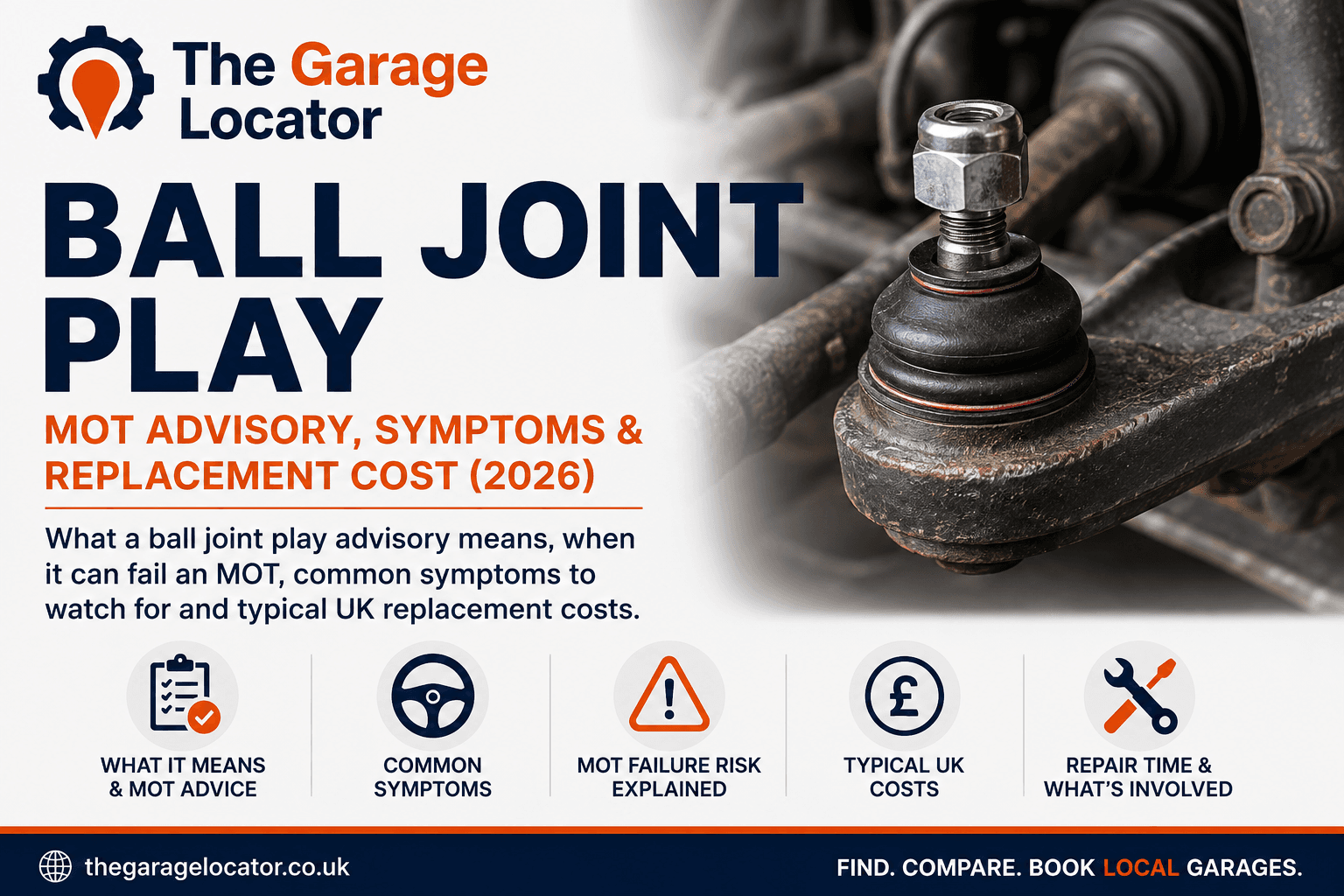
A ball joint play MOT advisory means the tester has detected some wear or movement in a suspension joint, but it was not considered excessive enough to fail the vehicle at that inspection.
It is an early warning worth paying attention to.
Ball joints allow suspension and steering components to move while helping keep the wheel securely located. As a joint wears, unwanted movement can increase, potentially affecting steering accuracy, tyre wear, wheel alignment and vehicle stability.
If the wear becomes excessive, the vehicle can fail its MOT. In the most severe circumstances, a joint that is likely to become detached represents a much more serious safety risk.
This guide explains what ball joint play means, whether you can continue driving, symptoms of a worn ball joint, MOT failure risk and typical UK replacement costs.
In this guide
- What ball joint play means
- What a ball joint does
- Slight play vs excessive play
- Whether ball joint play will fail an MOT
- Whether it's safe to drive
- Symptoms of a worn ball joint
- Common causes
- Ball joint dust-cover damage
- How garages inspect ball joints
- Typical UK replacement costs
- Ball joint vs complete suspension-arm replacement
- Wheel alignment
- Used-car buying advice
- Frequently asked questions
What does a ball joint play advisory mean?
A ball joint play advisory normally means the MOT tester has detected some movement in a suspension joint, but the amount of wear did not reach the failure threshold at that inspection.
Published MOT histories can contain wording such as:
- Ball joint has slight play
- Lower suspension ball joint has slight play
- Nearside Front Lower Ball Joint has slight play
- Offside Front Lower Ball Joint has slight play
- Suspension ball joint worn but not resulting in excessive movement
- Ball joint beginning to wear
The precise wording varies according to the component and condition found.
The important distinction is between slight play and excessive wear.
A small amount of wear may be recorded as an advisory.
Once the joint becomes excessively worn, it can become an MOT failure.
If you're investigating an advisory on a vehicle you're considering buying, use our Free MOT History Checker to see whether the warning has appeared on previous tests.
What is a ball joint?
A ball joint is a pivoting joint used within the vehicle's suspension and steering geometry.
Its ball-and-socket design allows connected components to move in different directions while remaining securely joined.
Depending on the vehicle's suspension design, ball joints help the wheels:
- Move up and down with the suspension
- Turn with steering movement
- Maintain their position relative to the suspension
- Respond to road movement
- Maintain stable wheel geometry
Ball joints are subjected to continual movement and loading whenever the vehicle is driven.
That makes them normal wear components over the life of a vehicle.
Why are ball joints important?
Ball joints help maintain controlled movement between the wheel assembly and suspension.
Healthy joints contribute to:
- Stable handling
- Accurate steering
- Correct suspension movement
- Consistent wheel positioning
- Predictable braking behaviour
- Even tyre wear
As wear develops, additional movement can appear where the joint should remain controlled.
Initially, this may be small enough that the driver notices nothing.
As the wear progresses, knocking, steering changes and tyre-wear problems can develop.
What is the difference between slight ball joint play and excessive play?
This is the key distinction when interpreting a ball-joint MOT advisory.
| Condition | What it can mean |
|---|---|
| No abnormal play | No significant wear detected |
| Slight play | Wear is present but has not reached the failure threshold |
| Increasing movement | Joint is deteriorating and should be inspected |
| Excessive play | Wear has become serious enough to fail the MOT |
| Joint likely to detach | Severe safety-critical condition |
A vehicle can therefore pass one MOT with a slight-play advisory and later fail if the same joint continues to deteriorate.
There is no reliable number of miles or months that tells you exactly when this will happen.
Will ball joint play fail an MOT?
It depends on the severity of the wear.
A ball joint that is excessively worn can result in a Major defect.
At the severe end of the scale, a suspension joint that is likely to become detached can be classified as Dangerous.
| Ball joint condition | Possible MOT outcome |
|---|---|
| No significant wear | Pass |
| Slight play | May pass with advisory |
| Excessive wear/play | Major defect |
| Joint likely to become detached | Dangerous defect |
This is why finding the words "slight play" in an MOT history is different from finding "excessively worn".
An advisory means deterioration has been identified before it reached the applicable failure threshold at that test.
For more information about these classifications, read MOT Advisory Codes Explained.
Is a worn ball joint dangerous?
A slight-play advisory does not automatically mean the vehicle is immediately dangerous.
However, a ball joint is a safety-critical suspension component, and progressive wear should not be ignored.
Increasing wear can contribute to:
- Knocking or clunking
- Loose or vague steering
- Vehicle wandering
- Poor wheel alignment
- Uneven tyre wear
- Reduced suspension control
- Unstable handling
In severe circumstances, deterioration can progress to the point where the joint risks becoming detached.
That is fundamentally different from the minor wear represented by a slight-play advisory.
Can you drive with ball joint play?
A vehicle that has passed its MOT with an advisory for slight ball-joint play may allow time to arrange inspection and repair.
You should have it checked sooner if:
- Knocking becomes noticeable
- Steering feels loose
- The vehicle begins wandering
- Steering vibration develops
- Tyres wear unevenly
- Handling changes
- The same advisory appears repeatedly
If the joint has excessive play, the vehicle becomes significantly unstable or the joint is considered likely to detach, do not continue normal driving.
Arrange professional assessment and repair.
An MOT only records the condition observed at the time of inspection. It does not guarantee how long a worn joint will remain below the failure threshold.
What are the symptoms of a worn ball joint?
Early wear may produce no noticeable symptoms.
As deterioration progresses, possible signs include:
- Knocking over bumps
- Clunking while turning
- Loose steering
- Vague steering response
- Vehicle wandering
- Steering vibration
- Uneven tyre wear
- Poor wheel alignment
- Unstable handling
- Changes in braking stability
These symptoms are not unique to ball joints.
Track rod ends, suspension bushes, anti-roll bar links, shock absorbers and other components can produce similar symptoms.
A physical inspection is therefore important.
Our Track Rod End Play guide explains one of the common steering faults that can produce similar symptoms.
What causes ball joints to wear?
Common contributing factors include:
- High mileage
- Age-related wear
- Rough road surfaces
- Potholes
- Kerb impacts
- Damaged protective boots
- Water ingress
- Dirt contamination
- Road salt
- Heavy vehicle loading
- Impact damage
Ball joints experience movement whenever the suspension operates.
Wear therefore accumulates naturally over time, although harsh road conditions and contamination can accelerate it.
Why is the ball joint dust cover important?
The protective rubber boot around a ball joint helps prevent water, dirt and road contamination from reaching the internal joint.
If the cover splits or deteriorates, contamination can enter and accelerate wear.
This can eventually lead to increasing play.
However, dust-cover damage and excessive ball-joint play are not the same defect.
A damaged or deteriorated cover should be assessed on its own condition, while excessive movement in the joint is evidence of mechanical wear.
If an MOT history mentions both, the combination deserves attention because loss of protection can accelerate deterioration of the joint.
Can potholes damage ball joints?
Yes.
A severe pothole impact can transmit substantial force through the wheel and suspension.
Depending on the impact, it can contribute to:
- Ball joint wear or damage
- Suspension-arm damage
- Bush deterioration
- Wheel-alignment changes
- Tyre damage
- Wheel damage
Repeated driving on badly surfaced roads can also accelerate general suspension wear.
If knocking, steering changes or vibration develops after a significant impact, have the steering and suspension inspected.
Can worn ball joints cause uneven tyre wear?
Yes, they can contribute.
Excess movement in a suspension joint can affect wheel positioning and alignment.
This may contribute to abnormal or accelerated tyre wear.
However, uneven tyre wear can also result from:
- Incorrect wheel alignment
- Incorrect tyre pressure
- Worn suspension bushes
- Track rod end wear
- Shock absorber problems
- Other suspension faults
Replacing a worn ball joint cannot restore tyre tread that has already worn away.
The tyres and wheel alignment should therefore be inspected as part of the repair.
How urgent is a ball joint advisory?
Urgency depends on the amount of play and whether symptoms are developing.
| Situation | Recommended response |
|---|---|
| Slight play with no symptoms | Arrange inspection and monitor |
| First advisory | Plan repair before wear becomes excessive |
| Same advisory repeatedly recorded | Arrange repair rather than continuing to defer it |
| Knocking or steering changes | Have the suspension inspected promptly |
| Uneven tyre wear | Inspect the joint, tyres and wheel alignment |
| Excessive play | Repair promptly |
| Joint likely to detach | Do not continue normal driving |
Repeated advisories are especially useful because they can show progressive or unresolved wear across several MOT tests.
For more on interpreting repeated warnings, read How Many MOT Advisories Are Too Many?.
How does a garage check ball joint play?
A garage will normally inspect the suspension joint for unwanted movement and check the surrounding suspension components at the same time.
The inspection may include:
- Checking the ball joint for excessive play
- Inspecting the dust cover
- Looking for splits or contamination
- Checking whether the joint is secure
- Inspecting the suspension arm or wishbone
- Checking suspension bushes
- Inspecting track rod ends
- Looking for corrosion or impact damage
- Checking tyre wear
- Inspecting wheel alignment where appropriate
The technician may move the wheel or suspension while watching and feeling for movement in the joint.
The important question is whether the amount of movement is still slight or has become excessive.
How is a worn ball joint repaired?
A worn ball joint is normally replaced.
Depending on the vehicle, that can mean replacing:
- The ball joint by itself
- The complete suspension arm
- The wishbone assembly
Some vehicles use a ball joint that can be removed separately.
Others integrate the joint into the suspension arm, meaning the complete assembly has to be replaced.
A typical repair may involve:
- Raising and safely supporting the vehicle
- Removing the wheel
- Disconnecting the ball joint
- Removing the old joint or suspension arm
- Inspecting the mounting points and bushes
- Installing the replacement component
- Reassembling the suspension
- Checking the joint for correct operation
- Inspecting related suspension components
- Checking wheel alignment where required
Corrosion and seized fixings can make the repair more difficult.
How much does ball joint replacement cost in the UK?
Typical UK costs are approximately:
| Repair | Typical cost |
|---|---|
| Ball joint replacement | £120–£220 |
| Suspension arm with ball joint | £180–£350 |
| Wheel alignment | £40–£100 |
For many common repairs, approximately £120–£300 is a useful article-level range.
These figures are estimates rather than quotations.
The final cost depends on:
- Vehicle make and model
- Suspension design
- Whether the joint is available separately
- Whether a full suspension arm is required
- Labour rates
- Parts quality
- Accessibility
- Corrosion
- Seized bolts or fixings
- Whether wheel alignment is required
The difference between replacing one joint and replacing a complete wishbone can make a significant difference to the final bill.
Why do some cars need a complete suspension arm?
On some vehicles, the ball joint is built into the suspension arm or wishbone rather than being supplied as a separate replaceable component.
In that case, replacing the worn joint means replacing the complete arm assembly.
That can increase the parts cost, but it may also replace other worn components contained within the arm.
The garage should confirm whether:
- The ball joint can be replaced separately
- The complete arm is required
- The arm bushes are included
- Additional suspension parts are worn
This is worth checking before comparing garage quotations because two quotes may be based on different repair methods.
How long does ball joint replacement take?
Replacing a standalone ball joint commonly takes around 1–2 hours.
Replacing a complete suspension arm may take approximately 1–3 hours.
Additional labour may be required when:
- Bolts are seized
- Corrosion is present
- The joint is pressed into the suspension arm
- Other suspension components require replacement
- Wheel alignment is required afterwards
Vehicle design makes a major difference.
A garage can provide a more accurate estimate after identifying the exact suspension arrangement.
Do you need wheel alignment after replacing a ball joint?
A wheel-alignment check is often recommended after ball joint or suspension-arm replacement.
The joint forms part of the suspension geometry, so replacing it can affect wheel positioning.
Incorrect alignment can contribute to:
- Uneven tyre wear
- Vehicle pulling
- Steering wheel being off-centre
- Reduced tyre life
- Poor steering response
Whether adjustment is required depends on the vehicle and repair carried out, but it is sensible to include alignment in the inspection process.
Should ball joints be replaced in pairs?
Not automatically.
If one ball joint is worn and the opposite side remains in good condition, there may be no need to replace both.
However, both sides should be inspected because they may have experienced similar:
- Mileage
- Age
- Road conditions
- Pothole impacts
- Suspension loads
If both joints show significant wear, replacing both may be sensible.
The decision should be based on actual condition rather than assuming every ball joint replacement must be carried out in pairs.
What is the difference between a ball joint and a track rod end?
They can look similar because both use ball-and-socket style joints, but they serve different functions.
| Ball joint | Track rod end |
|---|---|
| Part of the suspension system | Part of the steering linkage |
| Helps locate and support the wheel assembly | Transfers steering movement towards the wheel |
| Allows suspension movement | Allows steering movement |
| Wear can affect suspension stability and wheel position | Wear can affect steering precision and toe alignment |
| May be part of a complete wishbone | Usually connects to the track rod |
Both can produce similar symptoms, including:
- Knocking
- Steering looseness
- Uneven tyre wear
- Alignment problems
That is why a proper inspection is important.
For the steering-side fault, see our Track Rod End Play guide.
Can a worn ball joint cause knocking?
Yes.
Wear inside the joint can create unwanted movement that produces knocking or clunking.
This may be more noticeable:
- Over bumps
- On rough roads
- During steering movement
- When braking or changing load
However, front suspension knocks can also come from:
- Suspension bushes
- Anti-roll bar links
- Track rod ends
- Shock absorber mountings
- Coil springs
If the MOT has already identified ball joint play, the joint should be included in the diagnosis.
Can worn ball joints affect braking?
They can contribute to unstable vehicle behaviour if the wear becomes significant.
Ball joints help maintain controlled wheel position within the suspension.
Excessive movement can therefore affect how predictably the wheel responds under braking and cornering.
However, braking instability can have many causes, including:
- Tyres
- Brake imbalance
- Suspension bushes
- Shock absorbers
- Wheel alignment
- Steering wear
A wider inspection is important if the vehicle feels unstable under braking.
What happens if you ignore ball joint play?
A worn ball joint will not normally improve on its own.
Continued use can allow movement to increase.
A possible progression is:
Slight play → repeated advisory → increasing wear → excessive play → Major MOT failure
In severe cases, the joint can deteriorate to the point where separation becomes a risk.
Ignoring the problem can also contribute to:
- Poor steering accuracy
- Uneven tyre wear
- Wheel-alignment problems
- Suspension noise
- Reduced stability
- Additional suspension wear
- MOT failure
There is no reliable timetable for how quickly the wear will progress.
Is a repeated ball joint advisory a bad sign?
It deserves attention.
One slight-play advisory does not automatically indicate a serious problem.
However, repeated warnings across several MOT tests can suggest that the joint has continued to wear without being replaced.
Look for a progression such as:
Ball joint has slight play
followed later by:
Ball joint excessively worn
Also look for related advisories involving:
- Suspension bushes
- Track rod ends
- Tyres
- Coil springs
- Shock absorbers
- Wheel alignment
Several suspension and steering warnings appearing together can indicate broader wear.
Use our Free MOT History Checker to review the sequence rather than relying only on the latest test.
Should you buy a car with a ball joint advisory?
A ball joint advisory should not automatically stop you buying a used car.
Ball joints and suspension arms are common replaceable components.
What matters is whether the advisory is slight, repeated or part of a wider pattern.
Before buying, check:
- Which wheel is affected
- Whether the advisory has appeared before
- Whether knocking is present
- Whether steering feels precise
- Whether tyres are wearing unevenly
- Whether other suspension advisories exist
- Whether repair invoices are available
- Whether the joint can be replaced separately
- Whether a complete suspension arm is required
A single slight-play advisory on an otherwise well-maintained vehicle is very different from repeated unresolved suspension defects.
Can you negotiate on a car with a worn ball joint?
Yes, if the repair remains outstanding.
The likely cost depends heavily on whether the ball joint is available separately or whether the entire suspension arm must be replaced.
Before negotiating:
- Obtain a garage quotation
- Confirm the repair method
- Check whether alignment is included
- Inspect the condition of the opposite side
- Check tyre wear
- Look for other suspension faults
A quotation based on replacing one standalone joint may be much lower than the cost of replacing a complete arm and carrying out alignment.
For broader advice, read Buying a Used Car With MOT Advisories.
Ball joint inspection checklist
If you're assessing a vehicle with a ball-joint advisory, check:
- The complete MOT history
- Which side is affected
- Whether the warning has appeared repeatedly
- Whether knocking or clunking is present
- Steering response
- Tyre wear
- Wheel alignment
- Suspension bushes
- Track rod ends
- Dust-cover condition
- Repair invoices
- Evidence of previous suspension work
If you're uncertain, arrange an independent mechanical inspection before buying.
Quick decision guide
| Situation | Recommended action |
|---|---|
| Slight play with no symptoms | Arrange inspection and monitor |
| First ball joint advisory | Plan repair before wear becomes excessive |
| Same advisory appearing repeatedly | Arrange repair rather than continuing to defer it |
| Knocking or clunking develops | Have the suspension inspected promptly |
| Steering becomes loose or vague | Arrange inspection promptly |
| Uneven tyre wear | Check the joint, tyres and wheel alignment |
| Excessive ball joint play | Repair promptly |
| Joint likely to become detached | Do not continue normal driving |
| Buying a car with one slight-play advisory | Check condition and obtain a repair estimate |
| Several steering and suspension advisories | Arrange a broader steering and suspension inspection |
Frequently Asked Questions
What does a ball joint play advisory mean?
It means the MOT tester has detected some movement in a suspension joint, but the wear was not considered excessive enough to fail the vehicle at that inspection.
Is a worn ball joint dangerous?
Slight play is not automatically an immediate danger.
However, ball joints are safety-critical suspension components and progressive wear should not be ignored.
If deterioration becomes severe enough that the joint is likely to detach, the condition becomes much more serious.
Can you drive with a worn ball joint?
A vehicle that has passed with slight ball-joint play may allow time to arrange inspection and repair.
Have the vehicle checked sooner if knocking, loose steering, wandering, vibration or uneven tyre wear develops.
Do not continue normal driving if the joint is severely worn or considered likely to detach.
Will ball joint play fail an MOT?
Slight play may be recorded as an advisory.
A ball joint that becomes excessively worn can result in a Major defect.
A joint likely to become detached can be classified as Dangerous.
How much does ball joint replacement cost?
Typical UK costs are approximately £120–£220 for a standalone ball joint replacement.
If the complete suspension arm or wishbone needs replacing, costs can be around £180–£350.
Wheel alignment may add approximately £40–£100.
How long does ball joint replacement take?
A standalone ball joint commonly takes around 1–2 hours to replace.
Replacing a complete suspension arm may take approximately 1–3 hours.
Corrosion, seized components and alignment work can increase labour time.
Do ball joints need replacing in pairs?
Not automatically.
If one joint is worn and the opposite side remains serviceable, there may be no reason to replace both.
However, the opposite side should be inspected because both components may have experienced similar age, mileage and road conditions.
Does replacing a ball joint require wheel alignment?
A wheel-alignment check is often recommended after ball joint or suspension-arm replacement.
The repair can affect suspension geometry and wheel position.
Correct alignment helps prevent uneven tyre wear and steering problems.
What are the symptoms of a worn ball joint?
Possible symptoms include:
- Knocking or clunking over bumps
- Loose steering
- Vehicle wandering
- Steering vibration
- Uneven tyre wear
- Poor wheel alignment
- Unstable handling
Early wear may produce no noticeable symptoms.
Can a worn ball joint cause knocking?
Yes.
Movement inside a worn joint can cause knocking or clunking, especially over bumps or during steering movement.
Other suspension components can create similar noises, so the cause should be confirmed by inspection.
Can a worn ball joint cause tyre wear?
Yes.
Excessive movement can affect wheel position and alignment, contributing to uneven tyre wear.
The tyres and alignment should be checked as part of the repair.
What is the difference between a ball joint and a track rod end?
A ball joint is primarily part of the suspension system and allows controlled movement between suspension components.
A track rod end is part of the steering linkage and transfers steering input towards the wheel.
Both can develop play and produce similar symptoms, but they perform different jobs.
For the steering-side fault, read our Track Rod End Play guide.
Can a damaged ball joint dust cover cause wear?
Yes.
A damaged dust cover can allow water and dirt into the joint, which can accelerate internal wear.
However, dust-cover damage and actual excessive joint play are separate defects and should be assessed independently.
Can a ball joint advisory disappear from the next MOT?
Yes.
The same warning may not appear on a later MOT if the component has been replaced or the condition is not recorded again.
However, the original advisory remains visible within that historical MOT result.
Repair invoices provide stronger evidence that work was completed.
Should I buy a car with a ball joint advisory?
A slight ball-joint advisory should not automatically prevent you from buying the vehicle.
Check whether the warning is repeated, whether the steering and suspension feel normal, whether tyres are wearing evenly and whether other suspension advisories are present.
Factor any outstanding repair into the purchase decision.
How can I check previous ball joint advisories?
Review the vehicle's complete MOT history.
Our Free MOT History Checker lets you examine previous advisories, failures and mileage records.
Look especially for repeated ball-joint warnings and related issues involving bushes, track rod ends, tyres and other suspension components.
Final thoughts
A ball joint play MOT advisory normally means some wear has developed in a suspension joint, but the amount of movement was not considered excessive enough to fail the vehicle at that inspection.
The key distinction is between slight play and excessive wear.
Slight play is an early warning. Excessive wear can become a Major MOT defect, while a joint that is likely to detach represents a much more serious condition.
Typical UK repair costs are approximately £120–£220 for a standalone ball joint, although some vehicles require a complete suspension arm or wishbone costing around £180–£350.
Repeated advisories, worsening symptoms, uneven tyre wear and other suspension defects provide much more useful context than a single MOT entry.
Use our Free MOT History Checker to review the vehicle's complete MOT history.
For other MOT warnings, read MOT Advisory Codes Explained: What Every MOT Warning Means.