Affiliate disclosure: As an Amazon Associate I earn from qualifying purchases.
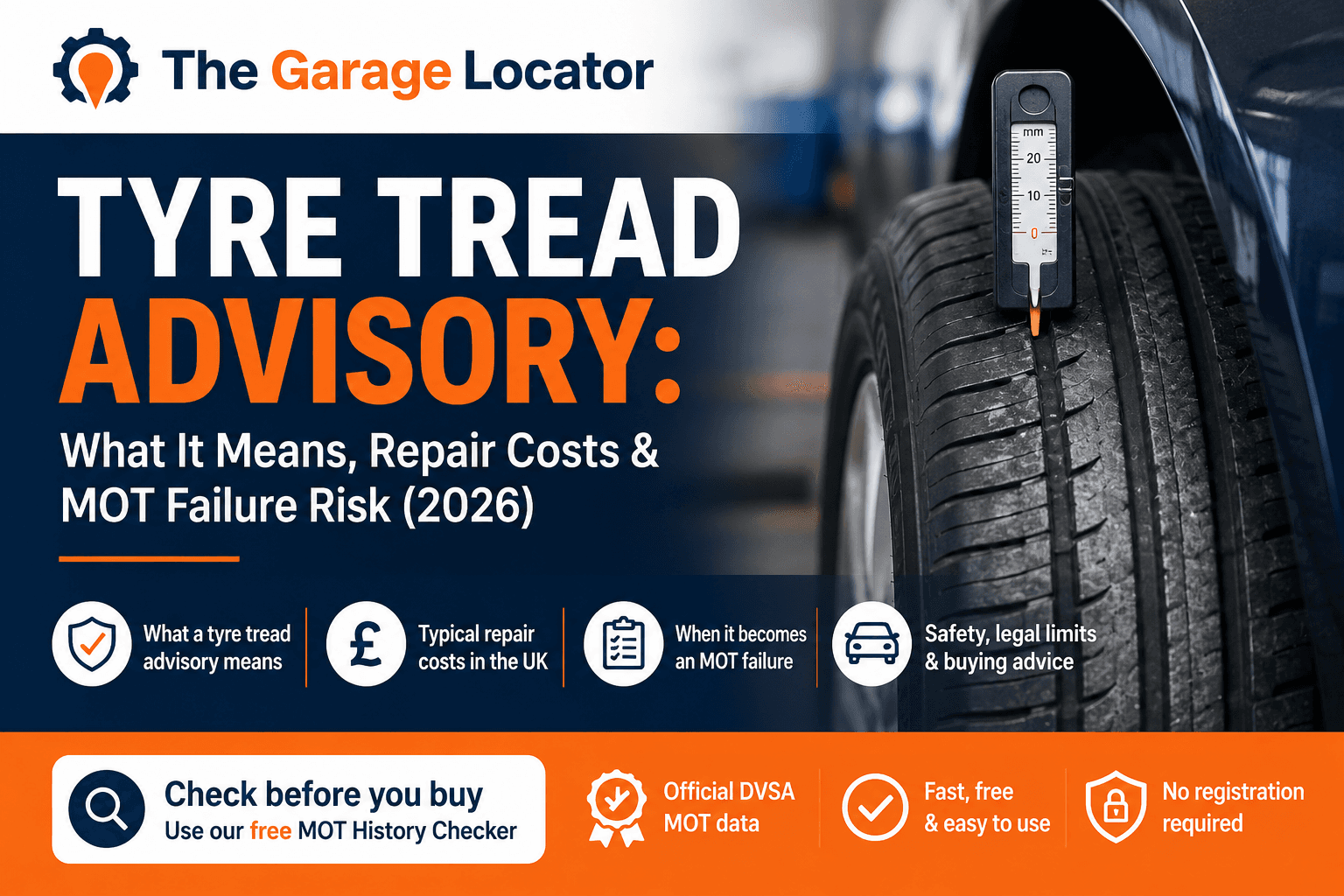
Seeing "tyre worn close to legal limit/worn on edge" on an MOT history means the tyre passed the tread-depth requirements when it was tested, but the tester identified enough wear to warn that attention may soon be needed.
It is not the same as an MOT failure.
However, tyres continue to wear after the test, and a tyre that is already close to the legal limit can eventually become both an MOT failure and illegal to use on the road.
The exact wording is particularly important when buying a used car because it can reveal more than simple tyre wear. Repeated edge wear can sometimes point towards tyre-pressure, alignment, steering or suspension issues that deserve further investigation.
At a glance
- Current MOT result
- Passed with an advisory
- Legal tread depth
- 1.6 mm across the required central three-quarters
- Repair priority
- Inspect regularly and replace before the tyre becomes illegal
- Used-car significance
- Check for repeated or uneven tyre wear in the MOT history
Before replacing tyres or buying a used vehicle, use our free MOT History Checker to review its previous advisories, failures and recorded mileage.
What Does "Tyre Worn Close to Legal Limit/Worn on Edge" Mean?
This is advisory wording used when an MOT tester identifies tyre wear that deserves attention but does not meet the relevant failure criteria at the time of the test.
You may see wording such as:
- Tyre worn close to legal limit/worn on edge
- Front tyre worn close to legal limit/worn on edge
- Rear tyre worn close to legal limit/worn on edge
- Nearside front tyre worn close to legal limit/worn on edge
- Offside front tyre worn close to legal limit/worn on edge
- Nearside rear tyre worn close to legal limit/worn on edge
- Offside rear tyre worn close to legal limit/worn on edge
- Both front tyres worn close to legal limit/worn on edge
- Both rear tyres worn close to legal limit/worn on edge
The position tells you which tyre or tyres were affected.
The key distinction is the word advisory.
The tyre was not recorded as failing the applicable tread-depth requirement at that MOT, but the tester considered its condition worth bringing to the vehicle owner's attention.
Advisory does not mean illegal
If you're unsure how advisory items work, read What Are MOT Advisories?.
What Is the Legal Tyre Tread Depth in the UK?
For most cars and light vehicles, the minimum legal tread depth is 1.6 mm.
The required tread must be present across the central three-quarters of the breadth of the tyre and around its entire circumference.
This distinction matters.
People sometimes assume the whole width of the tyre must have at least 1.6 mm of tread, but the legal tread-depth requirement is based on the prescribed central portion of the tyre.
Quick facts
- UK legal minimum
- 1.6 mm
- Required area
- Central three-quarters of the tyre breadth
- Circumference
- Required around the entire circumference
- Advisory meaning
- Wear identified but tyre passed the relevant requirement when tested
- Failure risk
- Continued wear can eventually result in a Dangerous MOT defect
Is "Worn Close to Legal Limit" an MOT Failure?
No — not when it is recorded as an advisory.
It means the tyre passed the applicable requirement when inspected but was sufficiently worn for the tester to draw attention to it.
A tyre that no longer meets the required tread depth is different.
Under the MOT inspection criteria, a tyre whose tread depth is not in accordance with the requirements can receive a Dangerous defect.
That means there is a significant difference between:
Advisory
Tyre worn close to legal limit/worn on edge
and:
MOT failure
Tyre tread depth not in accordance with the requirements
What Does "Worn on Edge" Mean?
The "worn on edge" part of the advisory deserves particular attention.
Tyre wear is not always uniform.
A tyre can have reasonable tread in one area while showing substantially greater wear towards an inner or outer edge.
Possible causes include:
Diagnosis guide
Common causes of tyre edge wear
Incorrect wheel alignment
Incorrect tyre pressure
Worn steering components
Worn suspension components
Vehicle geometry problems
Normal wear combined with driving conditions
The wear pattern can sometimes provide clues about the cause.
For example:
- Inner-edge wear can be associated with alignment or geometry problems.
- Outer-edge wear can also be associated with alignment, pressure or driving conditions.
- Wear on both shoulders can be associated with under-inflation.
- Excessive centre wear can be associated with over-inflation.
- Irregular or scalloped wear may justify checking suspension components.
These are possible causes rather than diagnoses.
A garage should inspect the vehicle if the tyre is wearing unevenly.
Why Does Uneven Tyre Wear Matter?
Because simply fitting another tyre may not solve the underlying problem.
Imagine a car repeatedly showing:
2024: Nearside front tyre worn on edge
2025: Nearside front tyre worn on edge
2026: Nearside front tyre worn on edge
The tyre itself may have been replaced during that period, but repeated wear in a similar position could justify checking:
- wheel alignment
- steering components
- suspension bushes and joints
- tyre pressures
- wheel or suspension geometry
This is where MOT history becomes particularly useful.
One tyre advisory is usually a relatively ordinary maintenance issue.
A repeated pattern can tell you considerably more.
Is It Safe to Drive With a Tyre Tread Advisory?
Often, yes — if the tyre has only received an advisory and remains otherwise legal and roadworthy.
But that does not mean you should ignore it.
Tyres provide the contact between your vehicle and the road. Their condition directly affects braking, steering and grip.
As tread becomes more worn, the tyre's ability to disperse water can deteriorate.
Is it safe to drive?
An advisory means the tyre passed the relevant requirement when tested. It does not guarantee how much usable life remains.
Driving guidance
- Check the tread depth and overall tyre condition regularly.
- Arrange replacement before the tyre reaches the legal limit.
- Investigate significant or repeated uneven edge wear.
If you're uncertain about driving after any advisory, see Can You Drive With an MOT Advisory?.
How Close to 1.6 mm Is Too Close?
There isn't a universal mileage figure that tells you when an advisory tyre will become illegal.
A tyre with limited tread remaining may last very different lengths of time depending on:
- annual mileage
- driving style
- vehicle weight
- road surfaces
- tyre construction
- tyre pressure
- wheel alignment
- suspension condition
This is why trying to convert an MOT advisory into a statement such as "you have 2,000 miles left" is unreliable.
Measure the tyre rather than guessing.
⚠️ An MOT is only a snapshot
Should You Replace a Tyre at 3 mm?
You will often hear 3 mm discussed when tyre replacement is considered.
It is important not to confuse that figure with the legal minimum.
For most cars, the relevant statutory tread-depth minimum is 1.6 mm across the required portion of the tyre.
A driver may choose to replace a tyre before reaching that point for safety, performance or convenience reasons, particularly when the remaining tread is becoming limited.
The decision should take account of:
- measured tread depth
- tyre condition
- wear pattern
- expected mileage
- weather and driving conditions
- professional inspection where necessary
The key legal figure remains 1.6 mm, not 3 mm.
How Can You Check Tyre Tread Depth?
A dedicated tyre tread-depth gauge is the most useful simple tool. A digital gauge provides a clear measurement in millimetres, making it easier to monitor tread after an MOT advisory.
View the GODESON digital tyre tread-depth gauge on Amazon (Amazon affiliate link)
Check several points around the tyre rather than measuring only one location.
You should inspect:
- the central tread area
- several points around the circumference
- inner and outer edges
- all four tyres
Also look for other tyre defects including:
- cuts
- cracking
- bulges
- exposed cords
- unusual deformation
- objects embedded in the tyre
If the MOT specifically mentions edge wear, make sure the affected edge is actually inspected.
Inner-edge wear can be particularly easy to miss during a casual visual check.
What Are Tyre Wear Indicators?
Many tyres incorporate tread-wear indicators within their main grooves.
These provide a useful visual reference as the tread wears.
However, they should not replace proper inspection and measurement where there is uncertainty about tread depth.
If your MOT has already recorded a tyre as close to the legal limit, using a tread-depth gauge gives you much more useful information than waiting for the next MOT.
How Quickly Can an Advisory Tyre Become Illegal?
There is no reliable fixed answer.
Consider two cars with exactly the same tread depth.
One covers 3,000 miles per year.
The other covers 20,000 miles per year.
Their tyres clearly will not necessarily reach the legal limit at the same time.
Wear can also accelerate if:
- wheel alignment is incorrect
- tyre pressures are wrong
- suspension components are worn
- the vehicle regularly carries heavy loads
- driving style is aggressive
That's why the correct response to a tyre advisory is monitor and inspect, not simply assume it will last until the next MOT.
Warning Signs a Tyre Needs Attention
You should inspect the tyres regardless of MOT history if you notice:
Some of these conditions involve defects other than tread depth and may have their own MOT or roadworthiness implications.
How Much Does Tyre Replacement Cost in the UK?
Replacement cost varies considerably according to:
- tyre size
- manufacturer
- performance rating
- vehicle type
- wheel diameter
- load and speed rating
- whether run-flat or specialist tyres are required
As a broad planning range, many ordinary replacement tyres may cost approximately:
- Budget: £70–£100 per tyre
- Mid-range: £100–£140 per tyre
- Premium: £140–£180+ per tyre
Large SUVs, EVs, performance vehicles and specialist tyre sizes can cost substantially more.
Typical tyre replacement cost
£70–£180
This is a broad UK planning range rather than a quote. Actual fitted prices depend heavily on tyre size, specification, brand and vehicle.
If you're buying a used vehicle with two or four tyre advisories, remember to calculate the potential total replacement cost rather than budgeting for only one tyre.
How Long Does Tyre Replacement Take?
Tyre replacement is generally a relatively quick workshop job when the correct tyre is available.
Repair time
Typical repair time
- Tyre inspection
- 10–15 minutes
- Single tyre replacement
- 20–30 minutes
- Two tyres replaced
- 30–45 minutes
- Typical turnaround
- Usually same day
Additional time may be required if the tyre has to be ordered or the vehicle also needs alignment or mechanical investigation.
A fitter will normally remove the old tyre, inspect the wheel, fit the replacement, inflate it correctly and balance the wheel.
If abnormal wear is present, simply fitting a tyre may not be the end of the job.
Should Wheel Alignment Be Checked?
If the tyre has worn unevenly, it can be sensible to investigate alignment and other possible causes.
Alignment affects the direction in which the wheels sit relative to the vehicle and road.
Incorrect geometry can cause a tyre to scrub against the road rather than wear evenly.
Possible signs include:
- heavy wear on one edge
- vehicle pulling to one side
- steering wheel sitting off-centre
- rapid wear after fitting new tyres
However, alignment is not the only possible cause.
Worn suspension or steering components can also affect tyre wear.
This is why diagnosis matters.
Can Suspension Problems Cause Tyre Edge Wear?
Yes.
Suspension components control wheel movement and help maintain the correct relationship between the tyre and road.
Wear in components such as bushes, joints or other suspension parts can affect wheel geometry and contribute to abnormal tyre wear.
This gives us an important MOT-history pattern to look for.
A tyre advisory appearing alongside repeated suspension or steering advisories may deserve more investigation than an isolated worn tyre.
For a used-car buyer, the combination matters.
Can Incorrect Tyre Pressure Cause Uneven Wear?
Yes.
Incorrect inflation can affect both tyre wear and vehicle behaviour.
Under-inflation can contribute to increased shoulder wear, while excessive inflation can contribute to greater wear towards the centre of the tread.
Always use the vehicle manufacturer's recommended tyre pressures rather than guessing from the tyre itself.
Pressures should also be checked regularly because gradual pressure loss can occur without an obvious puncture.
A portable digital inflator can make routine pressure checks and adjustments easier. Check pressures when the tyres are cold and always use the figures specified in the vehicle handbook or on the vehicle’s pressure label.
View the RING TYREINFLATE GO 2 on Amazon (Amazon affiliate link)
An inflator is not a repair for repeated pressure loss. If a tyre continues losing pressure, have the tyre, valve and wheel inspected.
Should Tyres Be Replaced in Pairs?
Not every situation requires replacing two tyres simply because one needs replacement.
The correct decision depends on:
- condition of the other tyre on the axle
- remaining tread
- vehicle drivetrain
- tyre specifications
- manufacturer recommendations
In some situations, matching tyres and tread characteristics across an axle can be important for consistent handling.
Ask the tyre fitter or follow the vehicle manufacturer's requirements rather than applying a universal rule.
Should You Replace All Four Tyres?
Not automatically.
If only one or two tyres are approaching the end of their usable life, replacing all four may be unnecessary.
However, if all four are heavily worn or similarly close to replacement, fitting a complete set may make sense.
Four-wheel-drive and certain other vehicles can also have specific requirements regarding tyre circumference and tread differences.
Follow manufacturer guidance for the particular vehicle.
What If the Same Tyre Advisory Appears Every Year?
This is where MOT history becomes especially useful.
Repeated advisories can indicate:
- the tyre was never replaced,
- another tyre later developed similar wear,
- replacement tyres are wearing unusually quickly, or
- an underlying cause has not been corrected.
Don't assume which explanation applies from the MOT history alone.
Instead, look at:
- tyre position
- advisory wording
- mileage between tests
- suspension advisories
- steering advisories
- previous tyre failures
A recurring pattern can justify a physical inspection before buying the car.
Use our free MOT History Checker to review the complete timeline.
Is a Tyre Advisory a Red Flag When Buying a Used Car?
Usually not by itself.
Tyres are consumable components.
Eventually every vehicle needs replacement tyres.
A single advisory for a tyre approaching the legal limit may therefore be ordinary wear and tear.
The situation becomes more interesting when you see:
- several worn tyres
- repeated tyre advisories
- recurring edge wear
- suspension defects at the same wheel
- steering defects
- tyre failures after earlier advisories
- evidence that inexpensive maintenance has repeatedly been postponed
Can You Negotiate the Price of a Used Car Because of Worn Tyres?
Potentially.
A tyre advisory represents a foreseeable ownership cost.
If a car needs two tyres shortly after purchase, obtaining a real replacement quote gives you a sensible basis for discussing price with the seller.
For example, don't simply claim:
"The MOT has advisories, so I want £500 off."
Instead establish:
- which tyres need replacing
- suitable replacement specification
- fitted price
- whether alignment or another repair is required
That creates a much more defensible negotiation position.
One Tyre Advisory vs Four Tyre Advisories
The number of affected tyres matters.
One tyre
Could simply represent normal wear, a previous puncture replacement creating different tread depths, or a localised issue.
Two tyres on the same axle
May represent broadly similar wear across that axle.
Several tyres
Can create a more substantial near-term replacement bill.
Repeated uneven wear at the same position
May justify investigation of alignment, steering or suspension.
This is another reason to look at the full MOT timeline rather than judging the vehicle from one advisory.
What If a Tyre Advisory Disappears at the Next MOT?
That is generally a useful sign.
It may indicate that:
- the tyre was replaced,
- the condition was addressed, or
- the relevant advisory was no longer present.
An MOT history cannot prove exactly what repair was performed unless supporting maintenance records are available.
But when assessing a used vehicle, advisories that appear and are subsequently cleared can be more reassuring than the same defects recurring year after year.
Tyre Advisory vs Dangerous Tyre Defect
These should not be treated as equivalent.
An advisory such as:
Tyre worn close to legal limit/worn on edge
indicates that the tyre passed the relevant requirement but deterioration was noted.
A tread-depth defect that does not comply with the MOT requirement can be categorised as Dangerous.
That is a fundamentally different situation.
⚠️ Do not rely on an old MOT pass
Can You Ignore a Tyre Advisory?
You are not normally required to repair an advisory simply because it appears on the MOT certificate.
But ignoring tyre wear until the next annual test is a poor strategy.
Tyres can cross the legal threshold between MOT tests.
Regular checks give you the opportunity to replace them at a convenient time rather than discovering an illegal tyre immediately before a journey or at the next MOT.
💷 Plan replacement rather than waiting for failure
What Are the Penalties for Illegal Tyres?
Driving with tyres that do not meet legal requirements can result in enforcement action.
For defective tyres, penalties can apply per tyre, which means multiple illegal tyres can make the consequences considerably more serious.
More importantly, tyres are safety-critical.
The aim should be to replace or repair an unsafe or illegal tyre because of the risk it creates, not merely to avoid the next MOT failure.
How to Check a Used Car With a Tyre Advisory
If you're viewing a used vehicle whose MOT history contains tyre advisories, inspect the car rather than relying entirely on the certificate.
Check:
- all four tyres
- tread depth
- inner edges
- outer edges
- tyre brands
- tyre sizes
- cracking or damage
- whether tyres on the same axle are broadly comparable
- evidence of abnormal wear
Then compare what you see with the MOT history.
What Other MOT Advisories Should You Look For?
Tyre wear can connect with several other areas of the vehicle.
Pay particular attention to:
- suspension bushes
- suspension ball joints
- track rod ends
- steering joints
- wheel alignment symptoms
- damaged wheels
- other tyre advisories
An isolated tyre nearing the legal limit is usually much less concerning than repeated tyre wear alongside unresolved suspension and steering defects.
Why MOT History Matters More Than One Tyre Advisory
An MOT certificate is a snapshot.
A full MOT history is a timeline.
Suppose two cars both have the same current tyre advisory.
Car A
Had no previous tyre or suspension issues and otherwise has a clean history.
Car B
Has repeatedly shown edge-worn tyres, steering advisories and suspension defects.
The wording on today's certificate might be similar, but the maintenance story is very different.
That's exactly why we built our free MOT History Checker around historical MOT data rather than showing only the latest result.
Frequently Asked Questions
What does "tyre worn close to legal limit/worn on edge" mean?
It means the MOT tester identified significant tyre wear worth bringing to the owner's attention, but the tyre passed the applicable tread-depth requirement when it was tested.
Is tyre worn close to legal limit an MOT failure?
Not when recorded as an advisory. If the tread subsequently no longer meets the legal requirement, the tyre can fail the MOT.
What is the UK legal tyre tread depth?
For most cars, the minimum is 1.6 mm across the central three-quarters of the tyre breadth and around the entire circumference.
Is a tyre below 1.6 mm a Dangerous MOT defect?
A tyre whose tread depth does not comply with the applicable requirement can receive a Dangerous defect under the MOT inspection criteria.
Can I drive with a tyre tread advisory?
Usually, provided the tyre remains legal and roadworthy. Check its condition regularly and replace it before it becomes illegal or unsafe.
What does "worn on edge" mean?
It means greater wear has been observed towards an edge of the tyre. Uneven edge wear can sometimes be associated with tyre pressure, alignment, steering or suspension issues.
Does inner-edge tyre wear fail an MOT?
It depends on whether the tyre meets the applicable tread and condition requirements. Edge wear should still be investigated because it may indicate abnormal wear or another vehicle problem.
How long will a tyre advisory last?
There is no fixed mileage. Wear rate depends on mileage, driving style, pressures, alignment, vehicle characteristics and other factors.
Should I replace a tyre at 3 mm?
The legal minimum for most cars is 1.6 mm across the required part of the tread. Drivers may choose to replace tyres earlier depending on condition and circumstances, but 3 mm should not be confused with the statutory minimum.
How much does a replacement tyre cost?
As a broad planning range, approximately £70–£180+ per tyre covers many ordinary budget-to-premium replacements, but actual prices vary substantially by size and specification.
Can wheel alignment cause tyre edge wear?
Incorrect alignment can contribute to abnormal tyre wear. However, steering, suspension, tyre-pressure and other issues can also be involved, so persistent uneven wear should be investigated.
Is a tyre advisory bad when buying a used car?
Not necessarily. Tyres are wear items. Repeated edge wear, several affected tyres or tyre advisories appearing alongside suspension and steering defects deserve more investigation.
Can I negotiate on a used car with worn tyres?
Yes. If replacement will be required soon, obtain realistic fitted tyre prices and use the expected cost when assessing or negotiating the vehicle's price.
Check the Full MOT History Before You Decide
A "tyre worn close to legal limit/worn on edge" advisory is normally a warning rather than an MOT failure.
The tyre met the relevant requirement when tested, but deterioration had progressed far enough for the tester to flag it.
For an existing owner, the sensible response is to inspect the tyre regularly, investigate abnormal wear and replace it before it becomes illegal or unsafe.
For a used-car buyer, go further.
Check whether the advisory is isolated or part of a pattern involving repeated tyre wear, suspension defects, steering problems or delayed maintenance.
Use The Garage Locator's free MOT History Checker to review the vehicle's previous tests, advisories, failures and mileage history before making your decision.