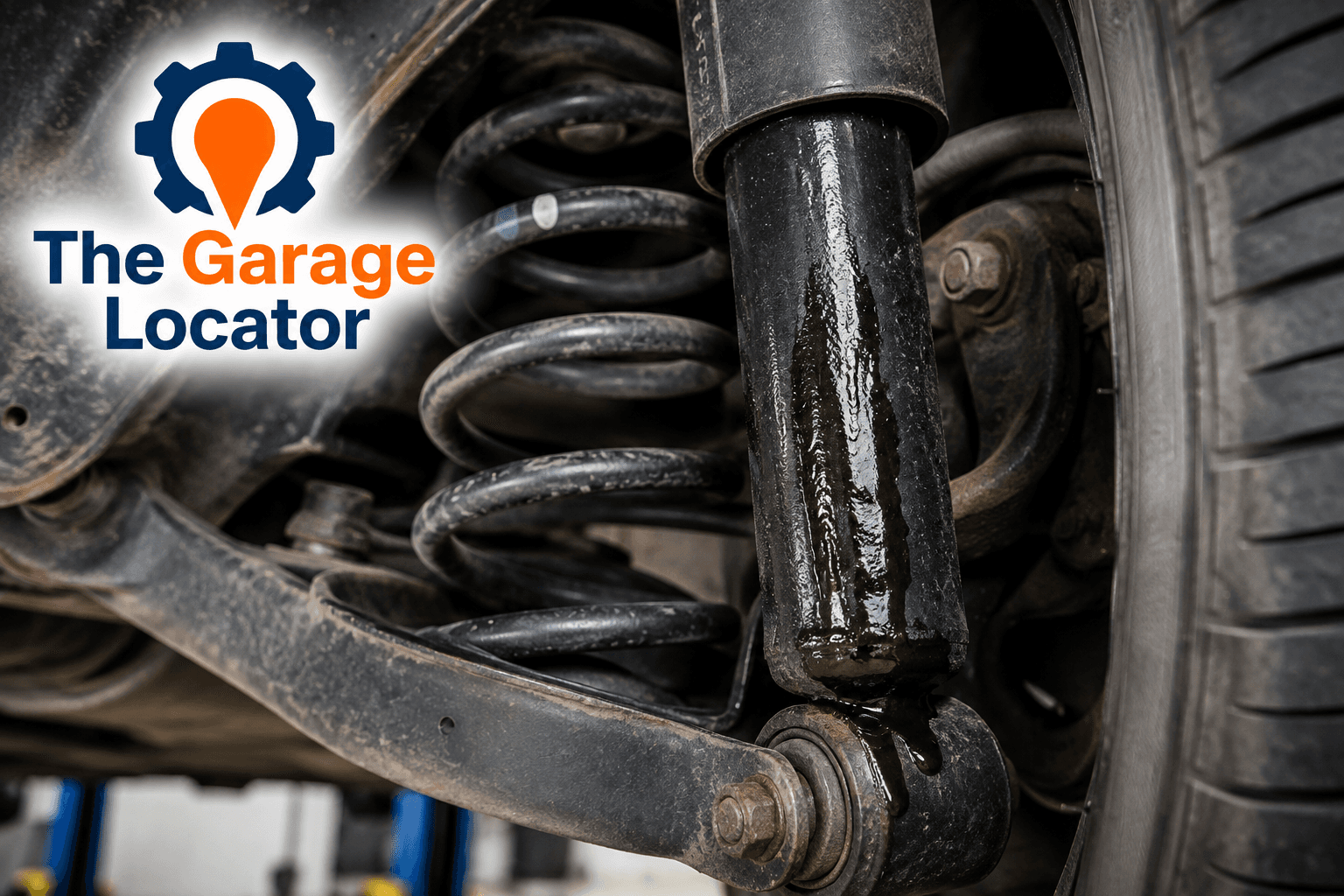
A shock absorber leaking means hydraulic fluid is escaping from the suspension damper. A small amount of misting does not necessarily mean the shock absorber has failed, but a serious fluid leak can result in an MOT failure.
Shock absorbers control suspension movement and help keep the tyres in contact with the road. As fluid escapes, the damper can become less effective, potentially affecting handling, braking stability, tyre wear and ride quality.
This guide explains the difference between shock absorber misting and leaking, when a leak can fail an MOT, whether the vehicle is safe to drive, symptoms of a failing shock absorber and typical UK replacement costs.
In this guide
- What a leaking shock absorber means
- Shock absorber misting vs leaking
- Whether a leaking shock absorber will fail an MOT
- Common MOT wording
- What shock absorbers do
- Symptoms of a leaking or failed shock absorber
- Whether it's safe to drive
- How quickly it should be repaired
- Common causes of shock absorber leaks
- How garages diagnose the problem
- Shock absorber replacement costs
- Whether shock absorbers should be replaced in pairs
- Buying a used car with leaking shock absorbers
- Frequently asked questions
What does a leaking shock absorber mean?
Shock absorbers, also known as dampers, contain hydraulic fluid that helps control the movement of the suspension.
When an internal seal begins to fail, oil can escape onto the outside of the shock absorber.
Depending on the severity, an MOT record might describe the problem using wording such as:
- Shock absorber leaking slightly
- Shock absorber beginning to leak
- Rear shock absorber showing signs of leakage
- Front shock absorber leaking lightly
- Suspension damper showing oil leakage
- Shock absorber has a serious fluid leak
The amount and severity of the leakage matters.
A small amount of misting around the damper is different from hydraulic fluid visibly running down the shock absorber.
Shock absorber misting vs leaking: what's the difference?
This distinction is particularly important.
A light film of oil around a shock absorber can sometimes be described as misting. This does not necessarily mean the damper has lost enough fluid to stop functioning correctly.
A genuine leak is more significant.
| Condition | What it can indicate |
|---|---|
| Light misting | Small film of oil around the damper |
| Slight leakage | Possible seal deterioration that needs monitoring |
| Visible fluid running down the shock absorber | More significant leakage |
| Serious fluid leak | MOT Major defect |
You should therefore not assume that every trace of oil means the shock absorber needs immediate replacement.
Equally, don't dismiss obvious fluid leakage as harmless misting.
If you're unsure which description appeared on a previous MOT, use our Free MOT History Checker to review the vehicle's previous advisories and failures.
Will a leaking shock absorber fail an MOT?
It can.
Under the MOT inspection criteria, a shock absorber with a serious fluid leak is a Major defect and will fail the MOT.
The distinction is severity.
A tester may observe a small amount of leakage or misting without considering it serious enough to meet the rejection criteria.
A significant hydraulic fluid leak is different.
| Shock absorber condition | Likely MOT outcome |
|---|---|
| Light oil misting | May pass |
| Minor signs of leakage | May be recorded as an advisory |
| Serious fluid leak | Major defect — MOT fail |
| Shock absorber insecure | Major defect — MOT fail |
| Shock absorber missing | Major defect — MOT fail |
There isn't a simple rule that says any visible oil automatically means failure.
The tester assesses the condition of the shock absorber and whether the fluid loss meets the MOT rejection criteria.
For an explanation of Major, Minor, Dangerous and advisory classifications, read our MOT Advisory Codes Explained guide.
What does a shock absorber do?
Shock absorbers work with the vehicle's springs to control suspension movement.
The spring allows the wheel to move when the vehicle travels over bumps. Without sufficient damping, however, the spring could continue oscillating after the initial movement.
The shock absorber controls that movement.
Shock absorbers help:
- Reduce excessive bouncing
- Keep tyres in contact with the road
- Improve braking stability
- Control body movement
- Maintain steering stability
- Improve ride comfort
- Keep suspension movement controlled
This is why a leaking shock absorber isn't simply a comfort problem.
If enough hydraulic fluid is lost, the damper's ability to control suspension movement can deteriorate.
If your MOT has also mentioned spring corrosion, see our Coil Spring Corroded MOT Advisory guide.
What are the symptoms of a leaking shock absorber?
A minor leak may initially produce few noticeable symptoms.
As the shock absorber deteriorates, possible signs include:
- Visible oil on the shock absorber
- Excessive bouncing after bumps
- Poor ride quality
- Unstable handling
- Increased body movement
- Knocking or suspension noises
- Uneven tyre wear
- Reduced stability over rough roads
- The vehicle feeling less controlled during braking
Not every symptom proves that the shock absorber itself is faulty.
Suspension bushes, springs, tyres, wheel alignment and other components can produce similar behaviour.
A physical inspection is therefore important.
How can you tell if a shock absorber is leaking?
Visible hydraulic oil on the shock absorber body is one of the clearest signs.
A garage will look at the pattern and amount of oil rather than simply checking whether the component is slightly damp.
Possible signs of a genuine leak include:
- Wet oil running down the shock absorber body
- A significant oily area below the damper seal
- Dirt and road debris sticking to leaked oil
- Fluid loss accompanied by poor damping
- Leakage appearing alongside excessive bouncing
Light misting can look different.
A thin film around the upper part of the damper may not represent a serious leak.
If you're unsure, have the suspension inspected rather than trying to judge the severity from the presence of oil alone.
Is it safe to drive with a leaking shock absorber?
It depends on the severity of the leak and how well the shock absorber is still functioning.
A small amount of misting or very minor leakage with no noticeable handling problems may allow time to arrange an inspection.
A serious fluid leak should be treated much more urgently.
Arrange prompt inspection if you notice:
- Excessive bouncing
- Unstable steering
- Poor control over bumps
- New knocking noises
- Significant visible fluid leakage
- Uneven tyre wear
- Noticeably poorer braking stability
If the vehicle feels unstable or difficult to control, do not continue driving simply because the previous MOT only recorded an advisory.
An MOT describes the vehicle's condition at the time it was inspected. A suspension fault can deteriorate afterwards.
How quickly should a leaking shock absorber be repaired?
The appropriate response depends on the severity.
| Condition | Recommended action |
|---|---|
| Light misting with normal suspension behaviour | Monitor and arrange inspection |
| Slight leakage | Have the shock absorber checked |
| Increasing leakage | Arrange repair promptly |
| Excessive bouncing or poor handling | Arrange inspection immediately |
| Serious fluid leak | Replace the affected shock absorber |
| MOT failure for serious leakage | Repair before returning the vehicle to normal use |
Once a shock absorber seal has genuinely failed, the problem does not repair itself.
Continued fluid loss can progressively reduce the damper's effectiveness.
Repeated MOT advisories can also reveal whether the problem has been present for some time.
Our guide to How Long Do MOT Advisories Stay on Record? explains how previous warnings remain visible within a vehicle's MOT history.
What causes a shock absorber to leak?
Shock absorbers operate continuously while the vehicle is moving, so their internal seals and other components experience wear over time.
Common causes of leakage include:
- Worn internal seals
- High mileage
- Vehicle age
- Corrosion
- Stone or road-debris damage
- Pothole impacts
- Rough road conditions
- Repeated heavy loading
- Previous accident or suspension damage
- General component wear
A shock absorber contains hydraulic oil under controlled conditions. As seals deteriorate, small amounts of fluid can begin escaping.
Once a genuine seal failure develops, leakage will normally worsen rather than repair itself.
Can potholes cause a shock absorber to leak?
They can contribute.
A severe pothole impact places a sudden load through the tyre, wheel and suspension.
Depending on the force involved, this can damage or accelerate wear in components including:
- Shock absorbers
- Coil springs
- Suspension bushes
- Ball joints
- Wheels
- Tyres
However, finding a leaking shock absorber after hitting a pothole does not necessarily prove that one impact caused the entire problem.
Age, mileage and existing wear may also have contributed.
How does a garage check a leaking shock absorber?
A garage will normally inspect the shock absorber and surrounding suspension rather than relying on one symptom.
Checks can include:
- Looking for visible hydraulic fluid
- Distinguishing light misting from significant leakage
- Inspecting the shock absorber body
- Checking mounting points
- Comparing the opposite shock absorber
- Looking for excessive suspension movement
- Checking coil springs
- Inspecting suspension bushes
- Checking top mounts
- Inspecting anti-roll bar links
- Examining tyre wear
- Road testing the vehicle where appropriate
The opposite shock absorber is particularly important because both dampers on an axle have usually covered the same mileage and experienced similar road conditions.
How is a leaking shock absorber repaired?
A leaking shock absorber is normally replaced rather than repaired.
Once an internal seal has failed and hydraulic fluid is escaping, replacing the damper is generally the practical repair.
The exact procedure depends on the suspension design.
A typical front shock absorber replacement may involve:
- Raising and safely supporting the vehicle
- Removing the wheel
- Disconnecting relevant suspension components
- Removing the strut assembly
- Compressing the coil spring where required
- Removing the faulty damper
- Inspecting the spring, top mount and related components
- Installing the replacement shock absorber
- Reassembling the suspension
- Checking suspension operation and alignment where appropriate
Some rear shock absorbers are considerably simpler to replace because the spring and damper are separate components.
Because suspension springs can store substantial energy, repairs involving spring compression require appropriate equipment and should normally be carried out by a competent garage.
How much does shock absorber replacement cost in the UK?
Typical UK replacement costs are approximately:
| Repair | Typical cost |
|---|---|
| One front shock absorber | £180–£320 |
| Pair of front shock absorbers | £300–£550 |
| One rear shock absorber | £150–£280 |
| Pair of rear shock absorbers | £240–£450 |
For most common repairs, approximately £180–£450 is a useful starting range, although replacing a pair of front dampers can cost more.
These figures are indicative rather than quotations.
The final price depends on:
- Vehicle make and model
- Front or rear suspension
- Suspension design
- Labour rates
- Parts quality
- Accessibility
- Seized or corroded fixings
- Whether springs must be removed
- Whether top mounts also require replacement
- Whether wheel alignment is required
A garage can provide an accurate quotation after identifying the affected component and inspecting the surrounding suspension.
Why can front shock absorbers cost more to replace?
Front suspension assemblies are often more complicated.
On many vehicles, the front shock absorber forms part of a strut assembly containing the coil spring.
Replacement can therefore require removal and dismantling of the strut.
The garage may also need to work around:
- Coil springs
- Top mounts
- Top-mount bearings
- Anti-roll bar links
- Brake hoses
- ABS wiring
- Steering and suspension components
Rear shock absorbers on some vehicles are mounted separately from the coil spring and can therefore be quicker to replace.
Vehicle design makes a significant difference to labour time and cost.
How long does shock absorber replacement take?
Replacing shock absorbers on one axle commonly takes around 1–2 hours in straightforward circumstances.
More extensive suspension work can take longer.
Additional labour may be required when:
- Springs need removing
- Top mounts require replacement
- Bolts or fixings are seized
- Heavy corrosion is present
- Other suspension faults are discovered
- Wheel alignment is required
Replacing dampers on multiple axles can take approximately 2–4 hours, depending on the vehicle.
Should shock absorbers be replaced in pairs?
It is generally sensible to consider replacing shock absorbers in axle pairs.
For example, if the nearside front shock absorber has failed, the offside front damper has normally experienced similar:
- Mileage
- Age
- Road conditions
- Suspension movement
- Vehicle loads
Replacing only one badly worn damper can leave different damping characteristics on opposite sides of the same axle.
Replacing them as a pair can help maintain more consistent:
- Suspension response
- Handling
- Braking stability
- Tyre contact
- Ride quality
That does not mean every minor sign of misting requires immediate replacement of both shock absorbers.
The garage should inspect both sides and advise based on their actual condition.
What else should be checked when replacing shock absorbers?
A leaking shock absorber can occur alongside other age-related suspension wear.
While inspecting or replacing the damper, it makes sense to check:
- Coil springs
- Top mounts
- Top-mount bearings
- Suspension bushes
- Anti-roll bar links
- Bump stops
- Dust covers
- Tyres
- Wheel alignment
These components do not automatically need replacing.
The purpose is to identify related deterioration while the suspension is already being inspected.
A deteriorated spring, for example, can create additional repair work. See our Coil Spring Corroded MOT Advisory guide for more information.
Can a leaking shock absorber damage tyres?
It can contribute to abnormal tyre wear.
Shock absorbers help control wheel movement and maintain tyre contact with the road.
When damping becomes ineffective, the wheel can move excessively over uneven surfaces.
Over time, this can contribute to irregular tyre wear.
However, uneven tyre wear has several possible causes, including:
- Incorrect wheel alignment
- Tyre pressure problems
- Worn suspension bushes
- Steering component wear
- Damaged springs
- Wheel or tyre defects
So unusual tyre wear should trigger a broader suspension and alignment inspection rather than automatically being blamed on the shock absorber.
Does a leaking shock absorber affect braking?
A badly worn shock absorber can affect vehicle stability during braking.
The dampers help control suspension movement and keep the tyres in consistent contact with the road.
If damping performance has deteriorated significantly, the vehicle may become less stable during:
- Heavy braking
- Emergency manoeuvres
- Cornering
- Driving over uneven surfaces
This is why serious shock absorber leakage is more than a ride-comfort issue.
The effect varies according to the severity of the fault, road conditions, tyres and the rest of the suspension system.
What happens if you ignore a leaking shock absorber?
A genuine leak will not normally repair itself.
As hydraulic fluid continues to escape, damping performance can deteriorate further.
Possible consequences include:
- MOT failure
- Excessive bouncing
- Poorer handling
- Reduced vehicle stability
- Abnormal tyre wear
- Suspension noise
- Reduced grip over uneven surfaces
- Additional wear on related suspension components
- Higher eventual repair costs
A typical MOT-history progression might look like:
Light misting → slight leakage → increasing leakage → serious fluid leak → Major MOT failure
Not every vehicle follows that exact sequence, but repeated observations can provide useful evidence that the problem is progressing.
Use our Free MOT History Checker to see whether shock absorber leakage or other suspension problems have appeared on previous tests.
Is a repeated shock absorber advisory a bad sign?
It deserves closer investigation.
One minor observation does not necessarily indicate an urgent problem.
However, similar leakage warnings appearing across several MOT tests may suggest that deterioration has continued without repair.
Check whether:
- The same side is repeatedly affected
- The wording has become more serious
- Both shock absorbers are now mentioned
- Related tyre advisories have appeared
- Coil spring or suspension-bush defects are present
- There is evidence that the dampers were replaced
The pattern across several MOT tests is often more informative than one advisory viewed in isolation.
For more guidance, read How Many MOT Advisories Are Too Many?.
Should you buy a used car with a leaking shock absorber?
A leaking shock absorber should be investigated, but it does not automatically make the vehicle a bad purchase.
Shock absorber replacement is a routine suspension repair.
The important questions are how severe the leak is and whether other suspension problems are present.
Before buying, check:
- Whether the problem is misting or genuine leakage
- Which shock absorber is affected
- Whether one or both sides are involved
- Whether the warning has appeared repeatedly
- Whether replacement invoices are available
- Whether the vehicle bounces excessively
- Whether handling feels stable
- Whether tyres show abnormal wear
- Whether coil spring advisories are present
- Whether top mounts or suspension bushes are worn
A single repairable fault on an otherwise well-maintained vehicle is very different from a history containing repeated unresolved suspension problems.
Our Buying a Used Car With MOT Advisories guide explains how to assess MOT warnings in the context of the whole vehicle.
Can a leaking shock absorber be used to negotiate a used-car price?
Yes, if the repair remains outstanding.
A leaking damper represents a foreseeable repair cost.
Before negotiating, ideally obtain a quotation and establish whether the garage recommends:
- One shock absorber
- Both shock absorbers on the axle
- New top mounts
- Additional suspension components
- Wheel alignment
- Tyre replacement
This matters because a quote for one replacement damper may be considerably lower than the complete cost of putting an ageing suspension system right.
Use the inspection findings and an actual repair quotation rather than assuming the cheapest possible replacement cost.
Can shock absorber misting turn into a leak?
Yes, it can.
Light misting does not necessarily mean a shock absorber is failing, but deterioration of the internal seal can eventually allow more hydraulic fluid to escape.
A possible progression is:
Light misting → increasing oil residue → visible leakage → serious fluid leak
However, there is no reliable timetable for this progression.
Some dampers may show light misting for a considerable period without developing a serious leak, while others can deteriorate more quickly.
This is why the condition should be assessed rather than assuming that all misting requires immediate replacement.
Is shock absorber misting an MOT failure?
Not by itself.
The MOT failure criterion is a serious fluid leak from the shock absorber.
A light film of oil or misting does not automatically mean the damper meets that threshold.
This distinction is important because replacing a functioning shock absorber simply because its body looks slightly oily may be unnecessary.
If an MOT history repeatedly mentions misting or leakage, monitor whether the wording becomes more serious on later tests.
Can you test shock absorbers by pushing down on the car?
The traditional "bounce test" can sometimes reveal a badly ineffective shock absorber, but it should not be treated as a reliable diagnosis.
If the vehicle continues bouncing excessively after being pushed down and released, the damping may be poor.
However, a vehicle can still have a leaking or deteriorating shock absorber without producing an obvious result from this test.
A proper suspension inspection is more reliable.
Quick decision guide
| Situation | Recommended action |
|---|---|
| Light misting with no symptoms | Monitor and arrange inspection |
| Slight leakage noted on MOT | Have the damper checked |
| Same leakage advisory repeatedly recorded | Investigate and budget for replacement |
| Visible oil running down the shock absorber | Arrange inspection promptly |
| Excessive bouncing or unstable handling | Arrange inspection immediately |
| Serious fluid leak | Replace the affected shock absorber |
| MOT failure for serious leakage | Repair before normal use |
| Buying a car with a minor damper advisory | Check condition and obtain a repair estimate |
| Buying a car with repeated suspension defects | Investigate the wider suspension system |
Frequently Asked Questions
What is the difference between shock absorber misting and leaking?
Misting usually describes a light film of oil around the shock absorber.
A genuine leak involves more significant hydraulic fluid escaping from the damper.
The distinction matters because light misting does not automatically mean the shock absorber has failed, whereas a serious fluid leak is an MOT Major defect.
Will a leaking shock absorber fail an MOT?
A serious fluid leak from a shock absorber is a Major defect and will result in an MOT failure.
Minor signs of leakage or misting may not meet the failure threshold.
Can you drive with a leaking shock absorber?
That depends on the severity.
Minor leakage without handling problems may allow time to arrange an inspection.
A serious leak, excessive bouncing, unstable handling or noticeably reduced suspension control requires much more urgent attention.
How much does shock absorber replacement cost?
Typical UK costs are approximately £180–£320 for one front shock absorber and £150–£280 for one rear shock absorber.
Replacing a pair can typically cost around £300–£550 at the front or £240–£450 at the rear.
Actual prices vary according to the vehicle, labour rate and whether additional suspension components require replacement.
How long does it take to replace a shock absorber?
Replacing shock absorbers on one axle commonly takes around 1–2 hours in straightforward circumstances.
More complicated suspension designs, seized components or additional repairs can increase the labour time.
Should both shock absorbers be replaced together?
Replacing shock absorbers in axle pairs is often sensible because both components have usually experienced similar mileage, age and road conditions.
It can also help maintain consistent damping and suspension behaviour across the axle.
The opposite damper should still be inspected rather than automatically replaced without assessing its condition.
What causes a shock absorber to leak?
Common causes include:
- Internal seal wear
- Age
- High mileage
- Corrosion
- Pothole impacts
- Rough roads
- Stone damage
- Heavy vehicle loading
- Previous suspension damage
Often several factors contribute to deterioration over time.
Can a leaking shock absorber damage tyres?
A badly worn damper can contribute to abnormal tyre wear because it is less effective at controlling wheel movement and maintaining consistent tyre contact with the road.
However, tyre wear can also be caused by alignment, pressure, steering and other suspension faults.
Does a leaking shock absorber affect braking?
A significantly worn shock absorber can reduce suspension control and vehicle stability during braking, particularly on uneven surfaces.
Shock absorbers help maintain consistent tyre contact with the road, so severe deterioration should not be treated purely as a comfort issue.
Can a leaking shock absorber repair itself?
No.
Once an internal seal has genuinely failed, it will not restore itself.
The leak may remain relatively minor for a period, but significant leakage normally requires replacement of the shock absorber.
Can you replace just one shock absorber?
It may be physically possible, but replacing dampers in axle pairs is commonly recommended to maintain more consistent suspension performance.
Ask the garage to inspect the opposite shock absorber before deciding.
Should I buy a car with a leaking shock absorber?
A leaking shock absorber does not automatically make a used car a bad purchase.
Determine how severe the leak is, whether it has appeared on several MOT tests and whether other suspension faults are present.
Factor any outstanding repair into the purchase decision.
Can a shock absorber advisory disappear from the next MOT?
Yes, the same advisory may not appear on a later MOT if the problem has been repaired or is not recorded again.
However, the original advisory remains permanently visible within that historical MOT test.
A missing advisory on a later test does not by itself prove that the shock absorber was replaced.
How can I check previous shock absorber MOT advisories?
Review the vehicle's complete MOT history rather than looking only at its latest result.
Our Free MOT History Checker lets you examine previous MOT tests, advisories, failures and mileage records.
Look for a progression from misting or slight leakage to more serious suspension defects, as well as related spring, tyre and suspension warnings.
Final thoughts
A leaking shock absorber means hydraulic fluid is escaping from a suspension damper, but the severity of that leakage is important.
Light oil misting is not the same as a serious fluid leak.
A shock absorber with a serious fluid leak is an MOT Major defect, while minor signs of leakage may be monitored or recorded as an advisory.
Pay particular attention to visible fluid loss, excessive bouncing, unstable handling, abnormal tyre wear and repeated MOT warnings.
If replacement is required, typical UK costs vary depending on the vehicle, whether the affected damper is at the front or rear and whether one or both shock absorbers are replaced.
If you're assessing a used vehicle, don't judge the suspension from one MOT entry alone. Use our Free MOT History Checker to see whether leakage has appeared repeatedly or alongside other suspension defects.
For other MOT warnings, read MOT Advisory Codes Explained: What Every MOT Warning Means.