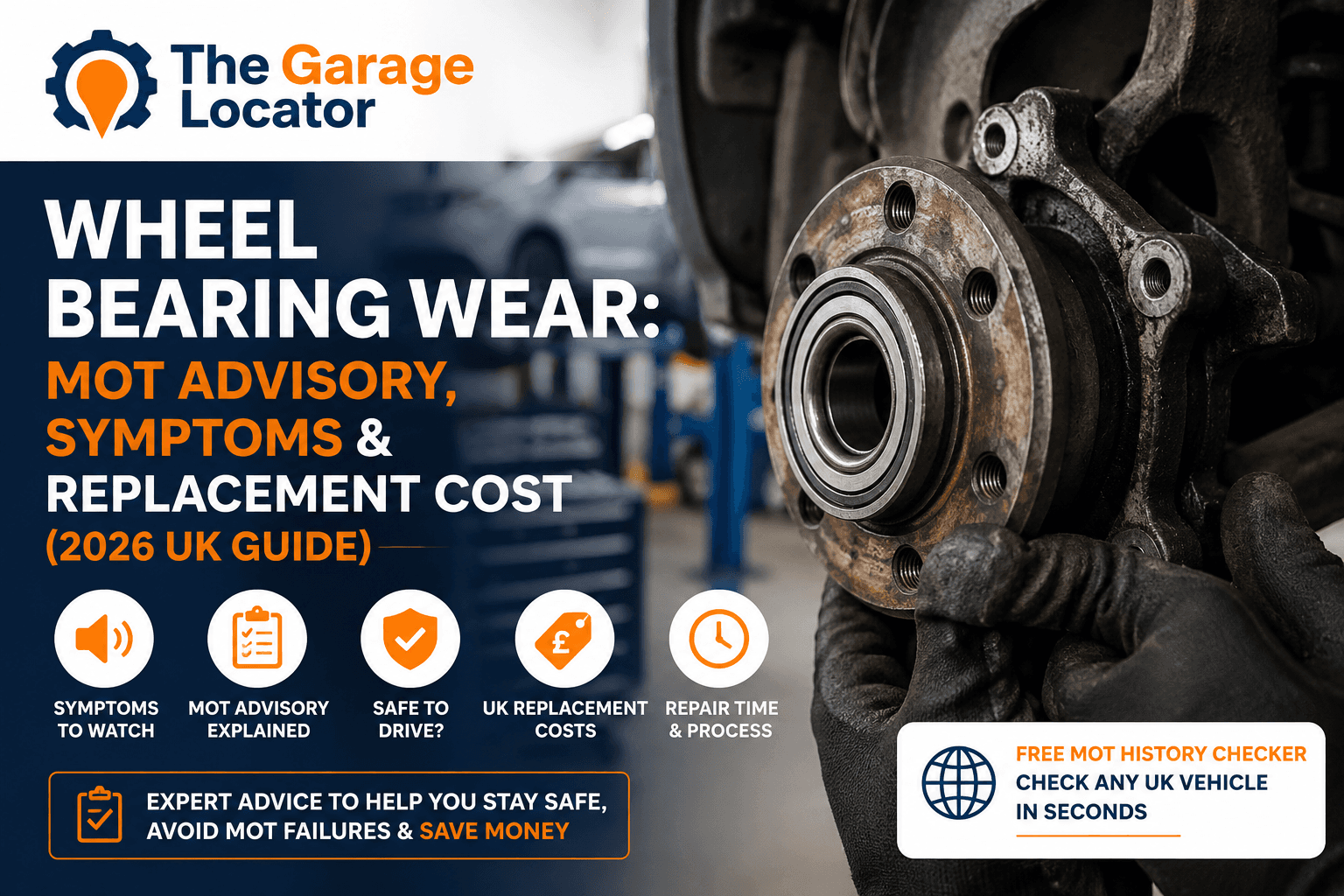
A wheel bearing advisory means an MOT tester has detected early signs of wear in one of your vehicle's wheel bearings, such as slight play, roughness or noise.
The car may still pass its MOT when the wear remains within acceptable limits, but a worn wheel bearing shouldn't simply be ignored. As the bearing deteriorates, noise and movement can increase until the defect becomes serious enough to fail an MOT.
A badly worn wheel bearing can also affect steering, handling and vehicle safety.
This guide explains what a wheel bearing MOT advisory means, the symptoms to watch for, when bearing wear becomes an MOT failure, whether it's safe to continue driving and how much wheel bearing replacement typically costs in the UK.
In this guide
- What a wheel bearing advisory means
- What wheel bearings do
- Common MOT advisory wording
- Will a worn wheel bearing fail an MOT?
- Wheel bearing symptoms
- What a worn wheel bearing sounds like
- Is it safe to drive?
- What causes wheel bearings to wear?
- How garages diagnose bearing wear
- Wheel bearing replacement costs
- How long replacement takes
- Whether both bearings should be replaced
- Buying a used car with a wheel bearing advisory
- Frequently asked questions
What does a wheel bearing MOT advisory mean?
A wheel bearing advisory means the MOT tester has detected some wear in a wheel bearing, but the condition was not serious enough to meet the failure criteria at the time of the test.
Typical advisory wording can include:
- Slight play in wheel bearing
- Wheel bearing has slight roughness
- Front wheel bearing slightly noisy
- Nearside front wheel bearing showing slight play
- Offside rear wheel bearing slightly noisy
- Wheel bearing beginning to wear
The exact wording can vary between MOT testers.
The important distinction is the severity of the wear.
Slight play or roughness may be recorded as an advisory, while excessive movement or roughness can result in an MOT failure.
If you're checking a used vehicle and want to see whether wheel bearing advisories have appeared previously, use our Free MOT History Checker to review its MOT history.
What does a wheel bearing do?
Wheel bearings sit within the wheel hub assembly and allow the wheels to rotate smoothly while supporting the weight of the vehicle.
A bearing must cope with substantial forces generated by:
- The vehicle's weight
- Acceleration
- Braking
- Cornering
- Potholes and road impacts
- Uneven road surfaces
Modern wheel bearings are generally designed as sealed units containing precisely manufactured rolling elements and lubricant.
When the bearing begins to deteriorate, friction and unwanted movement can increase.
That can produce the characteristic humming, rumbling or grinding noises associated with wheel bearing wear.
Will a worn wheel bearing fail an MOT?
It can.
A small amount of wear may result in an advisory, but more serious wheel bearing defects can cause an MOT failure.
The MOT distinction is important:
| Wheel bearing condition | Likely MOT outcome |
|---|---|
| Slight play or early wear | May receive an advisory |
| Slight roughness or noise | May receive an advisory |
| Excessive play | Major defect — MOT fail |
| Excessively rough bearing | Major defect — MOT fail |
| Bearing condition creating serious wheel insecurity | Dangerous defect — MOT fail |
Therefore, receiving a wheel bearing advisory doesn't mean your vehicle has failed its MOT.
It does mean the bearing should be monitored or repaired before the wear progresses.
If you've received several different warnings on the same MOT, our guide to MOT Advisory Codes Explained explains how advisories differ from minor, major and dangerous defects.
What are the symptoms of a worn wheel bearing?
Wheel bearings usually deteriorate gradually rather than failing without warning.
Common symptoms include:
- Humming or rumbling while driving
- Grinding or growling noises
- Noise increasing with road speed
- Noise changing when cornering
- Vibration through the steering wheel
- Excessive movement at the wheel
- Uneven tyre wear
- Reduced steering precision
- ABS warning light on some vehicles
Noise is often the first symptom a driver notices.
However, wheel bearing wear can sometimes be detected during an MOT or service before it becomes obvious from inside the vehicle.
What does a worn wheel bearing sound like?
A worn wheel bearing commonly produces a humming, rumbling or growling noise that increases as vehicle speed rises.
Unlike many engine-related noises, wheel bearing noise generally changes with road speed rather than engine speed.
The noise can also change when cornering.
For example, loading and unloading the affected side of the vehicle during a bend can make the sound louder or quieter.
This can help a mechanic identify which wheel bearing is worn.
However, tyre noise can sound surprisingly similar, so noise alone isn't enough to confirm a failed wheel bearing.
A garage should inspect the vehicle before parts are replaced.
Is it safe to drive with a worn wheel bearing?
That depends on how badly worn the bearing is.
A vehicle that has received an advisory for slight play or early bearing wear can usually continue to be driven for a limited period, provided there are no significant symptoms.
However, wheel bearing wear is progressive.
You should arrange an inspection or repair promptly if you notice:
- Increasing humming or grinding
- Strong vibration
- Noticeable wheel movement
- Poor steering response
- ABS warning lights
- A sudden change in the vehicle's handling
A severely worn bearing should not be ignored.
In extreme cases, excessive bearing wear can affect the security and control of the wheel.
If the MOT has classified the wheel bearing as a Dangerous defect, do not continue driving the vehicle until it has been repaired.
How quickly should a wheel bearing advisory be repaired?
There isn't a fixed number of miles that every worn wheel bearing can safely cover.
Bearing deterioration depends on factors such as:
- How advanced the wear already is
- Vehicle weight
- Mileage
- Road conditions
- Driving style
- Pothole impacts
- Whether the bearing seal has been damaged
For a minor advisory with no noticeable symptoms, you normally have time to arrange the repair rather than treating it as an emergency.
But don't wait until the next MOT without monitoring it.
If noise, vibration or wheel movement is increasing, have the vehicle inspected sooner.
A useful rule is:
An advisory gives you an opportunity to repair the bearing before it becomes a failure — not permission to ignore it for another year.
What causes wheel bearings to wear?
Wheel bearings are designed to last for many thousands of miles, but they are not permanent components.
Wear can be accelerated by:
- High mileage
- Potholes and severe road impacts
- Damaged roads and kerbs
- Water or dirt entering a damaged bearing seal
- Incorrect installation
- Accident damage
- Excessive loads
- Wear elsewhere in the wheel or suspension assembly
In many cases, however, a wheel bearing simply reaches the end of its service life through normal use.
Can potholes damage wheel bearings?
Yes.
A severe pothole impact can transmit a significant shock through the wheel, hub, bearing and suspension.
One pothole does not necessarily destroy a bearing immediately, but repeated impacts or a particularly severe impact can damage it or accelerate existing wear.
If a humming or rumbling noise appears after hitting a pothole, it is worth having the wheel, tyre, bearing and suspension inspected.
How is a worn wheel bearing diagnosed?
A mechanic will normally diagnose wheel bearing wear by combining a road test with a physical inspection.
Checks can include:
- Listening for humming, rumbling or grinding
- Checking whether the noise changes when cornering
- Raising the vehicle and checking the wheel for excessive play
- Rotating the wheel and feeling for roughness
- Inspecting the hub and surrounding suspension components
- Checking for other possible causes of the noise
Correct diagnosis matters because tyre wear, brake problems and some suspension faults can produce similar noises.
Replacing a wheel bearing based purely on noise without inspecting the vehicle can result in unnecessary repair costs.
Can tyre noise sound like a worn wheel bearing?
Yes.
Uneven or heavily worn tyres can create a humming or droning noise that sounds very similar to wheel bearing wear.
One clue is that bearing noise often changes as the vehicle corners because the load on the bearing changes.
Tyre noise may also vary according to road surface.
A mechanic can usually distinguish between the two by inspecting the tyres, checking the wheel for play and roughness, and carrying out a road test.
Can a worn wheel bearing cause vibration?
Yes.
As bearing wear becomes more advanced, unwanted movement within the hub can cause vibration.
You may feel this through:
- The steering wheel
- The floor
- The seat
- The vehicle body
Vibration can have many other causes, including wheel imbalance, damaged tyres, worn suspension components and brake problems.
It should therefore be diagnosed rather than assuming the wheel bearing is responsible.
Can a worn wheel bearing affect steering?
It can.
A badly worn bearing can allow unwanted movement at the wheel, which may make the steering feel less precise.
You might notice:
- Wandering
- Vibration
- Reduced steering accuracy
- Unusual movement from the affected wheel
These symptoms warrant prompt inspection because similar problems can also be caused by worn suspension or steering components.
Can a wheel bearing cause an ABS warning light?
Yes, on some vehicles.
Modern cars often use wheel-speed sensors as part of the ABS and stability-control systems, and the magnetic encoder ring used by the sensor may be integrated into the wheel bearing or hub assembly.
Damage or excessive movement around the bearing can therefore interfere with the wheel-speed signal.
However, an ABS warning light does not automatically mean the wheel bearing has failed.
The problem could instead involve:
- A wheel-speed sensor
- Wiring
- Electrical connections
- A damaged encoder or reluctor ring
- Another ABS system fault
The vehicle should be diagnosed before replacing components.
How is a worn wheel bearing repaired?
A worn wheel bearing is normally replaced rather than repaired.
On some vehicles, the bearing can be pressed out of the hub and replaced separately.
On others, the bearing is integrated into a complete hub assembly, meaning the entire unit is replaced.
The repair generally involves:
- Raising and supporting the vehicle
- Removing the wheel
- Removing brake components where necessary
- Removing the hub or bearing assembly
- Pressing out the old bearing or replacing the complete hub
- Installing the new component
- Reassembling the brakes and wheel
- Checking the repair for correct operation
The exact procedure varies considerably between vehicles.
Some bearings require specialist pressing equipment, while complete hub assemblies can sometimes be replaced more quickly.
How much does wheel bearing replacement cost in the UK?
A typical wheel bearing replacement costs approximately:
| Repair | Typical UK cost |
|---|---|
| Front wheel bearing | £180–£350 |
| Rear wheel bearing | £150–£300 |
| Complete hub and bearing assembly | £200–£450+ |
These figures are general estimates rather than fixed prices.
Your actual repair cost depends on:
- Vehicle make and model
- Front or rear axle
- Labour time
- Local garage labour rates
- Bearing design
- Whether a complete hub is required
- Parts quality
- Whether corrosion makes removal more difficult
Premium, performance, electric and larger vehicles can cost more.
If you're comparing repair prices, remember that the cheapest quote is not always directly comparable if different-quality parts are being used.
Why can wheel bearing replacement be expensive?
The bearing itself is only part of the cost.
Labour can be significant because the mechanic may need to remove several components before reaching the bearing.
On some vehicles, specialist equipment is required to press the old bearing out and install the replacement correctly.
Corrosion can also make bolts, hubs and bearing assemblies difficult to remove.
Other vehicles use an integrated hub assembly containing the bearing and sometimes components associated with the ABS wheel-speed system.
This can increase the price of the replacement part.
How long does wheel bearing replacement take?
A straightforward wheel bearing replacement commonly takes around 1–3 hours per wheel.
The actual time depends heavily on the vehicle and bearing design.
A complete bolt-on hub assembly may be relatively quick to replace, whereas a pressed bearing can require considerably more dismantling and specialist equipment.
Seized or heavily corroded components can also increase labour time.
Your garage should be able to give you a more accurate estimate after identifying which bearing requires replacement.
Should both wheel bearings be replaced together?
Not necessarily.
Unlike some components that are routinely replaced in axle pairs, wheel bearings are generally replaced individually when they show signs of wear.
If the opposite bearing is quiet, smooth and has no excessive play, there may be no reason to replace it.
However, on a high-mileage vehicle where both bearings are of a similar age, it can be sensible to have the opposite side inspected.
That does not mean it automatically needs replacing.
What happens if you ignore a worn wheel bearing?
Ignoring wheel bearing wear can allow a relatively straightforward repair to become a more serious safety problem.
Progressive bearing wear can lead to:
- Increasing humming or grinding
- Excessive wheel movement
- Poorer steering precision
- Vibration
- Uneven tyre wear
- ABS or stability-control problems on some vehicles
- MOT failure
- Damage to surrounding hub components
In severe cases, the bearing can deteriorate enough to affect wheel security.
That is why an advisory should be treated as an early warning rather than ignored until the next MOT.
Should you buy a used car with a wheel bearing advisory?
A wheel bearing advisory is not automatically a reason to walk away from a used car.
Wheel bearing replacement is a routine mechanical repair on many vehicles.
What matters is the severity of the wear, the repair cost and whether the vehicle has other problems.
Before buying, check:
- Which wheel bearing is affected
- Whether the bearing is now noisy
- Whether there is noticeable wheel movement
- Whether the seller has obtained a repair quote
- Whether the same advisory appeared on previous MOTs
- Whether there are additional suspension, tyre or braking advisories
If the bearing requires replacement, use the expected repair cost when negotiating the purchase price.
Repeated advisories are particularly worth investigating. A wheel bearing warning that appears across several MOT tests may indicate that the repair has been repeatedly postponed.
Use our Free MOT History Checker to review the vehicle's previous MOT tests, advisories, failures and recorded mileage before buying.
For a broader explanation of how to assess advisories on a used vehicle, read Buying a Used Car With MOT Advisories: Is It Worth the Risk?.
How urgent is a wheel bearing advisory?
The urgency depends on what the MOT tester found and whether the symptoms are getting worse.
As a general guide:
| Condition | What to do |
|---|---|
| Slight play with no symptoms | Monitor and arrange repair |
| Slight roughness or occasional noise | Book an inspection soon |
| Increasing humming or rumbling | Arrange repair promptly |
| Noticeable vibration or wheel movement | Have the vehicle inspected urgently |
| Excessive play or roughness | MOT failure — repair required |
| Serious wheel insecurity | Do not drive |
An MOT advisory is useful because it gives you an opportunity to deal with wear before it reaches the failure threshold.
If the vehicle has become noticeably noisier or its handling has changed since the MOT, don't assume the original advisory still represents its current condition.
Wheel bearing advisory vs MOT failure
The difference between an advisory and an MOT failure is primarily the severity of the defect.
An MOT tester may record early wear such as slight play or roughness as an advisory.
Once the bearing develops excessive play or becomes excessively rough, it can meet the criteria for a Major defect and fail the MOT.
If deterioration becomes severe enough to compromise wheel security, the defect can become Dangerous.
This progression is why previous MOT advisories are worth checking rather than looking only at whether a vehicle passed or failed.
Our MOT Advisory Codes Explained guide explains the difference between advisories, minor defects, major defects and dangerous defects in more detail.
Can a wheel bearing advisory disappear from the next MOT?
Yes, but you should establish why.
If the bearing was replaced after the previous MOT, the advisory would normally no longer be relevant.
However, the absence of the same advisory on a later MOT does not by itself prove that a repair was carried out.
MOT advisories involve the tester recording developing issues observed at the time of the inspection, and wording can vary between testers.
If you're buying a used vehicle, ask for invoices or service records if the seller claims an advisory has been repaired.
You can also use our Free MOT History Checker to compare the vehicle's MOT results across multiple years.
Can a worn wheel bearing damage other parts?
Potentially.
As bearing wear becomes more severe, excessive movement and vibration can place additional stress on components around the wheel and hub.
Depending on the vehicle and the severity of the problem, associated issues may involve:
- Hub components
- Tyres
- ABS wheel-speed sensing components
- Brakes
- Nearby suspension components
This doesn't mean a slightly worn bearing will automatically damage other parts.
The risk increases when significant bearing wear is allowed to continue.
Can a wheel bearing be repaired instead of replaced?
Usually not on modern vehicles.
Most modern wheel bearings are sealed units designed to be replaced once they become worn or damaged.
Adding grease is therefore not normally a permanent solution to a worn modern wheel bearing.
Depending on the vehicle, a garage may replace either:
- The individual bearing, or
- The complete wheel hub and bearing assembly
The correct repair depends on the vehicle's design.
How long do wheel bearings normally last?
There is no fixed replacement interval that applies to every vehicle.
Wheel bearing life varies according to:
- Vehicle design
- Mileage
- Vehicle weight
- Road conditions
- Pothole impacts
- Driving conditions
- Installation quality
- Water or contamination entering the bearing
Unlike brake pads or tyres, wheel bearings are not normally replaced simply because they have reached a particular mileage.
They are generally replaced when inspection or symptoms show that wear has developed.
What does a wheel bearing advisory mean?
It means an MOT tester has detected early signs of wear, such as slight play, roughness or noise, but the condition was not serious enough to meet the MOT failure criteria at the time of the test.
Will a worn wheel bearing fail an MOT?
It can.
Slight wear may receive an advisory, but excessive play or excessive roughness can be classified as a Major defect and result in an MOT failure.
A sufficiently severe condition affecting wheel security can be classified as Dangerous.
What does a worn wheel bearing sound like?
A worn wheel bearing commonly produces a humming, rumbling, growling or grinding noise.
The noise often increases with road speed and may become louder or quieter when cornering.
Is it safe to drive with a noisy wheel bearing?
It depends on the severity of the wear.
A slight advisory with no significant symptoms may allow you time to arrange a repair, but increasing noise, vibration, wheel movement or handling changes should be investigated promptly.
Do not continue driving a vehicle with a Dangerous MOT defect.
How much does wheel bearing replacement cost?
Typical UK costs are approximately £180–£350 for a front wheel bearing and £150–£300 for a rear wheel bearing.
A complete hub and bearing assembly can cost more.
Prices vary according to the vehicle, labour time, parts and bearing design.
How long does wheel bearing replacement take?
A typical replacement may take around 1–3 hours per wheel, although some vehicles require considerably more dismantling or specialist pressing equipment.
Corrosion and seized components can also increase repair time.
Should both wheel bearings be replaced together?
Not necessarily.
Wheel bearings are normally replaced individually when wear is detected.
The bearing on the opposite side should be inspected, particularly on a high-mileage vehicle, but it does not automatically require replacement.
Can a wheel bearing cause an ABS warning light?
Yes, on some vehicles.
Some wheel bearing or hub assemblies incorporate components used by the ABS wheel-speed sensor. Bearing wear, excessive movement or damage to the encoder can therefore contribute to an ABS fault.
However, an ABS warning light has many possible causes and should be diagnosed properly.
Can you tell which wheel bearing is bad while driving?
Sometimes.
A worn bearing may become louder or quieter when cornering because the load acting on it changes.
However, identifying the affected side from noise alone isn't always reliable.
A physical inspection should confirm which bearing requires replacement.
Should I buy a car with a wheel bearing advisory?
A wheel bearing advisory alone is not necessarily a reason to reject a used vehicle.
Check the severity of the problem, obtain a repair estimate and review the rest of the vehicle's MOT history.
If the advisory has appeared repeatedly without being repaired, factor that into your decision and negotiation.
Our guide to Buying a Used Car With MOT Advisories explains what other warning signs to look for.
How can I check whether a car has had wheel bearing advisories before?
Review its previous MOT history rather than relying only on the latest test.
Our Free MOT History Checker lets you review previous MOT results, recorded advisories, failures and mileage history.
Look for repeated wheel bearing warnings and other related tyre, suspension or braking defects.
A wheel bearing MOT advisory usually indicates that wear has started but has not yet reached the MOT failure threshold.
That makes the advisory useful: it gives you an opportunity to arrange an inspection or replacement before the bearing develops excessive play or roughness.
Pay particular attention to increasing humming or rumbling, vibration, wheel movement or changes in steering and handling. These can indicate that the bearing has deteriorated since the MOT test.
Wheel bearing replacement is a routine repair on many vehicles, with typical costs varying according to whether the individual bearing or complete hub assembly needs replacing.
If you're checking a vehicle before buying or want to see whether the same problem has appeared previously, use our Free MOT History Checker to review its complete MOT history.
For more help understanding warnings recorded on an MOT, read MOT Advisory Codes Explained: What Every MOT Warning Means.