Affiliate disclosure: As an Amazon Associate, The Garage Locator earns from qualifying purchases.
Keeping a few practical tools at home can make routine vehicle checks easier and help you recognise when professional attention is needed.
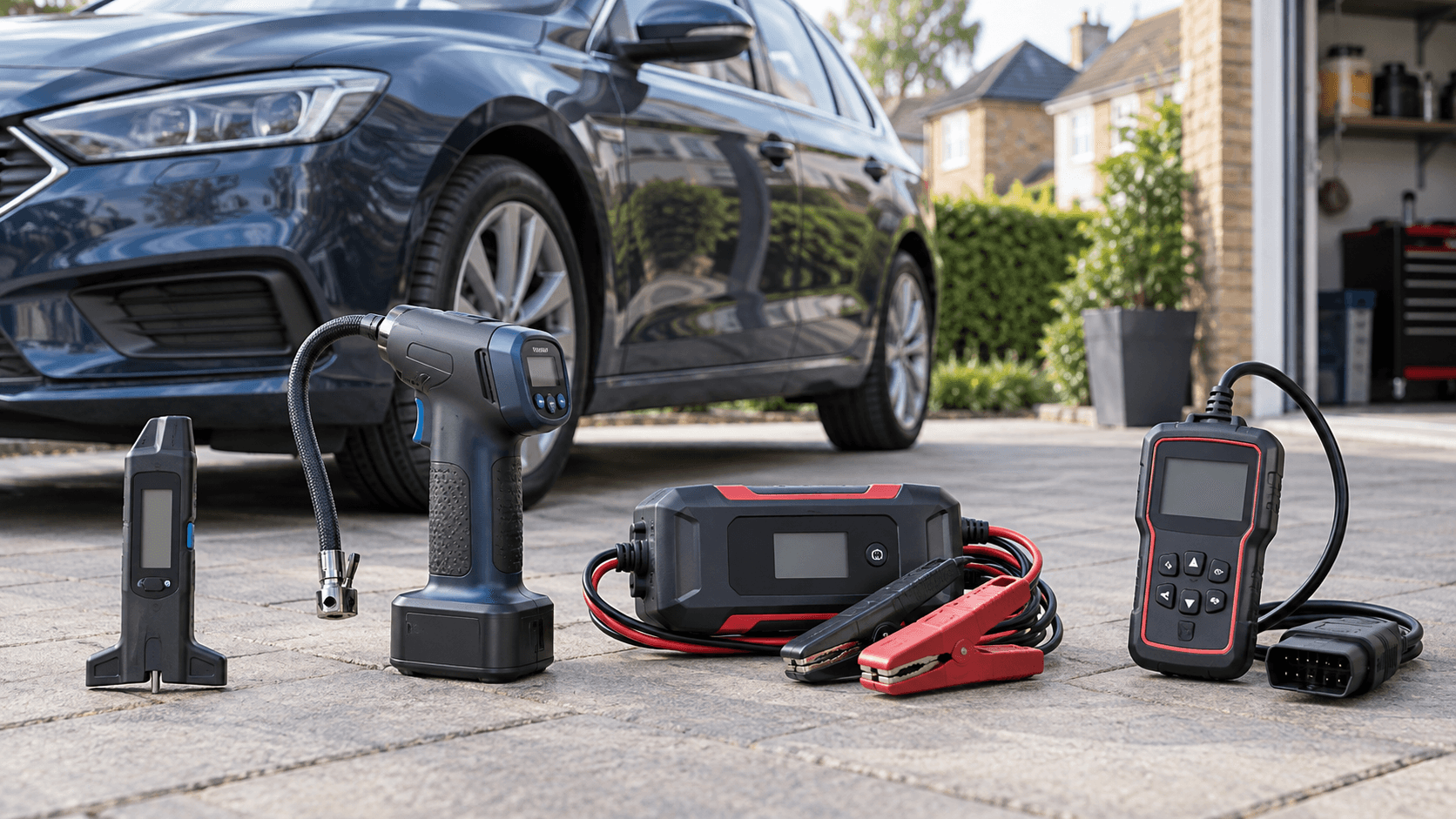
The four products below cover tyre tread, tyre pressure, battery maintenance and basic engine fault codes. They cannot replace a qualified inspection, but they can provide useful information between services and MOT tests.
At a glance
| Tool | Useful for | Important limitation |
|---|---|---|
| Digital tread-depth gauge | Measuring tyre tread in millimetres | Does not identify every tyre defect |
| Cordless tyre inflator | Checking and adjusting tyre pressure | Does not repair leaks or damage |
| Smart battery charger | Charging and maintaining compatible 12V batteries | Cannot repair a damaged or worn-out battery |
| OBD2 fault-code reader | Reading basic engine and emissions codes | A fault code is not a complete diagnosis |
1. Digital tyre tread-depth gauge
The legal tread-depth minimum for most UK cars is 1.6 mm across the central three-quarters of the tyre and around its entire circumference.
Estimating tread depth by eye is unreliable. A digital gauge provides a measurement in millimetres and makes it easier to monitor a tyre after an MOT advisory.
Measure several points:
- Across the central tread area
- Around the tyre’s circumference
- Near the inner and outer edges
- On all four tyres
Uneven measurements can indicate an alignment, pressure, steering or suspension issue. A gauge only measures tread depth, so you must also look for cuts, cracking, bulges, exposed cords and other damage.
View the GODESON digital tyre tread-depth gauge on Amazon (Amazon affiliate link)
Read our guide to tyres worn close to the legal limit for more information about tread requirements and MOT advisories.
2. Cordless digital tyre inflator
Correct tyre pressure supports predictable handling, even tyre wear and fuel efficiency. Pressure that is too low or too high can contribute to abnormal wear and may affect how the vehicle behaves.
Always use the pressures specified by the vehicle manufacturer. These can normally be found in the handbook, inside a door opening or behind the fuel flap. The pressure printed on the tyre sidewall is not normally the vehicle’s recommended operating pressure.
Check pressures when the tyres are cold where possible. Remember that front and rear pressures may differ, and manufacturers may specify different figures for heavy loads.
A portable inflator with a digital display and automatic stop can make routine pressure adjustments more convenient.
View the RING TYREINFLATE GO 2 on Amazon (Amazon affiliate link)
An inflator is not a puncture repair. Have the tyre, valve and wheel inspected if pressure continues to fall or if you notice damage, vibration or unusual handling.
3. Smart 12V battery charger
Short journeys, cold weather and long periods without use can leave a healthy battery discharged. A compatible smart charger may help restore and maintain its charge.
Cars with stop-start systems commonly use AGM or EFB batteries. Always confirm the battery type and ensure that the charger supports it before connecting anything.
Follow both the vehicle and charger manufacturers’ instructions. Some vehicles provide designated charging points under the bonnet and may require a particular connection procedure.
Do not attempt to charge a battery that is:
- Swollen or leaking
- Frozen or physically damaged
- Smoking or unusually hot
- Producing a strong rotten-egg smell
A charger cannot repair internal deterioration. If a fully charged battery quickly goes flat again, the battery, charging system and vehicle’s electrical drain should be tested.
View the Ring SmartCharge 8A battery charger on Amazon (Amazon affiliate link)
For further guidance, read our article about car battery problems, symptoms and causes.
4. Basic OBD2 fault-code reader
When the engine management light appears, the vehicle may store one or more diagnostic trouble codes. A basic OBD2 reader can display many generic engine and emissions codes before they are cleared.
This can provide a useful starting point and help you record information for a garage. However, a code identifies the system or condition detected—it does not automatically identify the component that needs replacing.
For example, an EGR-related code might be caused by the valve, wiring, vacuum control, airflow measurement or another connected fault.
Basic readers may not:
- Access every manufacturer-specific system
- Read ABS, airbag or body-control faults
- Provide all live data needed for diagnosis
- Perform coding, calibration or forced DPF regeneration
- Confirm whether a particular component has failed
Check compatibility with your vehicle before purchasing or connecting a reader. Do not clear codes immediately before a garage appointment because freeze-frame and stored information can help with diagnosis.
View the MOTOPOWER OBD2 fault-code reader on Amazon (Amazon affiliate link)
Read our guide to the engine management light and MOT test for more information.
Which tool should you buy first?
The most useful choice depends on your vehicle and driving pattern.
Choose a tread-depth gauge if you want to monitor tyre wear or have received a tyre advisory.
Choose an inflator if you regularly check and adjust tyre pressures.
Consider a smart charger if the vehicle is left unused, mainly completes short journeys or has suffered a discharged battery.
A basic OBD2 reader may be useful if you want to record generic engine codes, but it should not be treated as a substitute for professional diagnosis.
There is no need to purchase every tool immediately. Start with the one that addresses a genuine maintenance need.
When should you use a garage instead?
Stop using home tools and obtain professional assistance if:
- A tyre has a bulge, exposed cords or serious damage
- Tyre pressure falls repeatedly
- The battery is leaking, swollen, smoking or overheating
- A red warning light appears
- The vehicle loses power or behaves abnormally
- You are unsure how to connect or use equipment safely
- A warning returns after codes have been cleared
- The vehicle requires manufacturer-specific testing
Home tools are most useful for monitoring, basic checks and recording information. They should not encourage continued driving with an unsafe vehicle.
Useful vehicle checks
Before an MOT or long journey, check:
- Tyre tread and visible condition
- Tyre pressures
- Exterior lights
- Windscreen washers and wipers
- Fluid levels
- Dashboard warning lights
- Battery starting performance
- Number-plate condition
Our complete MOT test checklist covers the main checks you can perform before the test.
Final thoughts
A useful car tool should help you make a better decision rather than encourage you to guess at a repair.
A tread gauge and inflator support routine tyre checks. A compatible smart charger can help maintain a serviceable battery. An OBD2 reader can record basic fault codes for further investigation.
Always follow the product and vehicle instructions, check compatibility before purchasing and seek professional help when a fault affects safety or requires specialist diagnosis.