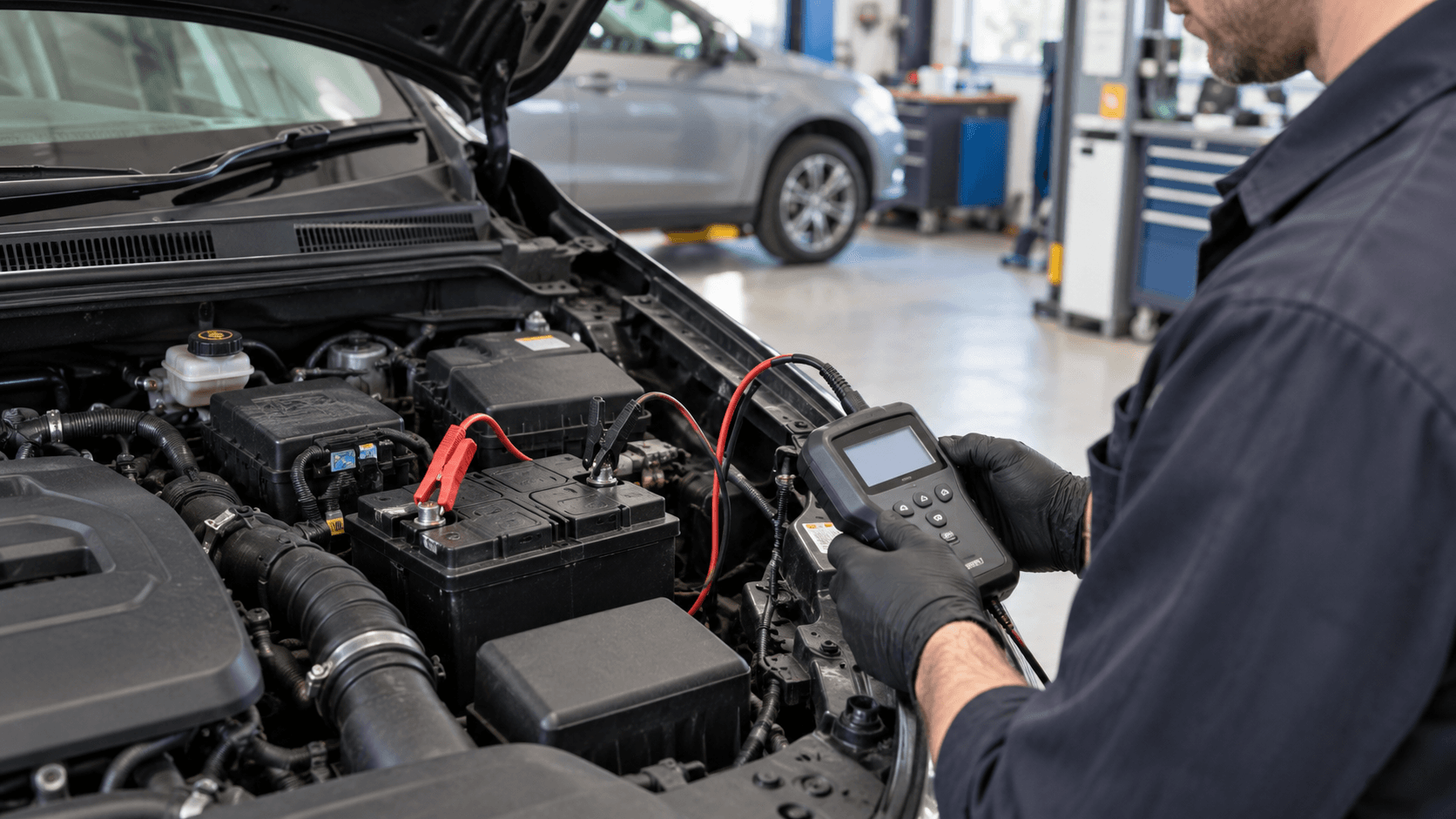
A failing car battery commonly causes slow cranking, clicking when you turn the key, dim lights, electrical resets or repeated starting problems. However, similar symptoms can also be caused by an alternator fault, loose connections, a starter-motor problem or an electrical drain, so testing is better than replacing the battery based on symptoms alone.
Quick advice: If the battery is swollen, leaking, unusually hot, smoking or giving off a strong rotten-egg smell, switch the vehicle off, keep away from it and obtain professional help. Do not attempt to charge or jump-start a visibly damaged battery.
What Are the Main Signs of Car Battery Trouble?
Common warning signs include:
The engine turns over more slowly than normal
A rapid clicking sound when trying to start
The dashboard lights appear but the engine will not crank
Interior or exterior lights look unusually dim
The clock, radio or other settings repeatedly reset
Stop-start stops operating, where fitted
The vehicle needs repeated jump-starts
Starting becomes worse after the car has been parked overnight
The battery warning light appears while driving
One symptom does not prove that the battery itself has failed. A charging-system fault can leave a healthy battery discharged, while a poor terminal connection can produce similar starting problems.
How Long Does a Car Battery Usually Last?
Many conventional 12-volt car batteries last roughly three to five years, but there is no guaranteed lifespan.
Battery life can be shortened by:
Frequent short journeys
Long periods without using the vehicle
Cold weather
Repeatedly allowing the battery to go flat
Electrical equipment being used while the engine is off
A charging-system fault
An electrical drain while the vehicle is parked
Incorrect battery specification or installation
Cars with stop-start systems commonly use AGM or EFB batteries. They should normally be replaced with the correct technology and specification rather than a cheaper conventional battery.
Battery Fault or Alternator Fault?
The battery supplies the power needed to start the engine. Once the engine is running, the alternator supplies electrical power and recharges the battery.
Symptoms that may point towards the battery include slow starting after the car has been parked, temporary improvement after charging, and a battery that fails a proper capacity or conductance test.
Symptoms that may point towards the charging system include the battery warning light remaining on while driving, lights changing brightness with engine speed, repeated discharge despite fitting or charging a good battery, or the vehicle losing electrical power while running.
These are clues rather than a diagnosis. A garage should test the battery, alternator output and electrical connections before recommending parts.
What Does the Battery Warning Light Mean?
The red battery symbol usually warns of a charging-system problem; it does not simply mean that the battery needs replacing.
If it remains illuminated after the engine starts, the alternator may not be charging correctly. The vehicle might continue running briefly on stored battery power, but it can eventually lose electrical systems and stop.
If the red battery warning light comes on while driving:
Avoid switching the engine off until you are somewhere safe, unless another warning or unsafe condition requires you to stop immediately.
Reduce unnecessary electrical use where safe to do so.
Arrange prompt professional assistance.
Stop as soon as it is safe if steering becomes heavy, the temperature warning appears, lights fade or the vehicle begins behaving abnormally.
On some vehicles, one drive belt powers both the alternator and other components. A broken belt can therefore create additional risks.
Why Does a Car Battery Keep Going Flat?
A repeated flat battery can be caused by:
An ageing battery that can no longer hold enough charge
Short journeys that do not replace the energy used during starting
Lights or accessories being left on
A faulty alternator or charging circuit
Loose, damaged or corroded battery connections
An electrical component continuing to draw power while parked
A dashcam or other accessory wired incorrectly
The vehicle being left unused for long periods
Very cold weather exposing an already weak battery
Replacing the battery without finding the cause can result in the replacement going flat as well.
Can You Test a Car Battery at Home?
A multimeter can provide a basic voltage reading, but voltage alone does not prove that a battery is healthy. A weak battery may show a reasonable resting voltage and still fail when asked to crank the engine.
A proper assessment can include:
Resting voltage
Voltage while cranking
Charging voltage with the engine running
Battery state of charge
Battery state of health or conductance
Terminal and earth-connection checks
Alternator output and ripple testing
Parasitic-drain testing where necessary
Many garages and battery retailers can carry out a battery and charging-system test. Ask for the results rather than accepting a replacement based only on the battery's age.
Can You Charge a Flat Car Battery?
A suitable smart charger may recover a healthy battery that has become discharged through lack of use or repeated short trips. Use a charger that is compatible with the battery type and follow both the vehicle and charger manufacturers' instructions.
Do not attempt to charge a battery that is leaking, swollen, frozen, smoking, excessively hot or physically damaged.
Charging will not repair internal deterioration. If a fully charged battery quickly becomes flat again, further testing is needed.
Can You Jump-Start the Vehicle?
A jump-start may get the engine running, but it does not identify why the battery became flat.
Incorrect jump-starting can damage electronics, create sparks or cause injury. Use the procedure and connection points specified in the vehicle handbook. Some vehicles require designated under-bonnet terminals rather than direct connection to the battery.
Do not repeatedly jump-start a vehicle without investigating the cause. If the battery is damaged or there is any uncertainty, use a breakdown service or qualified technician.
Is It Safe to Drive With Battery Problems?
It depends on the fault.
If the car started normally and no charging warning is showing, arrange testing soon if starting performance is deteriorating.
Do not rely on the vehicle for an important journey if it is repeatedly failing to start. If the red charging warning remains illuminated while driving, the car may stop once the stored battery power is exhausted.
Stop and seek help if you notice smoke, overheating, leaking, a swollen battery, a strong rotten-egg smell, fading lights, heavy steering or other serious warning lights.
How Much Does Car Battery Replacement Cost in the UK?
As a broad planning range, a supplied and fitted 12-volt battery may cost approximately:
Conventional battery: £90–£170
EFB stop-start battery: £140–£230
AGM stop-start battery: £180–£320+
Actual prices depend on battery size, capacity, brand, warranty, vehicle access and whether battery registration or coding is required.
Some modern vehicles need the replacement battery to be registered with the battery-management system. Fitting the wrong specification or failing to perform the required setup can affect charging behaviour and battery life.
Diagnostic work, alternator repair or investigation of an electrical drain costs extra.
Could a Battery Problem Affect the MOT?
A weak battery is not automatically an MOT failure simply because it is old or has limited capacity. However, related problems can affect the test.
For example:
The vehicle must be capable of being started and operated for the test.
Warning lights and electrical systems are inspected where they form part of the MOT requirements.
A battery must be secure and must not present an unsafe condition such as leakage.
Charging or electrical faults can affect tested items such as lamps, steering assistance or safety systems.
An MOT pass is not a battery health check. A battery can pass the MOT and still fail shortly afterwards.
What Should a Garage Check?
Ask the garage to check:
Battery age, type and specification
State of charge and state of health
Cranking performance
Battery terminals, cables and earth connections
Alternator output
Drive-belt condition where relevant
Stored fault codes
Parasitic drain if the battery goes flat while parked
Whether the replacement requires registration or coding
The useful question is not only whether the battery is flat, but why it became flat.
How Can You Reduce Future Battery Problems?
Take the vehicle on suitable longer journeys where practical rather than relying entirely on very short trips.
Switch off unnecessary electrical equipment before leaving the vehicle.
Investigate slow starting promptly.
Use a compatible smart charger or maintainer for vehicles left unused, following manufacturer guidance.
Keep battery connections clean and secure, but do not disconnect modern vehicle batteries without checking the correct procedure.
Replace the battery with the correct technology, dimensions, capacity and specification.
Have repeated discharge investigated instead of repeatedly jump-starting the vehicle.
Frequently Asked Questions
Will driving recharge a flat battery?
Driving may restore some charge if the alternator is working and the battery is still serviceable. A short journey may not fully recharge a deeply discharged battery, and driving will not repair a battery that can no longer hold charge.
Does a clicking sound mean the battery is flat?
Rapid clicking commonly occurs when there is insufficient power to operate the starter properly, but poor connections or a starter fault can produce similar symptoms. Testing is needed.
Can a new battery go flat?
Yes. A new battery can discharge because of an alternator fault, electrical drain, wiring problem, accessory use or long periods without charging.
Is the battery light warning me to replace the battery?
Not necessarily. It normally indicates that the charging system is not operating as expected. The alternator, drive belt, wiring or connections may be responsible.
Can I fit a normal battery to a stop-start car?
Usually not. Stop-start vehicles commonly require an EFB or AGM battery of the correct specification. Check the vehicle manufacturer's requirements.
Final Thoughts
Slow cranking or a repeated flat battery should be tested rather than guessed at. The battery may be worn out, but the real cause could be the alternator, an electrical drain or a poor connection.
If the vehicle has a red charging warning, loses electrical power while driving, or the battery shows physical damage, treat the problem as urgent. For less severe starting symptoms, arrange a battery and charging-system test before authorising replacement.
Recommended battery charger
As an Amazon Associate, The Garage Locator earns from qualifying purchases.
For safely charging and maintaining a 12V car battery at home, consider the Ring SmartCharge 8A battery charger on Amazon. Check that it is compatible with your vehicle’s battery type before using it.
Related tools and guides
Related Tools and Guides
Check a vehicle's MOT history
Use the free MOT Defect Decoder
Find a suitable local garage