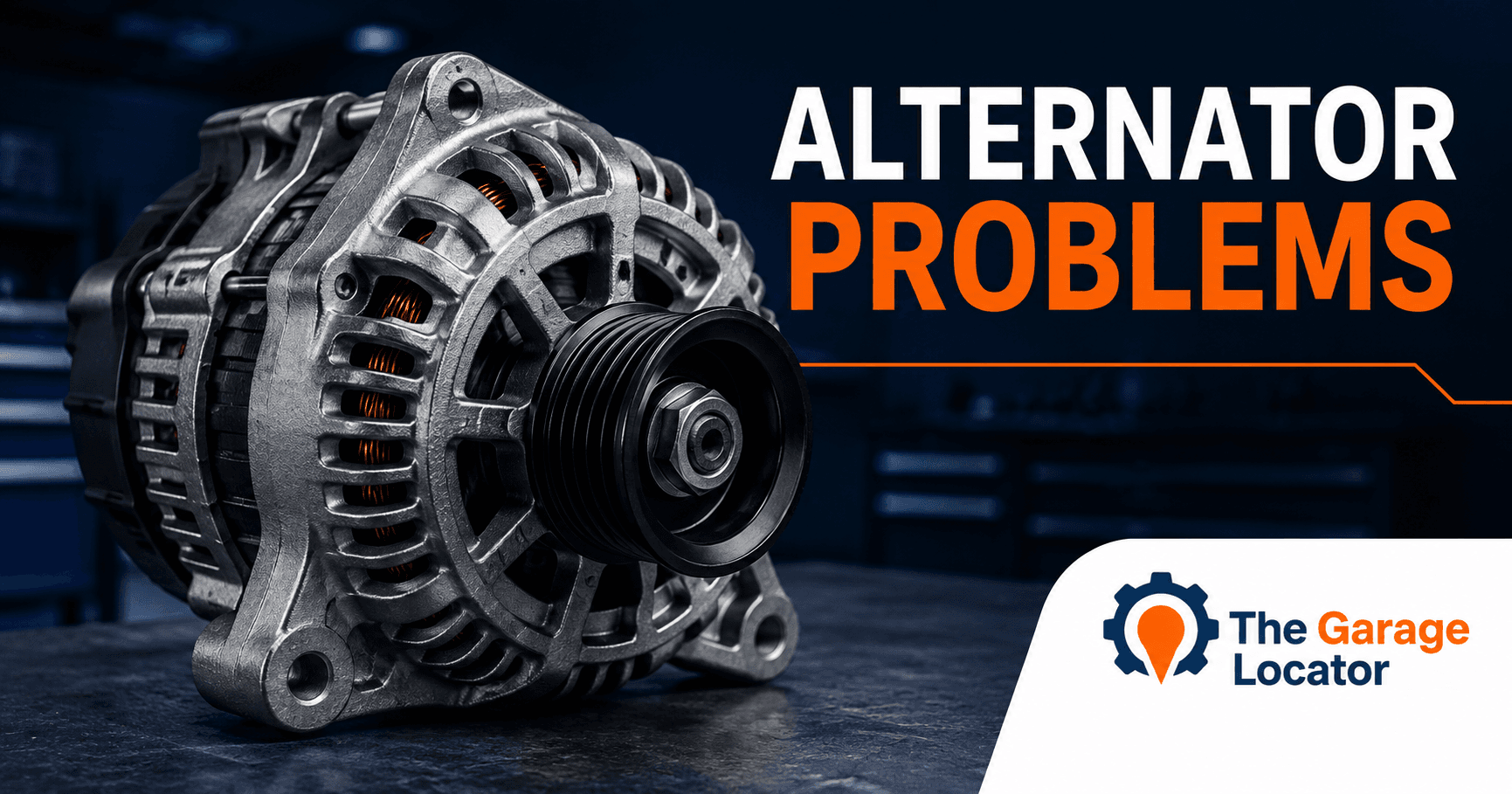
What does the alternator do?
The alternator powers electrical systems and replenishes the battery while the engine runs. A flat battery does not automatically mean a failed alternator: battery condition, wiring, belt drive and electrical drains all matter.
This guide helps you recognise useful clues and ask better questions. It cannot confirm a fault without inspecting and testing the vehicle.
Common alternator problem symptoms
Battery or charging warning light
System voltage or alternator control may be outside the expected range.
Repeated flat battery
Undercharging is possible, but battery capacity and key-off electrical drain must also be tested.
Lights brighten or dim with engine speed
Unstable output, belt slip or poor connections may be involved.
Whining, grinding or belt noise
Alternator bearings, pulley, tensioner or another belt-driven component may be responsible.
Multiple electrical warnings
Low system voltage can trigger several modules and misleading secondary faults.
Symptoms often overlap. Their timing matters: note whether they happen when cold or hot, at idle, during acceleration, while turning, or after recent work.
Common causes
Diagnosis guide
Common Causes
Regulator or internal electronic failure
Worn bearings or brushes where applicable
A slipping or broken auxiliary belt
An overrunning pulley fault
Corroded power or earth connections
Battery or smart-charging control problems
A failed component may be the result rather than the original cause. Correct diagnosis should identify both what is wrong and why it happened.
Is it safe to continue driving?
⚠️ Important warning
If the vehicle still behaves normally, avoid unnecessary journeys until you understand the fault. Dashboard instructions and vehicle-specific professional advice take priority over general guidance. Never inspect beneath an unsupported vehicle or touch hot, moving or high-voltage components.
What should a garage check?
Ask what evidence confirmed the diagnosis. Replacing the part named in a fault code is not always correct: a code identifies the system or condition detected, not automatically the failed component.
Could it affect the MOT?
Charging output is not a general alternator health certificate within the MOT. Related warning lamps, lights or steering operation may affect the test depending on the actual fault.
Use the exact wording from the certificate when researching an MOT result. An advisory is different from a minor, major or dangerous defect, and the result records the condition at the time of the test.
What affects the repair quotation?
Vehicle design, access, diagnostic time, seized fittings, required fluids, part quality and related damage can all change the total. Ask whether the price includes diagnosis, parts, labour, VAT, consumables, coding, calibration or alignment where required.
Compare the complete scope rather than just the headline figure. A cheaper quote may exclude work included elsewhere, while an expensive quote should still be supported by a clear diagnosis.
Can the problem be prevented?
Keep battery terminals secure, replace a weak battery before it overloads the system, investigate belt noise and oil contamination, and use proper support charging during lengthy diagnostic or software work.
No maintenance routine prevents every failure. The practical goal is to reduce avoidable damage and find developing faults before they affect safety or damage connected parts.
If you are buying a used car
Do not rely on a seller's verbal diagnosis or a promise that the repair is cheap. Ask for an independent inspection or written garage findings. Check invoices and the MOT history, while remembering that an MOT is not a complete mechanical inspection.
What to tell the garage
Describe the symptom in your own words, when it began and what makes it better or worse. Bring photographs of stationary warning messages and mention recent repairs, impacts, flat batteries or fluid loss. Do not clear codes immediately before diagnosis.
Useful next steps
Important
This is general UK motorist guidance, not a diagnosis or vehicle-specific repair procedure. A qualified garage must inspect the vehicle before confirming safety, the failed component and the required repair.